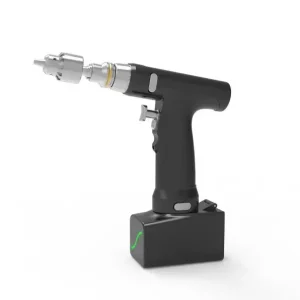
Engineered for trauma, spinal reconstruction, and cardiothoracic procedures. Built with electronic brushless commutation, sealed autoclave casing, and rigorous Class IIa / IIb CE conformance.







Examining the electro-mechanical transition from conventional carbon brush motors to multi-phase sensorless BLDC drives in modern orthopedic surgery.
In high-load orthopedic resection—particularly in total hip revision arthroplasty (THA), transfemoral amputations, and complex pelvic osteotomies—the reciprocating saw operates in one of the harshest physical environments within the operating theater. Traditional carbon-brush motors suffer from rapid brush degradation, ozone release, thermal buildup, and friction losses that limit sustained cutting efficiency. Furthermore, microscopic particulate shedding from mechanical commutators presents contamination hazards incompatible with modern sterile processing.
Our industrial engineering roadmap integrates three-phase Brushless Direct Current (BLDC) motors paired with advanced Field-Oriented Control (FOC) algorithms. By replacing mechanical commutators with magnetic rotor positioning and solid-state Hall effect sensing (or sensorless back-EMF tracking), the motor delivers flat torque curves from 500 to 15,000 strokes per minute. This architectural transition lowers internal core heat, prevents motor stall during hard cortical bone contact, and increases thermodynamic efficiency by more than 38% compared to legacy architectures.
Key Design Metric: Brushless reciprocating drive units eliminate spark hazard in oxygen-rich operating rooms, meet ISO 10993 cytotoxicity protocols, and withstand over 500 validated vacuum steam autoclave cycles (134°C at 2.2 bar) without degradation of stator winding insulation.
| Performance Parameter | Legacy Carbon Brush Reciprocating Saws | Brushless (BLDC) Gen-3 System (SNK Engineered) | Clinical / Procurement Significance |
|---|---|---|---|
| Motor Efficiency Rating | 52% - 61% | 88% - 94% | Longer runtime per Li-ion cell pack, zero drop-off in dense bone |
| Thermal Rise (10 min runtime) | ΔT > 28°C (Exceeds tissue necrosis limits) | ΔT < 9.5°C (ASTM F2180 Compliant) | Protects osteocyte viability; reduces thermal bone necrosis risks |
| Autoclave Durability (134°C/2.2 bar) | 70 - 100 cycles before coil/brush failure | 200 - 500+ verified cycles | Lowers Total Cost of Ownership (TCO) for hospitals by 60% |
| Acoustic Decibel Output | 78 - 84 dBA | < 62 dBA | Mitigates surgeon fatigue and OR noise pollution standards |
| Sealing Rating (Ingress) | IPX4 - IPX5 | Hermetic IPX9K Autoclave Barrier | Prevents corrosive enzymatic cleaning fluid infiltration |
Proprietary dynamic counter-balancing linkages convert rotational torque to reciprocating linear motion while counteracting secondary vibrations. This design cuts hand-transmitted vibration (HAVS) down to < 2.1 m/s².
Handpieces are encapsulated in medical-grade titanium and high-tensile 316L stainless steel. Ceramic hybrid bearings and PEEK insulating seals eliminate corrosion caused by chemical disinfectants.
Equipped with standardized quick-coupling interfaces and digital telemetry outputs compatible with 12 open protocols used by optical and robotic surgical navigation workstations.
Targeted mechanical configurations engineered for trauma centers, joint reconstruction units, and cardiothoracic departments worldwide.
In acute polytrauma cases, swift bone division and reduction are vital. Brushless reciprocating saws provide the torque required for fast cortical bone resection without stalling or bone splintering.
Removal of well-fixed femoral stems and bone cement in revision total knee and hip arthroplasties calls for high linear control to protect surrounding structural bone stock.
Engineered for primary and redo sternotomies, our reciprocating sternum systems provide steady sagittal cuts with integrated footpieces to shield pericardial structures.
Combining automated CNC machining centers, cleanroom assembly, and digital traceability to ensure delivery reliability for international distributors.
Our Shanghai manufacturing complex houses German 5-axis DMG MORI machining centers, producing reciprocating eccentric shafts, planetary gearheads, and motor housings with single-micron repeatability.
Contamination control is central to surgical power tool reliability. Stators, control PCBA modules, and mechanical drives are integrated in Class 7 cleanrooms with positive air pressure filtration.
In medical capital equipment distribution, stockouts can bring operating room schedules to a halt. While many assemblers depend on outsourced component manufacturers, our vertically integrated plant in Baoshan, Shanghai controls 87% of the total component value chain under one roof—from raw titanium alloy and PEEK billet turning to automated coil winding, surface passivating, and silicone mold casting.
This closed manufacturing loop insulates overseas OEM partners from geopolitical trade shifts, raw material delays, and unexpected pricing swings. We maintain a continuous rolling buffer of 200+ finished medical handpieces and critical service modules, enabling rapid air-courier dispatch within 24 to 48 hours to healthcare facilities worldwide.
Navigating the transition from MDD to EU-MDR 2017/745, alongside MDSAP audits and local registration dossiers across 80+ partner nations.
Full Notified Body audit completion covering Class I, Class IIa, and Class IIb active surgical instruments. Every handpiece carries UDI laser engraving and EUDAMED database registration.
Our quality management system is audited under the Medical Device Single Audit Program (MDSAP), satisfying regulatory requirements across five major target markets in one framework.
We provide distribution partners with ready-to-file Common Technical Documents (CTD), biocompatibility files, EMC reports (IEC 60601-1-2), and verified cleaning/sterilization protocols.
Essential audit checklist for hospital procurement directors, biomedical engineering heads, and private OEM label distributors.
Evaluating powered surgical instruments requires looking beyond the initial purchase cost. When factoring in sterile processing turnover times, battery replacement schedules, and mechanical wear cycles, the total operational expense over a 7-year hospital life cycle can vary substantially based on build quality.
Validate steam autoclave test reports beyond 150 cycles. Ensure the manufacturer uses brushless encapsulation to avoid routine brush replacement shutdowns.
Confirm handpieces utilize medical-grade LiFePO4 or specialized nickel-metal hydride batteries with internal smart monitoring to prevent thermal runaway under heavy cutting loads.
Ensure the saw features a keyless quick-lock mechanism to speed up intraoperative blade changes and avoid dropped accessories in the surgical field.
For EU markets, verify the presence of Basic UDI-DI codes on outer cases and laser markings on handpieces for compliance with MDR Article 27.
Audit the manufacturer's loaner pool. Reliable factories provide express spare unit programs within 24 to 48 hours to minimize OR suite downtime.
For device brands, confirm the OEM partner provides full documentation, laser customization, customized IFUs, and packaging within 3 to 4 weeks.
In-depth responses covering technical specifications, clinical applications, and supply chain logistics for our brushless reciprocating saws.
Brushless motors use electronic commutation via Hall effect sensors, eliminating physical brush contact. This avoids friction, carbon dust emission, and commutator wear. The result is an 88%+ motor efficiency, steady cutting torque under dense bone resistance, lower thermal rise (< 9.5°C), and a service life exceeding 200 steam autoclave cycles without degradation.
Every product line is supplied with an EU Declaration of Conformity under CE-MDR (EU) 2017/745, ISO 13485:2016 and MDSAP certificates, full EMC and electrical safety test reports (IEC 60601-1, IEC 60601-1-2), DIN EN ISO 17665-1 autoclave validation records, biocompatibility test results (ISO 10993), and Certificates of Free Sale.
Handpieces undergo automated environmental chamber cycling using moist heat steam sterilization at 134°C (273°F) at 2.2 bar pressure for 18 minutes, followed by vacuum drying. Transmission mechanical error, seal integrity, and motor insulation resistance are checked every 50 cycles to ensure linear deviation stays below 0.03 mm across 200+ cycles.
Standard catalog instruments with custom laser marking, localized packaging, and translated IFUs can be delivered in roughly 3 weeks. Custom electro-mechanical developments—including specific stroke amplitudes, speed profiles, or robotic quick-dock interfaces—generally require 6 to 10 weeks from 3D CAD sign-off to pilot production.
Yes. Our multi-fit quick-coupling collets accept major international hub configurations, allowing surgical teams to use standard hospital blade inventories without adapter rings. We also manufacture matching 316L medical stainless steel blades with hardened cross-cut teeth for minimal kerf loss and precise resection margins.
We maintain regional backup inventory in Europe and Asia-Pacific. If a clinical handpiece requires factory servicing, replacement standby units can be dispatched within 24 to 48 hours to minimize operating room downtime.
Explore our complete range of surgical handpieces, cannulated drilling units, and specialized attachments engineered to ISO 13485 standards for trauma and orthopedics.