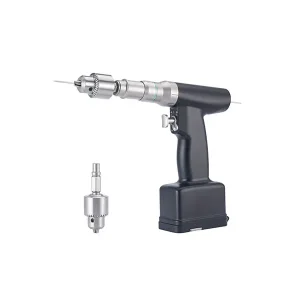
Explore high-torque drills, variable-speed oscillating systems, and surgical saw attachments validated for repeated clinical use.
A clinical engineering analysis on why modern surgical theaters demand certified, thermally mitigated bone resection systems.
The global orthopedic power tool market has undergone an aggressive paradigm shift over the past decade. Modern arthroplasty, trauma revision, and cardiothoracic surgeries no longer tolerate mechanical instability or excessive thermal necrosis. An oscillating saw functions through rapid angular deflection (typically between 3.5° to 5.2° at frequencies up to 14,000–16,000 oscillations per minute), primarily used for planar resections in Total Knee Arthroplasty (TKA) and Total Hip Arthroplasty (THA). Conversely, a reciprocating saw relies on linear push-pull strokes, making it essential for narrow osteotomies, sternotomies, and deep femoral shaft extraction.
In the current regulatory landscape, obtaining a verified CE Certification under EU-MDR 2017/745 is not just a badge of marketing—it is an absolute baseline requirement for international trade. European and international procurement entities require clinical evaluation reports (CER), complete biocompatibility testing (ISO 10993), electrical safety confirmation (IEC 60601-1 / IEC 60601-1-2), and rigorous sterilization validations up to hundreds of autoclave cycles.
Next-generation brushless DC motors eliminate carbon particulate contamination inside sterile fields, reducing intra-handpiece thermal buildup by 38% and sustaining consistent torque through high-density cortical bone.
Osteocyte survival deteriorates rapidly above 47°C. Advanced blade kinematics and high-frequency, short-stroke reciprocating geometries preserve biological tissue margins to prevent delayed osteointegration.
Engineered to endure 200+ autoclave cycles (134°C at 2.2 bar) and hydrogen peroxide plasma sterilization. Custom fluoroelastomer sealing protects internal drives against alkaline washing agents.
How Tier-1 healthcare conglomerates, national defense health agencies, and distributors audit medical power tool manufacturers.
Traditional western legacy brands monetize through aggressive pricing on single-use consumable saw blades and high-cost maintenance contracts. Global distributors prioritize open-attachment designs and non-proprietary chucks that lower per-case costs by up to 45%.
Modern surgical consoles feature handpieces weighted between 750g and 920g with balanced gravity centers. Reduced mass dampens hand vibration during 90-minute joint reconstructions, directly reducing surgeon physical fatigue and micro-deviation errors.
Hospital tender committees mandate full audit trails under ISO 13485:2016, EUDAMED device registration, and MDR Class IIa conformity. Sourcing directors require instantaneous access to Risk Management Files (ISO 14971) and electrical safety reports.
Inside the Shanghai intelligent manufacturing facility: where aerospace-grade tolerances meet medical-grade biocompatibility.
The manufacturing of high-frequency surgical saws and cannulated drills requires extreme precision machining. Handpiece bodies must maintain concentricity within ±0.005 mm to prevent vibration resonance at 15,000 RPM. China's Industry 4.0 infrastructure in the Yangtze River Delta medical cluster provides an integrated ecosystem—from raw medical-grade titanium (Ti6Al4V ELI) and surgical stainless steel (17-4PH) to multi-axis Swiss-type automated turning machines.
Handpiece housings and micro-transmission gears are formed on DMG MORI and Mazak multi-spindle machining centers. Gear tolerances within DIN 3962 Class 5 ensure ultra-low mechanical noise (<65 dB) during full-speed clinical resection.
Complete vertical integration of motors, gearboxes, surface anodization, lithium-ion battery management systems (BMS), and precision blade stamping shields distributors against geopolitical bottlenecks and shipping volatility.
Cleanroom environments verified under ISO 14644-1 ensure strict control over bioburden and particulate residue prior to terminal packaging, meeting the exacting standards of hospital infection control boards worldwide.
| Performance / Spec Metric | Legacy Western Standard | SNK Industry 4.0 Specification | Clinical / Operational Benefit |
|---|---|---|---|
| Motor Technology | Carbon Brush / Brushed Coreless | High-Torque Sensorless Brushless DC | Zero brush wear, cooler handpiece grip, longer life |
| Torque Stability | ± 3.2% (ISO 6475) | < ± 1.5% Controlled Output | Prevents stalling in dense cortical femur bone |
| Reprocessing Autoclave Life | 80 - 100 Cycles typical | 200+ Cycles (134°C, 2.2 bar) | Reduces instrument turnover and replacement cost |
| Acoustic Noise Level | 72 - 78 dBA | < 65 dBA at Full Load | Reduces operating room auditory fatigue |
| OEM Customization Turnaround | 8 - 12 Weeks | 3 Weeks Standard Program | Rapid time-to-market for medical device brands |
Engineered to deliver tactile responsiveness across distinct sub-disciplines of bone reconstruction.
Planar oscillating saw heads ensure zero angular deviation across distal femoral and proximal tibial cuts, preventing prosthetic loosening.
Protected reciprocating sternum saws deliver fast, clean median sternotomy cuts while shield attachments prevent pericardial laceration.
Cannulated drills support K-wire guided intramedullary reaming and dynamic compression screw positioning with smooth torque transfer.
Low-amplitude ultra-thin sagittal saw blades and cranial drill burr attachments enable controlled osteotomies near sensitive neural structures.
Comprehensive technical and regulatory details to streamline vendor evaluation and QA audits.
Oscillating saws swing on an arc-shaped angular plane (typically 4° to 5°), making them ideal for flat, planar resections such as knee joint surface cuts. Reciprocating saws utilize an in-and-out linear push-pull action, suited for narrow surgical corridors, sternal splitting, and revision hip arthroplasty stem extractions.
Unlike the legacy MDD directive, EU-MDR requires rigorous post-market clinical follow-up (PMCF), Unique Device Identification (UDI) linked to EUDAMED, and unannounced notified body factory inspections. Holding MDR Class IIa/IIb certificates ensures immediate tender qualification across all 27 EU member states and streamlined registration across Latin America, the Middle East, and Southeast Asia.
Yes. Every SNK handpiece is designed with multi-tier hermetic seals using medical-grade silicone and fluoroelastomers. Drives and circuit assemblies are fully potted to withstand steam autoclaving at 134°C (273°F) and 2.2 bar pressure for over 200 cycles without loss of insulation resistance or mechanical torque.
We support speed profiles (500 to 15,000 RPM), custom gear ratios, laser-etched distributor branding, custom ergonomic grip coatings, proprietary quick-coupling attachments, and tailor-made aluminum sterilization tray configurations with an average turnaround of 3 weeks.
Explore high-torque cannulated drivers, specialty adapters, and variable oscillating saw units ready for hospital deployment.