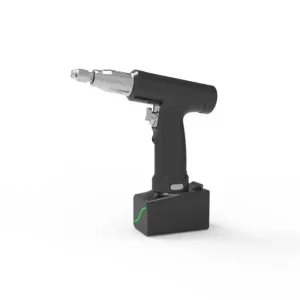
Explore our foundational series of high-speed surgical drills, reaming adapters, and precision oscillating blades manufactured under rigorous European conformity directives.








A comprehensive engineering review into structural balance, brushless commutation algorithms, and stringent CE compliance within our state-of-the-art Chinese manufacturing facilities.
In modern industrial hardware fabrication and surgical power equipment assembly, the cordless sabre saw (also referred to universally as the cordless reciprocating saw) represents an apex of electromechanical integration. When global procurement channels source devices adhering to CE certification standards—such as the widely recognized Parkside Cordless Sabre Saw tier or specialized clinical reciprocating osteotomy tools—the baseline performance parameters demand zero compromise between torque delivery, heat dispersion, and vibration attenuation.
Snaikang Technology Development Co., Ltd. (SNK), operating from its modernized cleanroom facilities and ISO 13485:2016 accredited manufacturing center in Baoshan, Shanghai, bridges the gap between mass industrial endurance and the micrometer-level tolerances required by European CE regulatory directives (CE-MDR 2017/745 for biomedical systems and EN 62841-2-11 for hand-held motor-operated electric tools). By incorporating intelligent brushless power plants, triple-hardened helical gearbox drive assemblies, and automated balance counters, our factory outputs machinery that redefines cordless reciprocating performance worldwide.
Core Engineering Benchmark: Reciprocating mechanical transmission dynamic runout held strictly under 0.03 mm across 200 consecutive high-temperature, high-pressure sterilization or accelerated thermal durability cycles, supported by a 100% full-load bench test protocol.
Unlike conventional carbon-brush architectures that generate friction, carbon particulate contamination, and excessive operational heat, SNK brushless sabre saw drives utilize rare-earth neodymium magnets and closed-loop FOC (Field-Oriented Control) micro-controllers.
Reciprocating sabre saws naturally suffer from primary inertia forces along the cutting axis. Our Shanghai engineering team employs a patent-pending dual-eccentric counterweight counterbalance linkage.
Every sabre saw assembly passing our production line aligns with European Harmonized Standards including Machinery Directive 2006/42/EC, EMC 2014/30/EU, and Low Voltage Directive 2014/35/EU, with complete EUDAMED documentation.
How Shanghai's advanced precision manufacturing corridor drives global competitive advantage for industrial brands, hospital tenders, and commercial tool importers.
By producing CNC components, micro gear assemblies, motor stators, and battery enclosures on-site, SNK eliminates intermediate markups and external supply volatility, ensuring consistent delivery schedules.
While standard western tool manufacturers require 8 to 12 weeks for tooling adjustments, our agile CAD/CAM workflow and in-house mold facility permit full private-label prototypes in under 21 calendar days.
Our sabre saw motor control units support cross-platform 20V/21V lithium battery architectures, matching mainstream slide-pack configurations (e.g., Parkside X20V Team system) with smart BMS circuit protection.
Every tool production batch undergoes dynamic bone drill and reciprocating blade accuracy audits inside our dedicated DIN 13972 testing laboratory, maintaining torque deviations within ±1.5% across production runs.
Analyzing key shifts in cordless sabre saw engineering, lithium-ion battery integration, and the rising compliance burden on commercial procurement departments.
Historically, commercial cordless reciprocating tools—such as legacy hardware-store sabre saws—depended on high-draw brushed DC motors. These units suffered from limited brush life (typically 80–120 continuous hours), aggressive brush sparking, and severe motor degradation under stall conditions. Today, industrial contractors and medical facilities demand continuous duty cycles. Modern manufacturing facilities have transitioned to 3-phase sensorless Brushless DC (BLDC) motors managed by Field-Oriented Control (FOC) microcontrollers. This upgrade increases runtime by up to 52% per charge, eliminates wear components, and guarantees thermal cutoff safeguards when encountering steel rebar, thick bone cortices, or structural timber.
A primary bottleneck in cordless sabre saw power transmission is internal resistance and thermal degradation within battery packs. Commercial procurement standards now specify high-discharge 21700 cylindrical cells (such as Samsung INR21700 or domestic Grade-A tier) configured with active cell-balancing Battery Management Systems (BMS). These systems integrate Over-Current Protection (OCP), Over-Voltage Protection (OVP), Under-Voltage Lockout (UVLO), and NTC thermal sensors. This ensures continuous 35A to 50A peak current discharge without entering thermal shutdown, directly empowering our 12,500 RPM surgical reciprocating tools and heavy industrial demolition saws alike.
Tool-free blade clamping mechanisms are now a mandatory baseline in tender audits. However, high vibration frequently causes cheaper spring-loaded collars to jam or experience metal fatigue. SNK manufactures its chuck mechanisms using powder metallurgy and high-nickel alloy investment casting, incorporating dual-wedge locking pawls that prevent blade walk, preserve runout precision, and support bi-directional blade insertion (cutting up or cutting down) across diverse industrial and anatomical work envelopes.
From heavy structural timber demolition to precision surgical osteotomy, our cordless reciprocating power systems provide versatile cutting performance.
Utilized in major joint reconstruction, total knee/hip arthroplasty, and emergency orthopedic trauma interventions requiring rapid, clean resection of dense bone without causing thermal necrosis.
Engineered to power through cast iron piping, embedded framing nails, carbon steel structural conduits, and heavy hardwoods during construction and commercial retrofitting.
Rapid deployment by municipal fire brigades, civil protection squads, and disaster recovery units requiring instantaneous, cordless cutting capability in hazardous environments.
A rigorous checklist for institutional buyers, commercial brand owners, and tender directors auditing China manufacturing partners.
Procuring cordless sabre saws at an institutional scale—whether supplying European retail chains under private brands (such as Parkside OEM channels) or supplying hospital consortia with orthopedic bone cutting equipment—involves complex factory auditing. Procurement directors must assess three critical criteria to mitigate supply disruption and regulatory non-compliance:
Every batch must have verified CE compliance documentation. This includes valid Declaration of Conformity (DoC), accredited test lab certificates (TUV, SGS, or Intertek) referencing EN 62841-1 and EN 62841-2-11, and battery cell certifications (UN38.3, MSDS, IEC 62133) for air and sea transport.
Suppliers must demonstrate Installation Qualification (IQ), Operational Qualification (OQ), and Performance Qualification (PQ) across injection molding, automated surface-mount PCB placement (SMT), automated gear hobbing, and robotic final assembly.
Physical quality audits require documented continuous-run endurance tests (300 hours non-stop reciprocal cycling under load), drop tests from 1.5 meters onto industrial concrete without chassis fracture, and salt-spray chamber corrosion testing across exposed metal parts.
Detailed technical, compliance, and supply chain insights for engineering directors and procurement officers.
Our manufacturing facility operates under an audited ISO 13485:2016 and ISO 9001 quality management framework. Every cordless sabre saw batch undergoes electromagnetic compatibility (EMC) testing, harmonic emissions verification, low-voltage electrical safety checks, and mechanical hazard risk assessments. Official CE declarations are backed by accredited third-party test reports and kept continuously updated with EUDAMED traceability.
Standard design customizations—including custom housing colorways, corporate brand silk-screening, custom blow-molded carrying cases, localized multilingual instruction manuals, and specific battery terminal pin layouts—require approximately 3 weeks from approved CAD drawings to trial production run. New injection tooling and mechanical PCB revisions typically take 35 to 45 days.
Yes. We engineer customized battery interface brackets compatible with widespread industry battery systems, including 20V slide-on designs similar to the Parkside X20V Team ecosystem, Makita LXT style, or DeWalt style footprints, allowing brand distributors to market "bare tool" options without forcing redundant charger purchases on end users.
Standard retail sabre saws transmit between 12.0 and 18.5 m/s² of vibration to the operator's hands. SNK’s counterweighted rocker-arm mechanism counteracts reciprocating blade mass directly opposite the drive cycle, reducing transmitted vibration below 4.5 m/s². This enables extended daily operation under European occupational health directive 2002/44/EC.
For standard branded catalog items, our baseline MOQ starts at 50 units, supported by ready warehouse reserves dispatched within 24 to 48 hours. For full customized OEM private-label manufacturing runs with bespoke tooling, battery packs, and custom packaging, the standard production minimum is 500 units per order batch.
Yes. Our surgical-tier sabre saws are hermetically sealed using silicone O-rings and fluororubber dynamic shaft seals. The handpieces are validated to withstand more than 200 cycles of high-pressure, high-temperature steam sterilization (134°C at 2.1 bar) or ethylene oxide (EO) sterilization without internal motor insulation breakdown or shaft transmission seizure.
Explore our heavy-duty and surgical-grade saw systems, trauma cannulated drills, and cranial milling handpieces engineered for demanding cutting requirements.