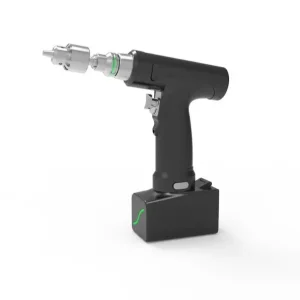
High-speed brushless micro-drive motors, high-frequency oscillating adapters, and high-load transmission mechanics certified for operating room safety and minimal thermal necrosis.








In modern orthopedic reconstructive, trauma, pelvic, and minimally invasive spine surgeries, the surgical corridor is constrained by vascular bifurcations, neural plexuses, and tight osseous boundaries. Conventional linear reciprocating handpieces demand an in-line clearance corridor that frequently forces surgeons to enlarge incisions or apply excessive soft tissue retraction. The deployment of a CE-MDR Certified Right Angle Reciprocating Saw fundamentally solves this spatial biomechanical bottleneck by translating longitudinal motor rotation into an orthogonal cutting stroke through hardened spiral-bevel or eccentric hypoid geartrains.
From an osteotomy perspective, linear bone resection in deep pelvic fractures, sacroiliac joint reconstructions, or trans-thoracic rib resections requires exact directional stability. When torque is transferred at 90 degrees, lateral blade chatter, micro-vibration back-propagation, and mechanical hysteresis must be suppressed. Under our ISO 13485:2016 quality management framework, SNK engineers have eliminated angular backlash using dual pre-loaded ceramic bearings and micro-machined titanium-alloy transmission heads. This ensures that surgeons achieve uniform osteotomy planes without thermal necrosis, maintaining local bone temperatures safely below the critical 47°C denaturation threshold.
Eliminates carbon particulate emissions in sterile operating environments. Proprietary digital drivers deliver constant 12,500 rpm reciprocating output under variable bone densities.
Dual dynamic fluoro-elastomer barriers protect motor coils from 134°C vacuum steam autoclave cycles, maintaining zero fluid ingress over more than 200 continuous reprocessing intervals.
360-degree indexed blade positioning allows surgeons to reorient cutting trajectories in 45-degree increments without altering handpiece ergonomic grip or line of sight.
The global demand for high-reliability right-angle surgical power systems has seen exponential expansion driven by two major market catalysts: the worldwide transition toward Ambulatory Surgical Centers (ASCs) and the rigorous enforcement of the European Medical Device Regulation (EU MDR 2017/745). Historically, surgical theaters relied heavily on pneumatic turbines or bulky single-purpose motors. Modern procurement committees now require integrated, multi-functional electric platforms that reduce instrument tray volume, streamline Central Sterile Supply Department (CSSD) workflows, and minimize total cost of ownership (TCO).
Hospital purchasing directors and tier-one medical distributors face stringent qualification hurdles. In secondary and tertiary hospital tenders, capital budgets prioritize handpieces that offer backward adapter compatibility, broad torque envelopes, and documented compliance with international electrical safety standard IEC 60601-1 and electromagnetic compatibility standard IEC 60601-1-2. Furthermore, regional distributors in Europe, Latin America, and Southeast Asia require manufacturers to provide fully localized technical documentation, risk management files according to ISO 14971, and pre-audited clinical evaluation reports (CER).
| Evaluation Parameters | SNK CE-MDR Brushless System | Legacy Pneumatic Saws | Generic Carbon-Brush Saws |
|---|---|---|---|
| Sterilization Reprocessing | Validated >200 Steam Autoclave Cycles | Moisture-Sensitive, Air-line Contamination Risk | Degrades after ~60-80 Autoclave Cycles |
| Operating Noise Profile | <62 dB(A) at Maximum Cutting Load | >78 dB(A) with High-Pressure Exhaust | ~72 dB(A) with Brush Commutation Whine |
| Thermal Rise at Cut Edge | <2.1°C Increase (ASTM F2180 Validated) | Variable, Dependent on Exhaust Cooling | >5.8°C Increase (Risk of Osteonecrosis) |
| MDR (EU) 2017/745 Status | Full Class IIa/IIb Annex IX Certified | Phased-out MDD Directives Pending Renewal | Self-Declared Class I (Non-Compliant) |
| OEM Delivery Lead Time | ~3 Weeks Flexible Agile Line | 12–16 Weeks Traditional Machining | 8–10 Weeks Batch Production |
A single central brushless motor console powers right-angle reciprocating saws, oscillating saws, sagittal saws, and cannulated drills, drastically decreasing hospital capital equipment investment and reprocessing complexity.
With regional logistics hubs maintaining ready-inventory buffers, emergency handpiece replacement kits and specialized saw blades ship within 24–48 hours across Europe, the Middle East, and the Asia-Pacific region.
We provide complete technical documentation sets including biocompatibility reports (ISO 10993), electrical safety verification, and Certificate of Free Sale (CFS) authenticated for over 21 international health ministries.
The boundary between manual surgical handpieces and automated surgical platforms is dissolving. SNK’s clinical R&D laboratory in Shanghai is actively executing a five-year technology roadmap targeting deep integration with optical tracking navigation systems and robotic arm end-effectors. Key technological pillars currently in clinical trials include:
1. Active Haptic Feedback & Boundary Enforcement: Through real-time current-load sensing and IMU (Inertial Measurement Unit) telemetry, the next-generation right-angle reciprocating saw communicates with navigation workstations at 1,000 Hz. When the saw blade approaches a pre-segmented safety envelope (such as the dura mater or the posterior cortex of the pelvis), the motor dynamically brakes within 8 milliseconds, preventing soft tissue laceration.
2. Autonomous Thermal Sensing Blades: By embedding micro-thermocouple thin films into surgical blades, real-time interface temperatures are displayed on the surgical console or transmitted via Bluetooth Low Energy (BLE) to intelligent irrigation pumps, triggering pulsatile saline cooling before cellular thermal damage occurs.
Detailed technical answers for hospital bio-engineers, regulatory directors, and medical equipment distributors.
Thermal necrosis occurs when osseous tissue exceeds 47°C for more than 60 seconds. Our right-angle reciprocating design maintains a micro-stroke stroke length (typically 2.5 mm to 3.2 mm) at high reciprocating frequencies (12,500 rpm). This creates localized bone chip evacuation rather than friction buildup. Tested according to ASTM F2180 standards, temperature elevation remains strictly beneath 2.1°C under standard saline irrigation.
Every shipment is backed by a complete regulatory packet: EU Declaration of Conformity (DoC), Notified Body CE certificates under MDR Annex IX, ISO 13485:2016 audited quality certificates, Class IIa/IIb classification rationale, UDI-DI codes traceable on the European EUDAMED database, and multi-language Instructions for Use (IFU) covering cleaning, disinfection, and sterilization.
The right-angle gearbox utilizes case-hardened medical stainless steel spiral-bevel gears ground to AGMA Class 12 tolerances. Mechanical axial runout is maintained under 0.03 mm even after 200 consecutive high-pressure vacuum steam autoclave cycles (134°C at 2.2 bar for 18 minutes), ensuring smooth cutting without erratic lateral kickback.
Yes. We manufacture universal quick-coupling collets compatible with industry-standard flat-shank and cross-pin reciprocating blades. Additionally, our tool housings can be fitted with navigation tracker clamp arrays conforming to Stryker, Medtronic, and Brainlab optical tracking standards.
Brushless motors utilize electronic commutation through Hall-effect sensors and digital motor controllers. Without physical brushes rubbing against a commutator, there is no mechanical friction, zero particulate carbon dust shedding into the sterile field, dramatically reduced heat generation in the surgeon's hand, and a lifespan exceeding 3,000 surgical hours compared to ~300 hours for carbon motors.
Engineered to meet the exact clinical criteria demanded by trauma specialists, neurosurgeons, and orthopedic procurement authorities worldwide.