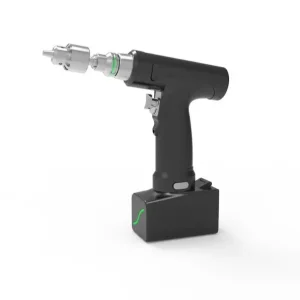
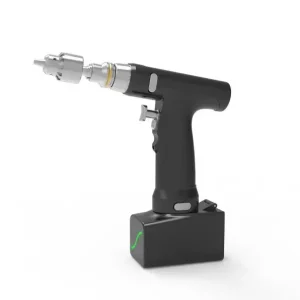
Precision Surgical Engineering White Paper: Analyzing Brushless Drive Topologies, CE-MDR Compliance Pathways, OEM Interoperability, and Scalable Medical Device Supply Chains.
Explore medical-grade powered handpieces and precision surgical tools engineered for Stryker-compatible interfaces, trauma fixation, osteotomy, and cranial trephination.
In modern orthopedic operating suites, the powered surgical handpiece is the direct extension of surgical biomechanics. When selecting alternative systems or high-tier OEM attachments for Stryker-compatible handpieces, surgical directors and hospital biomeds require zero clinical divergence.
Sensorless brushless DC (BLDC) motors eliminate mechanical commutators and carbon friction. This architecture yields steady dynamic torque across fluctuating cortical bone densities while reducing internal heat buildup and particle shedding under vacuum autoclaving.
Repeated 134°C vacuum steam sterilization demands medical-grade sealing. Handpieces feature multi-stage fluororubber O-rings and proprietary laser seam welding to prevent steam moisture ingress into gearboxes and bearings.
Precision-milled couplings enable rapid intraoperative transitions between cannulated drilling, high-frequency sagittal osteotomy, reaming, and wire driving without requiring auxiliary wrenches.
Global medical device brands and hospital group GPOs leverage China's advanced precision medical cluster to secure tier-one clinical reliability at sustainable capital acquisition budgets.
Our Shanghai facility integrates 5-axis Swiss-type turning centers and German micro-grinding machines. This vertical integration guarantees precise dimensional tolerances across drive gears, cannulated shafts, and adapter collars.
Engineering modifications—such as custom RPM/torque gearing, modified handgrip ergonomics, and tailored battery docking systems—transition from 3D CAD modeling to clinical validation prototypes within 21 business days.
Original brand power systems often place excessive fiscal pressure on orthopedic surgery margins. China's mature surgical power supply chain reduces initial capital expenditure by 40–60% while matching performance specifications.
In cross-border hospital tenders and regulatory registrations, formal documentation is non-negotiable. SNK delivers verified compliance files, traceable test protocols, and robust quality governance.
All clinical handpieces, power consoles, and saw modules meet EU Regulation 2017/745. Technical documentation incorporates full Clinical Evaluation Reports (CER), Risk Management (ISO 14971), and Usability Engineering (IEC 62366).
Manufacturing facilities operate under audited quality systems aligned with the Medical Device Single Audit Program (MDSAP). This streamlines distributor clearance across the United States, Canada, Australia, Japan, and Brazil.
We empower regional medical distributors with pre-compiled technical filing dossiers, factory Declarations of Conformity (DoC), Certificates of Free Sale (CFS) authenticated for 21 countries, and multilingual IFU assets.
Engineered for high-duty operating theaters, SNK power systems accommodate specialized bone resection and fixation procedures with precision handpiece feedback.
Cannulated bone drills with hollow bores up to Ø4.2 mm allow smooth insertion along Kirschner wires and guidewires. Dynamic speed modulation up to 1,600 RPM prevents drill bit skidding during emergency intramedullary nailing.
Total knee (TKA) and total hip (THA) replacements demand massive low-speed torque without motor stall. Our high-torque reamer adapters deliver 20 N·m of continuous power while limiting bone thermal necrosis below 41°C.
From fine laminectomy and emergency craniotomy flaps to midline sternotomies in cardiothoracic surgery, modular adapters provide specialized protection guards and high-frequency cutting stability.
The global orthopedic drill sector is evolving rapidly. Next-generation instruments emphasize lighter architectures, telemetry diagnostics, and real-time robotic navigation compatibility.
Robotic-assisted orthopedic surgery (RAOS) requires handpieces that feed real-time RPM, temperature, and torque telemetry back to surgical consoles. SNK handpieces offer optical tracker array mounting and closed-loop data buses.
Transitioning from NiMH and legacy lithium cells to smart LiFePO4 / high-density ternary lithium cells allows 40% lighter handpieces with built-in battery management systems (BMS) that survive repetitive autoclave heat cycles.
Heavy surgical handpieces cause wrist fatigue during lengthy trauma procedures. Future chassis designs integrate medical-grade PEEK and carbon-fiber matrix composites to reduce handpiece weight by 35% without sacrificing rigidity.
Key technical, regulatory, and supply chain questions addressed for biomedical engineering departments, OR purchasing committees, and medical device distributors.
Complete surgical tool configurations engineered for rapid hospital deployment, clinical precision, and long-term durability across diverse orthopedic subspecialties.