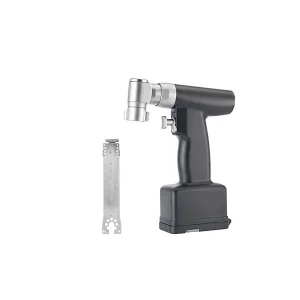
Direct from our certified manufacturing facility. Fully verified for repeated high-temperature autoclave and EO sterilization cycles under strict clinical operating room conditions.







Analyzing how modular surgical drive platforms match or exceed legacy OEM performance standards while addressing modern hospital procurement challenges.
Global cardiothoracic surgical suites face surging replacement and maintenance costs for proprietary legacy systems like Stryker System 7 and System 8. OEM ecosystem lock-in drives up total cost of ownership (TCO).
Cutting sternal cortical bone generates localized thermal spikes exceeding 47°C, which triggers irreversible osteonecrosis and delayed sternal union. Our engineered blade-handpiece kinematic coupling guarantees low-heat cutting.
Beyond median sternotomies, modern hospitals demand cross-functional surgical platforms capable of rapid transition between thoracic, spine, trauma fixation, and acetabular reaming procedures.
"In cardiovascular and thoracic interventions, every millimeter of oscillating excursion and every degree of thermal management directly translates into post-operative sternal closure integrity and reduced deep sternal wound infection (DSWI) rates."
How healthcare system reforms, dual-sourcing strategies, and localized MDR compliance are reshaping international hospital equipment bids.
For decades, legacy American and European brands maintained closed vendor lock-in. Tier-1 health systems across Germany, the UK, Saudi Arabia, and Brazil now mandate vendor diversification to insulate supply chains against single-source failure.
Transition from the MDD to CE-MDR (EU) 2017/745 caused extensive product revocations across legacy factories. As an ISO 13485:2016 and MDR compliant manufacturer, our sternum saw handpieces maintain validated EUDAMED safety files.
Long shipment delays have historically paralyzed operating room turnover. Through centralized strategic warehouses in Europe (≤48h dispatch) and Asia-Pacific (≤24h dispatch), distributors maintain uninterrupted field service.
| Performance Specification | Stryker System 7 Sternum Equivalent (SNK) | Legacy Brush Saw Systems | ISO / Clinical Benchmark |
|---|---|---|---|
| Motor Architecture | Brushless DC Sensorless Drive | Carbon Brush Commutator | IEC 60601-1 Medical Electrical |
| Oscillation / Stroke Rate | 0 – 14,500 CPM (Variable Trigger) | 0 – 11,000 CPM (Fluctuating) | DIN 13972 Precision Standard |
| Operating Temperature Rise | < 2.0 °C under sustained cutting | > 6.5 °C (Thermal creep risk) | ASTM F2180 Temperature Safety |
| Hermetic Sealing & Autoclave | IPX9K Hermetic Laser Seal (200+ Cycles) | O-Ring Gasket (Degrades at 60 Cycles) | ISO 17665 Moist Heat Sterilization |
| Sternal Blade Compatibility | Stryker System 7/6 & SNK S2150 Universal Fit | Proprietary dedicated hub only | ISO 6475 Surgical Instruments |
| Regulatory Approval Tier | CE-MDR 2017/745 + MDSAP | Legacy MDD (Expiring status) | Full EUDAMED Traceability |
Empowering local hospital distributors and biomedical engineering teams with turn-key registration support and rigorous auditing transparency.
Navigating national health authorities (ANVISA, SFDA, COFEPRIS, TGA, and EU Notified Bodies) requires exhaustive risk analysis files and mechanical stress benchmarks.
Hospital operating theaters cannot endure week-long delays when repair needs arise. We provide certified spare assembly kits and hot-swap handpiece buffers.
We ensure distributor technical teams achieve independent factory-level service competency through comprehensive certification programs.
Real-world surgical applications requiring instantaneous torque response, superior blade stability, and uncompromising sterility.
Full midline sternal division demanding rapid cutting without snagging marrow or dragging periosteal layers. Ergonomic balance prevents plunge trauma to underlying retrosternal structures.
Secondary chest re-entry carries severe risks of right ventricular laceration due to dense retrosternal adhesions. Demands ultra-controlled shallow oscillation profiles.
Partial sternotomies and lateral thoracotomies require lightweight handpieces with slim profile front attachments to access restricted operational corridors.
Pioneering the convergence of sensory feedback, real-time bone density telemetry, and robotic-assisted cardiac surgical suites.
Incorporating micro-piezoelectric sensors within the saw chuck to analyze cutting acoustics and torque curves. Automatically differentiates hard cortical bone from spongy marrow and soft retrosternal pleural boundaries.
Transitioning from traditional lithium cells to sterile autoclavable solid-state battery technology. Integrated RFID modules log autoclave cycles, running hours, and preventative overhaul alerts directly to hospital BMS systems.
Integrating optical positioning tracker arrays compatible with 12 open-source orthopedic and cardiovascular navigation platforms. Supports boundary-constrained haptic robotic sawing arms for zero-deviation cuts.
Comprehensive technical and regulatory clarity for biomedical engineers, OR managers, and distributor sourcing directors.
Complete surgical tool arrays for neurosurgery, spine, trauma fixation, and joint reconstruction. Fully backed by factory-direct warranty and spare parts support.