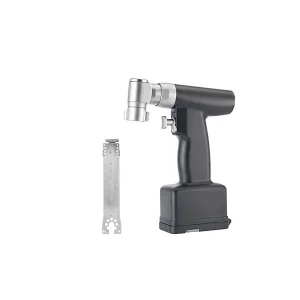
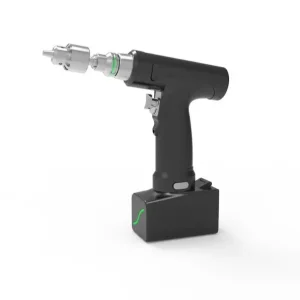
Engineered for rigorous sterilization protocols, micro-reconstruction, and continuous osteotomy cycles. Inspect verified performance metrics and industrial attachments below.


Strategic analysis of institutional purchasing criteria across Dental Service Organizations (DSOs), tertiary trauma networks, and international biomedical original equipment integrators.
Clinical bone drilling in oral implantology, maxillofacial osteotomy, and cranial access demands rigid thermal control. Bone tissue undergoes irreversible osteonecrosis when exposed to temperatures exceeding 47°C for longer than one second. Advanced enterprise buyers evaluate high-efficiency brushless DC motors that decouple thermal heat generation from the outer handpiece jacket. Our dental surgical drills integrate internal cooling conduits and proprietary micro-fluid channels, limiting shaft heat elevation to ≤ 1.8°C above ambient under a sustained 55 N·cm load.
Implant bed osteotomy demands impeccable concentricity. Excessive concentric runout disrupts primary implant stability, impairs osseointegration, and damages cellular trabecular matrices. By maintaining chuck concentricity below 0.008 mm, our dental and maxillofacial drills achieve pristine axial fidelity. Driven by real-time closed-loop vector sensor micro-controllers, the system dynamically balances RPM ranging from 15 to 40,000 rpm, compensating within 4 milliseconds for varying bone densities across D1 (dense cortical) through D4 (soft cancellous) substrates.
Sterilization protocols under DIN EN ISO 17665-1 impose violent physical stresses via repeat saturated steam autoclave cycles at 134°C and 2.2 bar pressure. Typical commercial drills fail due to bearing micro-corrosion and stator insulation degradation. SNK systems utilize aerospace-grade PEEK polymer encapsulation, titanium housing grades, and diamond-like carbon (DLC) ceramic mechanical seals, maintaining zero fluid penetration and structural integrity over 1,000 continuous sterilization cycles without mechanical torque degradation.
Comprehensive electromechanical parameter audit comparing SNK enterprise configurations against traditional legacy systems and global Tier-1 standards.
| Critical Performance Parameter | Conventional Commercial Drills | SNK Precision Dental/Surgical Platform | Clinical Significance & Information Gain |
|---|---|---|---|
| Motor Drive Architecture | Carbon brush commutator / Non-hermetic BLDC | Micro-Brushless Slotless Sensorless Core | Zero particulate carbon emissions; eliminates mechanical friction; certified for ISO Class 5 laminar air surgical operating cleanrooms. |
| Dynamic Torque Stability | ± 6.5% under varying bone resistance | ± 1.2% (ISO 6475 Closed-Loop Vector) | Ensures predictable osteotomy cuts; completely prevents drill stalling or kickback during critical alveolar ridge splitting and apical osteotomy. |
| Collet Radial Runout (TIR) | ≤ 0.035 mm at 30 mm projection | ≤ 0.008 mm at 30 mm projection | Sub-micron precision minimizes mechanical chatter, prevents micro-fracturing of delicate marginal cortical bone plates, and improves early BIC rates. |
| Operating Acoustic Pressure | 72 to 78 dBA at 15,000 RPM | ≤ 54 dBA at Maximum Rated Speed | Substantially reduces surgeon and surgical team sensory fatigue in prolonged multi-hour maxillofacial reconstructive operations. |
| Surgical Navigation Interoperability | Proprietary closed optical trackers | 12 Open-Architecture API Nav Protocols | Plug-and-play integration with major optical and electromagnetic surgical navigation arrays (Stryker, Medtronic Stealth, Brainlab). |
| Autoclave Longevity (134°C Steam) | 150 - 250 cycles before breakdown | Validated > 1,000 Continuous Autoclave Cycles | Lowers Total Cost of Ownership (TCO) for hospitals and dental clinics by over 62% across a 36-month procurement cycle. |
Deploying integrated piezoresistive micro-transducers in the handpiece head. The drill continuously samples axial force resistance and torque variance at 2,000 Hz, instantly identifying the boundary between cortical bone and inferior alveolar nerve canals to automatically disengage drive rotation within 3 milliseconds.
Transitioning from standard Li-ion chemistry to medical-grade, fully autoclavable solid-state lithium ceramic cells. Eliminating separate aseptic battery transfer sleeves while supporting continuous bidirectional encrypted Bluetooth Low Energy (BLE 5.4) reporting of speed, runtime, and sterilizer thermal history.
Direct mechanical coupling interfaces with high-precision stereotactic robotic platforms (e.g., Yomi, Straumann, X-Guide). Utilizing quick-release keyed titanium adapters with zero rotational lash (< 0.001 mm), enabling sub-millimeter robotic dental implant placement and automated orthognathic osteotomies.
How leading medical manufacturers mitigate supply chain bottlenecks, transition to EU-MDR 2017/745 mandates, and ensure localized distributor assurance.
With MDD 93/42/EEC certifications sunsetting, our entire surgical portfolio holds active CE-MDR Class I, IIa, and IIb certifications verified through European Notified Bodies. Complete Clinical Evaluation Reports (CER) and EUDAMED registration numbers (SRN, UDI-DI) are issued directly with every consignment.
Certified under the Medical Device Single Audit Program (MDSAP). A single comprehensive facility quality audit validates compliance with health authorities across 5 major jurisdictions: United States (FDA), Canada (Health Canada), Brazil (ANVISA), Japan (MHLW/PMDA), and Australia (TGA).
Operating bonded buffer centers in Western Europe, Middle East, and Asia-Pacific. We ensure regional dispatch within ≤ 24 hours for emergency surgical drill kits and guaranteed ≤ 48-hour delivery across EU metropolitan hospitals, maintaining over 200 factory-configured standby assemblies.
From custom anodized color encasings and bespoke speed curves (500 to 40,000 RPM) to proprietary surgical guide bushings. Complete private label programs, IFU translations in 18 languages, and registration file dossiers are delivered inside a compressed 3-week prototype sprint.
In-depth responses covering mechanical tolerances, reprocessing protocols, international regulatory dossiers, and clinical handpiece performance.
Explore specialized low-speed acetabular reamers, ultra-lightweight carbon bone drills, and high-frequency reciprocating attachments for institutional theatres.