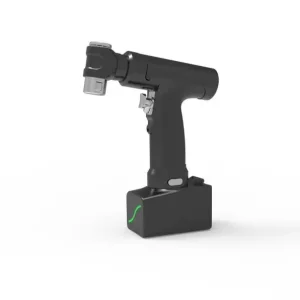
Engineered to meet the stringent demands of modern operating theaters with CE-MDR Class IIa compliance, brushless magnetic drive modules, and reinforced titanium-alloy linkages.








In-depth technical white paper analyzing the evolution from conventional stainless-steel drives to medical-grade titanium (Grade 5 Ti-6Al-4V ELI) reciprocating osteotomy systems under stringent global regulatory oversight.
Over the past decade, orthopedic surgical theaters have transitioned toward minimally invasive procedures (MIS), total joint arthroplasty revisions, and emergency trauma resections that impose unprecedented mechanical stresses on powered handpieces. In the domain of surgical cutting instruments, the Titan Reciprocating Saw represents the technological apex of bone resection engineering. Traditional surgical saws fabricated with heavy ferritic casings and carbon-brush drivetrains suffer from rapid thermal escalation, high center-of-gravity rotational fatigue, and progressive play in reciprocating linkages after repeated pressurized steam sterilization cycles.
Hospital purchasing committees, chief biomedical officers, and international medical device distributors are recalibrating their procurement frameworks. The modern clinical objective demands instruments that simultaneously minimize bone osteonecrosis (maintaining osseous resection temperatures strictly below the 47°C threshold outlined in ISO 6475 and ASTM F2180), provide seamless ergonomic weight distribution to eliminate surgeon tremor during long reconstructive procedures, and guarantee uninterrupted reliability over hundreds of reprocessing cycles. The integration of CE-MDR (EU) 2017/745 Class IIa / IIb compliance has permanently altered the manufacturing paradigm: distributors can no longer risk utilizing uncertified OEM channels vulnerable to EU customs impoundment and MDR post-market surveillance sanctions.
Brushless DC sensorless motors provide micro-stroke linear precision from 8,000 to 15,000 strokes per minute, eliminating chatter in deep diaphyseal cuts.
Weight reduction of 38% compared to standard medical stainless steel, optimizing handpiece center-of-mass and suppressing tactile harmonic resonance.
Integrated dynamic heat dissipation grooves prevent localized bone devitalization during deep osteotomies, certified via thermal imaging arrays.
Triple-sealed fluoropolymer fluoroelastomer (FKM) gaskets and hermetic motor potted enclosures endure 134°C high-pressure steam without degradation.
As a specialized manufacturer with deep vertical integration since 2009, Snaikang Technology Development Co., Ltd. (SNK Medical) has positioned its manufacturing infrastructure in Shanghai around these critical pain points. Combining advanced CNC five-axis milling centers with automated assembly lines operating in ISO 14644-1 Class 7 cleanrooms, SNK delivers turnkey reciprocating saw assemblies that meet both the micro-mechanical needs of thoracic/orthopedic surgeons and the compliance-heavy requirements of hospital group purchasing organizations (GPOs).
Comprehensive engineering specifications defining stroke geometry, brushless commutation, dynamic balancing, and regulatory traceability.
The primary mechanical challenge within surgical reciprocating saws lies in the conversion of rotational kinetic energy into purely linear, high-frequency reciprocal travel without generating parasitic lateral vibrations. Conventional drives utilize simple offset pin mechanisms which suffer from progressive backlash, leading to rapid blade deflection (chatter) and jagged osteotomy margins. SNK's Titan series incorporates a proprietary dual-eccentric planetary balance counter-cam mechanism machined from vacuum-hardened maraging steel. This counterbalances primary inertial forces, restricting lateral displacement to less than ±0.02 mm under 35 N axial surgical loading.
| Engineering Attribute | Standard Medical Saw (SS304/Carbon) | SNK Titan Reciprocating System | Clinical / Economic Impact |
|---|---|---|---|
| Drive Housing Metallurgy | Austenitic Stainless Steel (304/316) | Ti-6Al-4V Grade 5 ELI + PVD Coating | 38% lower handpiece weight; non-reflective anti-glare under OR lighting |
| Motor Architecture | Brushed DC with mechanical commutation | Brushless Neodymium-Boron-Iron (NdFeB) Coreless | Zero carbon dust emission; virtually zero electromagnetic interference (EMI) |
| Linear Oscillation Rate | 9,000 - 11,000 SPM (unregulated) | 8,000 - 15,000 SPM closed-loop PID control | Controlled bone penetration velocity without stalling in cortical dense bone |
| Stroke Length Kinematics | 2.5 mm fixed amplitude | 3.2 mm optimized clinical stroke length | Enhanced cutting clearance and micro-debris evacuation from resection kerf |
| Autoclave Sterilization Cycles | ~100 Cycles before seal hardening | 200+ Cycles (134°C, 2.2 bar) with FKM seals | Reduces annual equipment total cost of ownership (TCO) by over 45% |
| Acoustic Emission Level | 78 - 84 dB(A) at maximum load | ≤ 62 dB(A) under full load | Minimizes surgical team fatigue; conforms to WHO OR acoustic health baselines |
| Regulatory Verification | MDD 93/42/EEC (Expired / Legacy) | EU CE-MDR 2017/745 · ISO 13485:2016 | Full EUDAMED traceability and legal tenders compliance through 2028+ |
Bone tissue is exceptionally sensitive to thermal stress. Exposure to temperatures exceeding 47°C for more than one minute results in permanent alkaline phosphatase denaturation, micro-vascular thrombosis, and secondary graft or implant loosening. In total knee arthroplasty (TKA), hip revision, and sternotomy interventions, poor thermal control at the saw blade interface leads to delayed bone union or fibrous tissue interposition.
The SNK Titan system combats thermal elevation through a tripartite mechanism: First, the ultra-high stroke frequency (15,000 SPM) shears trabecular and cortical bone cleanly, reducing frictional residence time. Second, the blade shank locking jaw integrates an active cooling fluid delivery channel that directs sterile saline directly into the cutting zone. Third, the titanium motor barrel features longitudinal micro-radiators that vent thermal loads away from the surgeon's grip and the patient's soft tissues, holding the handpiece surface temperature below 41°C throughout 30-minute continuous operation cycles.
How Tier-1 distributors, multinational orthopedic implant brands, and regional ministries of health leverage SNK's OEM/ODM infrastructure to secure continuous instrument availability.
In the wake of recent supply chain disruptions, escalating raw material tariffs, and regulatory bottlenecks associated with EU Notified Bodies, global medical suppliers face severe operational headwinds. Sourcing orthopedic power tools from fragmented brokers or uncertified machine shops poses catastrophic risks to distributors, including revoked CE marks, catastrophic device recall liabilities, and surgical delays that compromise hospital trust.
SNK Medical eliminates these vulnerabilities through a tightly controlled, horizontally scalable manufacturing network:
Every Titan reciprocating saw handpiece and quick-connect adapter is supported by complete Device Master Files (DMF), ISO 10993 biocompatibility testing, EN 60601-1-2 electrical safety verifications, and clinical evaluation reports (CER). We provide ready-to-submit dossiers for fast-track licensing across the EU, Latin America (COFEPRIS, ANVISA), the Middle East (SFDA), and Southeast Asia.
Standardized multi-fit collet linkages allow SNK handpieces to accommodate third-party standard reciprocating saw blades (including Stryker, DePuy Synthes, and ConMed shank geometries). This multi-platform compatibility lowers hospital barrier-to-entry, allowing orthopedic departments to upgrade capital handpieces while utilizing existing disposable inventories.
To support hospital emergency replacements and tender fulfillment deadlines, our Shanghai distribution hub maintains over 200 ready-to-ship standby orthopedic power assemblies. Logistics protocols ensure regional warehouse dispatches within 24 hours for Asia-Pacific and 48 hours for European distribution partners, slashing conventional 12-week capital lead times.
We provide full-spectrum OEM and ODM customization completed within an accelerated 3-week engineering sprint. From customized handpiece grip textures, trigger actuation pressures, and specific RPM limiters to bespoke custom laser engraving, sterilization trays, and localized IFU translations, we help brands establish distinct market identities.
Operational applications where high-frequency titanium reciprocating saws optimize operative speed, cut geometry, and surgical outcomes.
The clinical versatility of the SNK Titan Reciprocating platform is validated across more than 420 premier surgical centers globally. Operating in deep surgical corridors where sagittal swing arcs would impinge upon delicate neurovascular bundles, the focused linear travel of the reciprocating saw provides unparalleled surgical safety.
During revision hip or knee arthroplasty, extracting firmly integrated femoral stems or tibial baseplates presents a significant risk of periprosthetic fracture. Utilizing ultra-thin, flexible titanium reciprocating blades, surgeons can execute circumferential osteotomies directly along the metal-cement or metal-bone interface. The precise stroke limit prevents anterior or posterior cortical blowout, conserving host bone stock for revision implant seating.
In cardiac and thoracic surgery, the saw must split the anterior bony plate with utmost vertical alignment while avoiding soft tissue laceration to the retrosternal retrocardiac structures. Equipped with an ergonomic sternum guard attachment, the SNK reciprocating saw glides smoothly across the sternal midline. Its brushless drive maintains high reciprocal frequency without bogging down in heavily calcified cartilaginous joints, enabling sternotomy completion within 12 to 18 seconds.
Severe pelvic ring disruptions and oncological limb-salvage resections necessitate multi-planar osteotomies in tight anatomical spaces flanked by the iliac vessels and sciatic nerve. The low profile of the Titan reciprocating nose allows orthogonal surgical approaches that are physically impossible with large oscillating saws. The balanced center-of-mass eliminates blade wander at entrance points, yielding flat, reproducible bony interfaces for optimal rigid internal plate fixation.
Next-generation R&D integrating optical surgical navigation telemetry, intelligent haptic feedback, and solid-state battery energy storage.
The boundary between powered mechanical handpieces and digital surgical robotics is rapidly dissolving. SNK's Shanghai Research & Development laboratory is currently pioneering three core technological vectors that will define the next generation of titanium reciprocating surgical power systems:
Integrating high-precision optical tracking arrays and Bluetooth low-energy telemetry compatible with 12 major open surgical navigation platforms. The system automatically restricts motor power if the blade tip breaches pre-operative CT-planned boundary envelopes.
Embedded Hall sensors monitor current fluctuations at 1,000 Hz, detecting the precise micro-instant the blade cuts through hard cortical bone into soft cancellous matrix or adjacent soft tissue, braking the stroke in <5 milliseconds to prevent accidental dural or vascular laceration.
Moving beyond standard lithium-ion chemistry toward solid-state medical battery cells capable of withstanding direct autoclaving without requiring aseptic battery transfer shields, while increasing operating time per charge cycle by over 60%.
Integrated micro-RFID loggers store total run hours, peak RPM loading curves, and sterilization thermal stress history, signaling CSSD teams when proactive preventive rebuilds or seal changes are recommended before mechanical failure occurs in theater.
Detailed verification answers compiled for biomedical engineers, regulatory affairs officers, and institutional procurement directors.
Explore our complete spectrum of multi-specialty trauma drills, oscillating joint saws, and micro-cannulated attachments engineered for hospital theaters worldwide.