Featured hospital-grade handpieces, micro-saws, and surgical drive adapters manufactured for rigorous trauma, spine, neurosurgical, and orthopedic applications.








A comprehensive technical perspective on mechanical transitions, motor architectures, and clinical advancements shaping powered bone cutting instruments.
The global orthopedic market has shifted rapidly from carbon-brush handpieces toward electronically commutated Brushless DC (BLDC) motors. In high-demand trauma resections and joint arthroplasty, 18v cordless reciprocating systems deliver sustained torque density without brush degradation, virtually eliminating carbon particulate contamination in sterile fields while operating at cooler, bio-safe temperatures.
Traditional pneumatic and corded systems present physical tripping hazards and tether surgeons to central consoles. Modern high-drain 18V lithium cell configurations offer the optimal power-to-weight balance. They deliver massive instantaneous burst currents for rapid osteotomies while keeping the center of gravity balanced directly beneath the surgeon's grip.
A primary bottleneck in bone saw reliability is thermal shock and steam ingress during steam autoclaving (134°C / 273°F at 2.2 bar). Leading factories engineer advanced dynamic fluoropolymer rotary seals, laser-welded aerospace titanium housings, and potted PCB assemblies to ensure uncompromising electrical integrity through hundreds of sterilization runs.
Addressing structural supply chain challenges, institutional hospital tenders, and OEM private-label requirements with verifiable engineering benchmarks.
Global procurement teams prioritize versatile handpiece drive units that interface seamlessly across multiple quick-connect attachments: sagittal oscillating heads, sternum guards, reciprocating saw quick-locks, and reaming reductions. This consolidation lowers institutional capital expenditure and simplifies sterile processing workflows.
Procurement directors analyze the complete lifecycle cost rather than simple initial unit pricing. Direct manufacturer partnerships that guarantee spare component accessibility—drive gears, replacement lithium modules, eccentric shafts, and chuck retainers—safeguard medical systems from premature field obsolescence.
For brand owners looking to launch a tailored surgical system, scalable factories offer end-to-end realization: motor torque mapping from 500 to 15,000 OPM, proprietary quick-coupling blade chuck configurations, bespoke ergonomic handle molding, and specialized private-label sterilizable transport cases within 3 to 4 weeks.
Navigating the complex global landscape of medical device registration, biological safety validations, and post-market clinical traceability.
Our operations have phased out legacy MDD protocols in favor of stringent CE-MDR certification across Class I, IIa, and IIb devices. Distributors receive direct technical documentation files, complete risk analysis matrices (ISO 14971), and verifiable EUDAMED registration codes to facilitate prompt European tender submissions.
Audited through the Medical Device Single Audit Program (MDSAP), our production adheres concurrently to regulatory systems across the United States (FDA QSR 21 CFR 820), Canada (CMDR), Australia (TGA), Japan (PMDA), and Brazil (ANVISA), accelerating localized national market entry.
To reduce administrative friction during hospital tender registrations in the Middle East, Latin America, Southeast Asia, and Africa, we maintain a comprehensive archive of legalized Free Sale Certificates (FSC), consular authentications, and test validation reports under ASTM F2503 and ISO 6475.
Advancing orthopedics through smart micro-sensing, intraoperative feedback mechanisms, and surgical navigation integration.
Next-generation 18V reciprocating saws integrate sub-millisecond current-sensing circuitry that continuously tracks blade resistance. As the saw blade finishes cutting dense cortical bone and approaches softer cancellous structure or periosteal soft tissue boundaries, the system automatically slows its oscillation to prevent soft-tissue laceration.
With computer-assisted orthopedic surgery (CAOS) becoming the gold standard in joint revision and spinal fixation, modern handpieces must communicate directly with optical and electromagnetic tracking systems. Our engineering roadmap includes low-latency spatial tracking trackers and active telemetry links with open navigational software suites.
Smart sterilizable handpieces incorporate non-volatile internal data logs that record aggregate thermal cycles, cumulative motor run hours, peak mechanical torque events, and battery impedance trends. Biomedical hospital departments can query this information wirelessly to schedule preventative maintenance before intraoperative mechanical issues arise.
Explore trauma hollow bone drills, cranial systems, sternum saws, and specialty reciprocating adapters engineered to deliver tight tolerances.



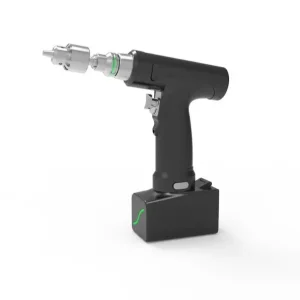

Essential guidance on motor topologies, reprocessing validation, OEM cycles, and quality certifications for procurement teams.
