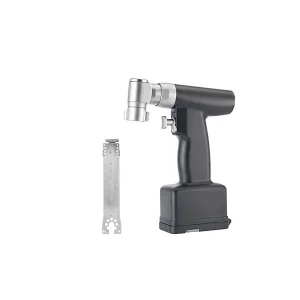
Explore our core engineered handpieces, cannulated drills, oscillating attachments, and reciprocating bone saws fabricated under ISO 13485:2016 and CE-MDR European standards.
Analyzing search intent and operational requirements: Why commercial enterprises and surgical centers deploy air-powered reciprocating saws over conventional electromechanical drivetrains.
In petrochemical refineries, deep offshore platforms, and paint finishing environments, electrical arcing can trigger catastrophic explosions. Air-powered reciprocating saws harness high-velocity compressed gas, creating a 100% cold-cutting mechanism devoid of sparking components.
Within cardiothoracic sternotomy, total hip arthroplasty (THA), and complex revisions, surgical power stability must prevent bone necrosis. Modern pneumatic reciprocating saws maintain a uniform 10,000 to 12,500 SPM (Strokes Per Minute) without motor strain.
Electric cordless systems suffer battery degradation, excessive armature mass, and rapid overheating during prolonged shifts. Pneumatic drivetrains leverage continuous fluid dynamics, running 24/7 in salvage, dismantling, and shipbuilding without thermal downtime.
Quantitative breakdown of air-powered reciprocating drivetrains compared against carbon-brush and brushless direct-drive architectures for manufacturing and surgical evaluation.
| Evaluation Parameter | Air Powered Reciprocating System | Brushless Electric Motor Drive | Legacy Carbon Motor System |
|---|---|---|---|
| Operating Energy Medium | Filtered Clean Air / Medical Nitrogen (6.0–8.0 bar) | 14.4V–24V Li-ion Battery / Digital Inverter | Direct AC Line or Brushed DC Pack |
| Max Stroke Frequency (SPM) | 0 – 14,000 Adjustable via Proportional Valve | 0 – 12,500 Regulated by Microprocessor | 0 – 9,500 Non-linear under load |
| Combustion / Ignition Safety | 100% Spark-Free; ATEX Zone 1/2 Certified | Requires Sealed Explosion-Proof Housing | High Arcing Risk from Carbon Brushes |
| Operating Weight (g) | 650g – 880g (Ultra-light aluminum/titanium) | 1,200g – 1,650g (Handpiece + Battery) | 1,400g – 1,800g (Heavy magnetic core) |
| Heat Generation Profile | Self-cooling via gas exhaust expansion (ΔT < 1°C) | Thermal dissipation managed via heat sink (ΔT ~ 6–10°C) | High thermal loss (ΔT > 18°C after 10 min) |
| Sterilization Survivability | > 500 Autoclave cycles (134°C @ 2.1 bar) | ~ 200–300 Autoclave cycles for sealed coils | Low reprocessing resilience (< 100 cycles) |
| Primary B2B Use Cases | Refineries, Mining, Sterile Surgery, Underwater | Modern Smart Theatres, Portable Field Surgery | Secondary Markets, Cost-Sensitive Tenders |
Optimizing internal multi-vane and fluidic cylinder designs to slash volumetric air consumption (CFM) by 28% without sacrificing stall torque.
Integrating carbon-fiber structural sleeves and DLC (Diamond-Like Carbon) coatings to completely eliminate lubrication oil mist in sterile zones.
Embedding wireless MEMS pressure and vibration transducers into air inlets to deliver predictive blade wear and real-time resection feedback.
Pioneering closed-loop regenerative nitrogen recovery systems for micro-invasive robotic surgeries and sealed hyperbaric chambers.
B2B procurement demands strict compliance with global technical barriers. Our production facilities maintain end-to-end certification matrices for global distribution.
Full conformance with Class I, IIa, and IIb European Medical Device Regulations. Comprehensive Clinical Evaluation Reports (CER) and EUDAMED unique device identifiers (UDI) ensure uninterrupted access to European public hospital tenders and surgical distributors.
Audited under the Medical Device Single Audit Program (MDSAP) encompassing FDA (USA), Health Canada, TGA (Australia), and MHLW (Japan). Every reciprocating saw batch undergoes rigorous vibration testing under ISO 5349-1 to mitigate hand-arm vibration syndrome (HAVS).
Supply chain reliability is verified by localized logistics hubs delivering rapid emergency replacements. Dedicated regional spare parts buffers guarantee 24-hour dispatch for hospitals and 48-hour turnarounds for industrial assembly lines.
From micro-invasive cardiac surgery to subsea decommissioning, examine how the kinematics of pneumatic reciprocating saws solve critical industrial bottlenecks.
Emergency sternal opening demands immediate, controlled cutting through bone without lacerating underlying cardiac structures. Air-driven reciprocating sternum saws with dedicated sternum blade guards provide high-torque cuts at 12,500 SPM, resisting blade stalling even in calcified tissue.
Key Benefit: Dual safety triggers and pneumatic cold-cut dynamics protect fragile internal pericardial boundaries during rapid emergency thoracotomy.
When dismantling chemical transfer lines carrying volatile hydrocarbons, hydraulic or gas torches are strictly prohibited. Air-powered reciprocating saws cut heavy-gauge carbon steel, high-nickel alloys, and ductile iron safely without heating above ignition thresholds.
Key Benefit: Eliminates continuous water quench requirements and nitrogen purging cycles, cutting industrial shutdown costs by up to 45%.
Submerged salvage and emergency extrication teams require cutting equipment that operates underwater without short-circuiting. The sealed pneumatic exhaust vents air away from the cut face, blowing away water and metal debris while maintaining full cutting torque.
Key Benefit: Fully submersible design operational at continuous depths up to 30 meters on high-pressure umbilical feed lines.
Explore our extended series of cannulated drilling modules, oscillating adapters, and high-frequency sternum saws engineered for hospitals and distribution brands worldwide.
Comprehensive engineering, regulatory, and purchasing answers for surgical procurement officers, industrial safety directors, and distributor partners.
Pneumatic reciprocating saws provide a continuous 100% duty cycle without thermal throttling or lithium cell degradation. Because compressed gas expands as it travels through the motor cylinder, pneumatic tools naturally cool themselves during operation. This prevents thermal buildup, reduces handpiece weight by over 40%, and eliminates sparking hazards in volatile or explosive atmospheres.
Medical-grade pneumatic handpieces operate on filtered dry medical nitrogen or clean, oil-free medical air delivered at 6.0 to 7.0 bar (87–102 psi) with an air consumption of 120–160 L/min. Heavy industrial reciprocating saws use standard filtered plant compressed air at 6.2 to 8.0 bar (90–116 psi) with flow requirements between 12 and 18 CFM, typically routed through an inline lubricator-filter regulator (FRL).
Our surgical handpieces are machined from medical-grade anodized titanium and 316L stainless steel, fitted with specialized fluoropolymer dynamic seals. In destructive validation tests under DIN 13972, the transmission mechanism maintains an axial runout of less than 0.03 mm after 200 continuous high-pressure steam autoclave cycles (134°C @ 2.1 bar), proving superior mechanical endurance against thermal shock.
Standard private-label modifications—such as custom quick-connect couplings, stroke adjustments (from 8 mm to 24 mm), personalized laser engraving, and custom sterilizing cases—are completed in approximately 3 weeks. Full custom ODM designs requiring bespoke CFD fluidic cylinder prototyping and custom gearboxes take 8 to 12 weeks from initial CAD design to verified pilot batch.
Yes. We manufacture universal quick-locking chucks and multi-brand adapter hubs compatible with major international blade designs (including Stryker, ConMed, Zimmer, and Synthes interfaces). This cross-compatibility lets hospitals and distributors consolidate their blade inventories and lower overall supply costs.
All our medical devices are certified under EU Medical Device Regulation CE-MDR (EU) 2017/745 for Class I, IIa, and IIb devices, complete with EUDAMED registration. Our manufacturing system complies with ISO 13485:2016 and the international Medical Device Single Audit Program (MDSAP). We also maintain Certificate of Free Sale (CFS) documentation supporting distributor registrations in over 21 countries.
Whether you require CE-MDR certified medical reciprocating saws for orthopedic surgery tenders or heavy-duty spark-free pneumatic saws for industrial dismantling, our engineering team delivers precision, compliance, and guaranteed delivery.