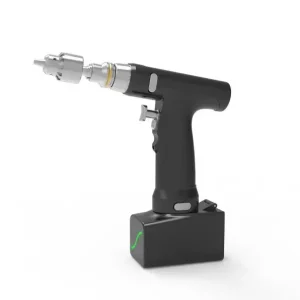
Explore standard-compliant attachments engineered to eliminate runout, reduce acoustic footprint, and withstand harsh thermal autoclave reprocessing.
In cranial access procedures, the interface between the surgical motor handpiece and the perforator drill determines tactile precision, axial runout, and patient safety margins.
Standard operating room sterilization demands dynamic exposure to high-pressure steam at 134°C (273°F) for 18 minutes under prevacuum configurations. Cranial drill attachments face catastrophic degradation if bearing seals and gear assemblies lack resistance to thermal expansion mismatch.
Our manufacturing philosophy utilizes custom-machined 17-4 PH precipitation-hardened martensitic stainless steel and medical-grade titanium alloy couplings. Instead of conventional elastomeric O-rings that dry and fissure over cycle counts, proprietary fluorosilicone hermetic barriers isolate the inner transmission gearsets. This prevents moisture ingress, lubricant leaching, and internal corrosion, preserving high-speed concentricity over hundreds of consecutive hospital sterilization cycles.
Cranial burr hole trephination requires an instant mechanical stop mechanism when traversing inner cranial compacta into the dura mater. The autoclavable cranial drill attachment serves as the vital kinetic decoupling medium between surgical power motors (operating at speeds up to 15,000 rpm) and cranial perforator bits.
Precision planetary gear reducers step down the handpiece motor output to a clinical sweet spot of 800–1,200 rpm, amplifying stall torque up to 16–20 N·m. This allows smooth bone cuts without judder, micro-fractures, or accidental thermal osteonecrosis, ensuring predictable disengagement the microsecond axial mechanical counter-pressure vanishes.
How concentrated precision engineering infrastructure, vertical supply consolidation, and scalable QA deliver unmatched reliability and cost value to world markets.
Equipped with 5-axis Swiss-type multi-tasking turning centers and micro-wire electrical discharge machining (EDM), our production maintains component accuracy within ±0.002 mm. Every shaft, bearing race, and coupling is cut and hardened in-house, preventing vendor bottlenecking.
With an annual production throughput topping 38,000 surgical power sets, raw material procurement costs for bio-compatible titanium and specialized gear lubricants are reduced by up to 35% compared to low-volume European or North American manufacturing facilities.
While traditional medical manufacturers require 8 to 16 weeks to alter an interface or gear torque curve, our fully synchronized prototyping pipelines turn CAD adaptations, 3D simulation analysis, and pilot autoclave testing into completed production runs in around 21 days.
B2B hospital buyers, multinational distributors, and private labeling medtech brands require rigorous compliance documentation, supply security, and verifiable testing.
Supplied with full Technical Documentation dossiers aligned with (EU) 2017/745 Class IIa requirements, clinical evaluation reports (CER), and registered EUDAMED traceability identifiers.
Our quality management architecture is dual-certified under ISO 13485:2016 and MDSAP, accelerating audit acceptance across Canada, USA, Japan, Australia, and Brazil.
Strategic bonded warehouses and safety stock of 200+ quick-dispatch replacement units ensure emergency orders arrive within 24–48 hours for clinical operational continuity.
Precision quick-connect modular fittings are engineered to seamlessly interlock with industry-leading brushless console drive systems without signal error or torque dissipation.
From university trauma theaters to resource-sensitive field hospitals, our cranial attachments deliver tailored reliability across demanding medical workflows.
Scenario: Acute epidural or subdural hematoma requiring urgent trephination.
Value: Rapid attachment docking, instant start at full torque, and automatic perforator safety release eliminate critical access delays within golden triage windows.
Scenario: Extended osteoplastic bone flaps for deep intracranial tumor resections.
Value: Minimal vibration transfer protects underlying dura during adjacent perimeter drilling. Thermal containment keeps cutting bone temperature under 41°C to avoid flap devitalization.
Scenario: High-volume teaching hospitals performing 8–12 cranial cases per suite daily.
Value: Fast flash steam and standard autoclave cycles cause zero optical or mechanical degradation. Resistant to alkaline wash disinfectants and ultra-sonic enzymatic baths.
The global neurosurgical tools market is advancing toward lighter structures, digitized integration, and smarter thermal safeguards.
Modern cranial attachments now feature pre-calibrated geometric tracker collar mounts. These interfaces link directly into optical surgical navigation and robot-assisted burr hole positioners with zero calibration loss.
Embedding autoclavable RFID chips inside the attachment housing allows sterile processing units to digitally log total sterilization cycles, alert maintenance teams before seal degradation, and verify hospital trace compliance.
Utilizing 3D-printed metal hollow lattice casings reduces total handpiece attachment weight by up to 28% while boosting torsional stiffness, markedly reducing hand tremor during critical neurosurgical access.
We supply more than medical hardware. We deliver comprehensive local market clearance documentation, ensuring fast-track registration worldwide.
Ready-to-submit documentation suites tailored for FDA 510(k), Brazil ANVISA, Mexico COFEPRIS, and Saudi SFDA clearance. Includes comprehensive biocompatibility test data per ISO 10993 and risk assessments via ISO 14971.
Our regulatory support team provides translated, compliant Instructions for Use (IFUs), laser-etched laser part numbering, UDI barcodes, and customized sterile pack typography supporting up to 21 local languages.
Receive comprehensive technical servicing training for distributor engineers, calibration test benches, factory replacement gear assemblies, and repair jig kits for regional self-reliant servicing.
Clear, direct answers addressing sterilization reliability, mechanical tolerances, and international contract manufacturing.
Complete surgical tool configurations manufactured to exact clinical tolerances, ready for global distributor ordering and hospital deployment.