

OEM China SNK S2150 Sternum Saw – High-Frequency Brushless Bone Resection Tool from Reliable Suppliers and Factory Manufacturer, Factory
Request Technical Specs
Engineered for high-frequency bone osteotomy, sternotomy, trauma repair, and arthroplasty with verified CE-MDR and ISO 13485:2016 clinical compliance.






A rigorous engineering review of how battery-powered surgical reciprocating saws achieve micro-stroke precision, thermal necrosis prevention, and acoustic mitigation.
In modern orthopedic reconstruction, cardiothoracic sternotomy, and trauma osteotomy, the demand for surgical power tools has outpaced traditional pneumatic line drives and corded mains-powered consoles. Early pneumatic saws, while capable of high torque, severely restricted surgical access through cumbersome gas hoses, posed operating theater hazards from pressurized line rupture, and introduced potential particulate contamination into laminar airflows. The modern battery powered reciprocating saw represents a milestone convergence of aerospace-grade Brushless DC (BLDC) servomotors, lithium-ion battery management systems (BMS), and precision gear trains encased within hermetically sealed, autoclavable enclosures.
From an osteological biomechanics standpoint, cutting bone is fundamentally distinct from industrial machining. Bone tissue, composed of hydroxyapatite embedded in a collagenous matrix, exhibits anisotropic and viscoelastic properties. When subject to reciprocating blade friction, local temperatures exceeding 47°C for more than one minute inevitably induce irreversible osteocyte apoptosis—a clinical failure known as thermal necrosis. This leads to early implant loosening, non-union in osteotomies, and heightened post-operative infection risks. Consequently, contemporary medical manufacturers engineer reciprocating drives that optimize linear stroke excursion (typically calibrated between 2.5 mm and 4.2 mm) combined with variable high frequencies up to 15,000 strokes per minute (SPM). This dynamic balances rapid chip evacuation with minimal thermal friction.
Unlike legacy carbon-brush systems that shed microscopic conductive carbon dust and suffer rapid brush degradation under high mechanical load, brushless DC servomotors employ Hall-sensor-less magnetic rotor positioning. Electronic commutation delivers constant torque across dynamic bone density gradients, eliminating stall risks during deep diaphyseal cortical resections.
A dual-tier strategy separates active lithium cells from aggressive autoclave environments. Tier-one utilizes aseptic battery transfer funnels where the power pack remains unexposed to heat. Tier-two integrates high-temperature Lithium Iron Phosphate (LiFePO4) or specialized ternary cells encased in vacuum-welded PEEK sleeves capable of direct steam sterilization at 134°C.
Handpiece housings machined from medical-grade aviation aluminum alloys or austenitic stainless steel (316L) undergo hard-anodizing passivation. Multi-stage fluoroelastomer O-rings and laser-welded seams prevent pressurized steam, enzymatic detergents, and biological fluids from penetrating gear transmissions and sensor electronics.
Key parameters for hospital procurement boards, orthopedic implant OEMs, and national tenders qualifying long-term supply agreements.
B2B medical procurement of powered bone cutting instruments has matured beyond initial unit acquisition cost. Sophisticated supply chain directors assess capital allocation across a 5-to-7-year life cycle, factoring in maintenance overhead, proprietary blade attachment lock-ins, sterilization cycle resilience, and battery degradation rates. When surveying battery powered reciprocating saw manufacturers, engineering executives evaluate three critical operational metrics:
| Evaluation Parameter | Tier-1 Brushless Systems (e.g., SNK Flagship) | Conventional Carbon-Brush Systems | Impact on Clinical TCO & Operational ROI |
|---|---|---|---|
| Motor Mechanism | BLDC Electronic Commutation | Mechanical Carbon Commutator | Brushless reduces preventative maintenance by 75%; zero risk of carbon particle contamination in bone beds. |
| Autoclave Cycle Life | 200 – 500+ Cycles (134°C Steam / EtO) | 80 – 120 Cycles | Multiplies handpiece operational lifespan by 3x, deferring capital replacement budgeting. |
| Torque Stability | ±1.5% under severe axial cortical load | ±5.0% to ±8.0% (speed droop) | Consistent torque eliminates surgical delays and minimizes micro-fracturing of brittle osteoporotic bones. |
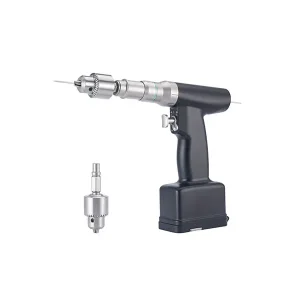
| Coupling Adaptability | Multi-quick-connect (AO, Hudson, Jacobs, Sternum) | Dedicated fixed-chuck tooling | A single power head powers drills, sagittal saws, and reciprocating blades, reducing modular tray inventory by 40%. |
| Sterile Transfer vs Direct Autoclave | Dual-compatibility (Aseptic Funnel or Autoclavable Battery) | Aseptic housing shield only | Provides operational flexibility for emergency trauma setups versus scheduled orthopedic joint replacements. |
How versatile battery reciprocating tools serve as cornerstone infrastructure in orthopedic trauma, cardiothoracic, spine, and oncology surgeries.
In high-energy fractures and corrective osteotomies, the reciprocating blade provides safe deep-margin access in narrow anatomical windows where wide-arc oscillating saws risk damaging periosteum, muscular vessels, and adjacent nerve bundles.
Equipped with specialized sternum guards and reverse-cutting reciprocating blades, our systems ensure instantaneous median sternotomy during emergency cardiac bypass while fully shielding pericardial tissues and aorta structures.
Extracting well-fixed intramedullary femoral stems or tibial trays demands long, flexible reciprocating osteotome blades. High-power brushless torque ensures steady bone-cement interface dissection without cortical perforation.
Wide segmental bone tumor resection demands razor-sharp margin delineation. Reciprocating configurations grant multi-planar clearance, allowing orthopedic oncologists to execute precise curved or bi-planar cuts according to 3D surgical models.
Navigating the transition from legacy MDD to stringent Medical Device Regulation (EU) 2017/745, MDSAP requirements, and technical dossiers.
While many legacy suppliers face export barriers due to the expiration of MDD certificates, our medical manufacturing lines maintain comprehensive MDR technical files verified by EU Notified Bodies for Class IIa/IIb surgical active devices, supported by live EUDAMED registration.
Our production facilities operate under the Medical Device Single Audit Program (MDSAP), satisfying regulatory requirements across five major markets: United States (FDA), Canada (Health Canada), Japan (PMDA), Brazil (ANVISA), and Australia (TGA).
To eliminate clinical downtime, authorized distributors are integrated into an international emergency spares pipeline. With centralized hubs in Shanghai, coupled with regional partner buffer depots in Europe and Southeast Asia, critical tool sets ship within strict SLAs.
Bridging surgical handpieces with robotics, robotic optical tracking, and IoT-driven preventive maintenance telemetry.
Next-generation reciprocating tools integrate calibrated optical tracking arrays and electromagnetic sensors directly into the handpiece chassis. Interfacing with open navigation protocols (e.g., Stryker, Brainlab, Medtronic), the saw automatically decelerates or halts oscillation upon reaching predefined virtual safety boundaries.
R&D is transitioning from liquid-electrolyte cells to all-solid-state ceramic electrolytes. This leap eliminates thermal runaway hazards entirely, allowing handpieces with integrated battery cells to undergo hundreds of 134°C steam autoclave cycles without degrading chemical capacity or risking explosive outgassing.
By monitoring microsecond current fluctuations in the brushless motor windings, onboard microcontrollers distinguish cortical bone from cancellous trabeculae and soft ligaments. When the saw blade exits the far cortex, the system triggers an instantaneous dynamic brake (< 20 ms), virtually preventing soft-tissue laceration.
Explore our extended series of cannulated surgical drills, ultra-torque bone resection motors, and modular reciprocating attachments designed for flexible operating theater configurations.




In-depth responses curated by biomedical engineers and regulatory specialists to assist hospital committees and distributor audits.