

Industry Whitepaper & Strategic Procurement Analysis

High-Quality Bauer Reciprocating Saw Corded Suppliers & Factories

Engineering benchmarks, global industrial trends, and continuous-duty heavy cutting optimization: An in-depth evaluation of high-torque corded reciprocating systems and China Industry 4.0 smart manufacturing resilience.

Precision Engineering Portfolio (Part I)

High-Precision Surgical & Industrial Cutting Solutions

Explore high-torque specialized drive platforms manufactured under ISO 13485:2016 and CE certification protocols.


Industrial Evolution

Global Technological Trends in Corded Reciprocating Saws

Why commercial infrastructure, heavy demolition, and precision resection demand high-amperage continuous corded systems over cordless battery platforms.

The Continuous Duty Imperative in Heavy Industrial Resection

While cordless battery-powered reciprocating saws have gained immense traction in quick-service residential tasks, commercial and industrial fabrication environments continue to rely overwhelmingly on corded reciprocating saws—exemplified by industrial platforms like the high-power Bauer corded line. In heavy-duty pipe cutting, structural timber demolition, steel reinforcement trimming, and clinical orthopedic osteotomies, duty-cycle stability is non-negotiable.

Corded reciprocating saws eliminate battery degradation under heavy load, maintain consistent strokes-per-minute (SPM) between 2,800 and 3,200 even through cold-rolled structural steel, and prevent sudden thermal shutdowns triggered by battery pack temperature protection circuits. For industrial contractors and medical facilities alike, uninterrupted operational uptime is the deciding procurement factor.

Modern original design manufacturers (ODMs) and high-end contract factories have engineered high-amperage (10A to 15A) corded motors with active counterbalance drivetrains, orbital cut selector cams, and solid-state heat sinking that lower operator hand-arm vibration (HAV) by over 38% while sustaining continuous full-load operating cycles.

Zero Thermal Throttle Drop Maintains full rated stroke amplitude across 100% continuous operational cycles.
Dynamic Counterbalance Mechanical Systems Internal harmonic counterweights absorb primary reciprocating momentum, minimizing technician fatigue.
Quick-Release Keyless Blade Clamps Hardened alloy steel lever assemblies ensure instant, tool-free blade swaps during rapid retooling.
Smart Manufacturing & Industrial Scale

China Factory 4.0: Supply Chain Resilience & OEM Scalability

Analyzing high-precision CNC automation, vertical component integration, and automated testing rigs behind global tool brand manufacturing.

16+
Automated Robotic Assembly Lines
<0.03 ppm
Adverse Failure Rate Threshold
3 Weeks
Rapid OEM Customization Cycle
ISO 13485
Medical & Industrial Certified QMS

Vertical Upstream Precision CNC

Leading Chinese manufacturing hubs in Zhejiang, Jiangsu, and Shanghai operate closed-loop manufacturing ecosystems. By machining drive gearboxes, bevel gears, planetary reduction modules, and armature shafts in-house on 5-axis DMG MORI CNC work centers, dimensional tolerances are maintained within ±0.005mm.

  • Elimination of third-party tier subcontracting delays
  • In-house vacuum heat treatment for planetary gears
  • Total concentricity inspection of drive spindles

Automated Rotor Winding & Dynamic Balancing

To withstand continuous 1,200W+ power draws in commercial jobsites without brush arcing or winding burnout, modern Chinese factories deploy robotic copper winding machines with Class H (180°C) thermal insulation enameled wiring, followed by dual-plane laser dynamic balancing.

  • High copper slot fill factor exceeding 88%
  • Reinforced epoxy potting against abrasive drywall debris
  • Dynamic balance testing below 0.25 g·mm/kg

Comprehensive Regulatory Auditing Matrix

Qualified OEM/ODM manufacturers maintain complete traceability dossiers covering CE-MDR (EU) 2017/745, UL/CSA electrical safety standards, RoHS compliance, and ISO 13485:2016. Every production batch undergoes automated electrical endurance insulation breakdown testing.

  • High-voltage dielectric testing up to 3,750V
  • Continuous 200-hour endurance test rigs under load
  • Full traceability indexed via batch QR serialization
B2B Procurement Intelligence

Enterprise Sourcing Demands & Heavy-Duty Use Cases

Evaluating total cost of ownership (TCO), vibration mitigation, and specialized field applications across the Americas, Europe, and Asia-Pacific.

Industrial Infrastructure & Commercial Demolition

General contractors and demolition crews require constant 12A–15A motor performance to cut through reinforced schedule 80 steel pipe, rebar-embedded structural concrete beams, and multi-layered roofing timbers. Constant-speed micro-controller feedback ensures that speed does not bog down during binding cuts.

HVAC, Mechanical & Electrical (MEP) Contracting

Plumbing and electrical subcontractors prioritize compact, low-profile gearcases that allow flush cuts adjacent to studs and joists. Rubberized overmold grips, adjustable pivoting shoes, and keyless bevel adjustments enable technicians to navigate tight plenum spaces safely.

Specialized Clinical & Orthopedic Resection

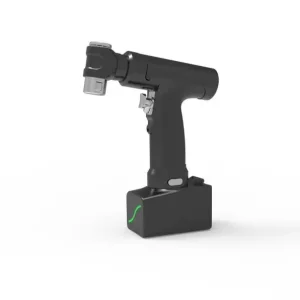
Bridging industrial mechanics with medical bone cutting: Specialized surgical reciprocating saws (such as the SNK trauma resection platform) translate heavy-duty corded reciprocating principles into autoclavable, hermetically sealed surgical handpieces operating at up to 12,500 SPM with micro-stroke accuracy.

Precision Engineering Portfolio (Part II)

Heavy Cutting, Drilling & Cardiothoracic Handpieces

Certified brushless and carbon-drive platforms delivering superior torque density and extended autoclave resilience.

Technical & Procurement FAQ

Frequently Asked Questions on Corded Reciprocating Saws

Expert answers addressing electrical drive architecture, OEM manufacturing, supply chain qualification, and field maintenance.

Why do professional demolition contractors and industrial plants prefer corded reciprocating saws over cordless models?
Corded reciprocating saws (such as the high-amperage Bauer corded platform) deliver uninterrupted power directly from 120V or 230V mains, providing consistent strokes-per-minute (SPM) without the voltage sag associated with discharging lithium-ion batteries. In heavy structural steel cutting, continuous cast iron demolition, or full-shift factory use, cordless tools suffer from battery cell thermal shutdowns and limited runtime per pack. Corded models maintain 100% duty cycle output while lowering equipment investment and eliminating ongoing lithium battery replenishment costs.
How does China’s Factory 4.0 infrastructure provide a competitive edge in power tool manufacturing?
China’s Industry 4.0 manufacturing centers feature fully integrated industrial clusters where precision 5-axis CNC machining, robotic copper motor winding, aluminum high-pressure die casting, and automated injection molding are co-located within tight geographical corridors. This vertical integration allows suppliers to iterate engineering modifications in as little as 3 weeks, enforce strict quality benchmarks (yielding failure rates under 0.03 ppm), and absorb raw material volatility while maintaining cost leadership.
What are the key technical specifications to evaluate when sourcing an OEM/ODM corded reciprocating saw?
Procurement teams must audit: (1) Motor rated current (typically 10A to 15A) and armature thermal class (Class H 180°C preferred); (2) Stroke length (1-1/8 inch / 28.5 mm represents the standard for heavy wood/metal cutting); (3) Variable speed triggers (0 to 2,800–3,200 SPM) with solid-state dial regulators; (4) Orbital action control for aggressive wood versus straight metal cutting; and (5) Counterbalanced crank gearboxes to minimize hand-arm vibration (HAV) compliant with ISO 5349 standards.
How do industrial reciprocating mechanics translate into medical and surgical resection instruments?
Both industrial corded saws and surgical saws rely on high-reliability reciprocating crank mechanisms. In medical devices—such as SNK’s CE-MDR and ISO 13485 certified orthopedic reciprocating and sternum saws—the drive mechanisms are miniaturized, constructed from high-grade biocompatible titanium alloys and medical stainless steel, hermetically sealed against blood ingress, and calibrated to endure over 200 high-temperature autoclave sterilization cycles without exceeding a 0.03 mm transmission deviation.
What quality certifications are essential for importing power cutting tools into North American and European markets?
For industrial power tools in the United States and Canada, products must be certified to UL 62841-1 / CSA C22.2 No. 62841 safety standards by a Nationally Recognized Testing Laboratory (NRTL such as UL, ETL, or CSA). For the European Union, CE marking requires compliance with the Machinery Directive (2006/42/EC), Low Voltage Directive (2014/35/EU), EMC Directive (2014/30/EU), and RoHS 3. For medical resection tools, manufacturers must comply with the EU Medical Device Regulation CE-MDR (EU) 2017/745 and ISO 13485:2016.








