Explore our core powered surgical instruments featuring brushless electronic commutation, high thermal stability, and Class I–IIb regulatory documentation ready for global registration.






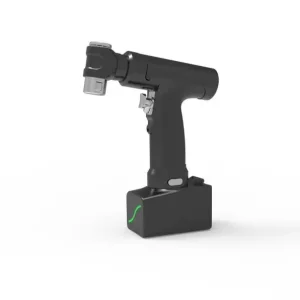
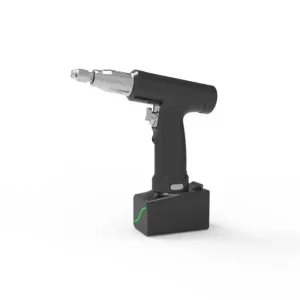
A technical examination of permanent magnet synchronous motors (PMSM) versus legacy carbon-brush systems in high-load orthopedic bone resections.
Traditional orthopedic power tools relying on mechanical carbon brush commutation suffer from friction-induced thermal losses, carbon particle contamination inside sterile fields, and accelerated brush wear under frequent autoclave steam reprocessing. SNK’s cordless brushless reciprocating saw architecture adopts an advanced electronically commutated 3-phase Brushless DC (BLDC) motor topology powered by high-coercivity Neodymium-Iron-Boron (NdFeB) permanent magnets.
By eliminating mechanical brush contact, electrical efficiency rises above 88%, reducing peripheral thermal generation while providing immediate, linear torque feedback across varying bone densities—from dense cortical diaphyseal structures to soft cancellous metaphyseal bone.
Clinical literature conclusively proves that cortical bone exposed to temperatures exceeding 47°C for more than one minute experiences irreversible osteocyte death and microvascular shutdown. SNK’s dynamic blade drive utilizes an eccentric counterbalance balancing arm that converts rotary brushless motion into high-frequency axial reciprocating stroke (up to 15,000 strokes/min) with stroke lengths optimized between 2.8 mm and 3.5 mm.
Equipped with intelligent Battery Management System (BMS) logic featuring overcurrent, undervoltage, and cell balancing safeguards. The quick-release battery casing incorporates a non-sterile transfer funnel mechanism, ensuring OR staff maintain strict sterile barriers without exposing the lithium cells to heat sterilization.
Sterilization failure is the leading cause of premature handpiece decommission in high-volume trauma hospitals. SNK’s medical reciprocating saws utilize custom double-lip Viton fluoroelastomer sealing rings, PEEK high-performance polymer insulation, and vacuum-impregnated epoxy encapsulation over all stator copper windings. Handpieces undergo multi-parameter validation encompassing 200 consecutive cycles of 134°C vacuum steam sterilization at 2.2 bar pressure, maintaining motor insulation resistance above 50 MΩ and blade chuck transmission runout under 0.03 mm.
Quantitative benchmarks evaluated across surgical duty cycles, clinical ergonomics, and lifetime sterilization endurance.
| Performance Parameters | SNK Brushless Cordless Saw | Conventional Carbon-Brush Saws | Pneumatic Compressed Air Saws |
|---|---|---|---|
| Motor Technology | Brushless DC (BLDC) Permanent Magnet | Mechanical Carbon Brush Commutated | Pneumatic Rotary Vane Turbine |
| Sterilization Reprocessing Limit | > 200 Autoclave Cycles (134°C) | 50–80 Cycles before brush failure | 120–150 Cycles (O-ring degradation) |
| Intraoperative Noise Output | < 65 dB(A) at 1 meter | 76–82 dB(A) (Brush friction whine) | 84–92 dB(A) (Exhaust gas noise) |
| Thermal Rise on Continuous Cut | < 2.0 °C (ASTM F2180 Compliant) | > 8.5 °C (High bone necrosis risk) | Cooling effect, but hose drag hazard |
| Intraoperative Mobility | Cordless (Quick-Swap Li-ion Pack) | Cordless / Cable-dependent | Tethered via High-Pressure Air Line |
| Annual Adverse Event Rate | < 0.03 ppm across 16 lines | 1.2 – 2.8 ppm (carbon debris) | 0.8 ppm (air contamination risks) |
| Surgical Navigation Interoperability | Integrated tracking bracket mount | Limited adapter compatibility | Hose interference with optical line-of-sight |
How concentrated industrial clusters in Shanghai and the Yangtze River Delta deliver surgical-grade precision at scalable international cost benchmarks.
Every reciprocating saw housing and titanium eccentric cam is milled from solid aircraft-grade 6061-T6 aluminum and Ti-6Al-4V titanium alloy billet. Using temperature-controlled 5-axis CNC machining centers, dimensional runout is kept within ±0.005 mm, guaranteeing absolute concentricity and eliminating mechanical vibration before assembly.
China refines over 85% of the world’s rare-earth elements. Snaikang harnesses direct partnerships with premier sintered NdFeB magnet producers to utilize high-temperature-grade (N45SH / N38UH) magnets capable of retaining magnetic flux without irreversible demagnetization during repetitive 134°C autoclave sterilization cycles.
Equipped with an internal DIN 13972 surgical tool metrology laboratory, dynamic dynamometer test benches, coordinate measuring machines (CMM), and accelerated life-cycle test chambers. Every production lot undergoes rigorous mechanical stroke verification, acoustic decibel emission profiling, and electrical dielectric insulation audits.
Conventional Western surgical instrument manufacturers require 16 to 24 weeks for OEM modifications. Leveraging China’s integrated vertical component supply chain—encompassing rapid metal 3D prototyping, silicone mold tooling, custom winding micro-stators, and laser etching—SNK completes end-to-end bespoke OEM/ODM handpiece programs (including custom stroke rates, proprietary chuck interfaces, and bespoke battery housings) in approximately 3 weeks, expediting market entry for distributors worldwide.
How national health systems, orthopedic group purchasing organizations (GPOs), and B2B medical distributors evaluate supplier credibility and supply chain resilience.
Tender specifications demand guaranteed uptime. SNK maintains 200+ finished standby power tool sets in warehouse inventory, enabling urgent European surgical kit response within 48 hours and Asia-Pacific dispatch within 24 hours.
Eliminate tender evaluation delays with complete technical files: Bio-compatibility reports (ISO 10993), electrical safety testing (IEC 60601-1, IEC 60601-1-2 EMC), cleaning/disinfection validations, and clinical evaluation reports (CER).
Hospital biomed departments face exorbitant repair charges from legacy brands. SNK provides accessible modular spare parts, universal blade attachments, and straightforward servicing protocols that reduce handpiece 5-year TCO by over 45%.
Tailored solutions for multinational orthopedic implant manufacturers seeking branded resection power tool kits. We offer custom pantone color anodizing, corporate laser marking, custom software speed curves, and custom sterilization case design.
Fully compliant with EU-MDR, FDA regulations, and regional market registrations to safeguard your commercial distribution channels.
While many overseas suppliers struggle with the phase-out of the old Medical Device Directive (MDD), SNK has completed full CE-MDR conformity assessment under Notified Body auditing. Our Class I, IIa, and IIb certifications are active, and every device is registered on EUDAMED with unique device identification (UDI) laser-etched barcodes for clinical batch traceability.
Our quality management system is audited under the Medical Device Single Audit Program (MDSAP), satisfying regulatory requirements across the USA, Canada, Brazil, Japan, and Australia. In addition, we maintain authorized Free Sale Certificates (FSC) filed for 21 emerging markets across LATAM, the Middle East, and Southeast Asia to fast-track regional import licenses.
We provide localized technical assistance through comprehensive service manuals, step-by-step video training for distributor biomedical engineers, localized multilingual Instructions for Use (IFUs in English, Spanish, French, German, Arabic, and Russian), and direct access to our Shanghai engineering escalation team.
Key transformative shifts revolutionizing orthopedic surgery theaters over the 2026–2030 cycle.
Modern bone cutting is shifting toward robotic-assisted alignment. Next-generation SNK brushless platforms integrate high-frequency tracking arrays and open communication protocols compatible with top-tier optical and electromagnetic surgical navigation systems.
Micro-controller embedded motor drivers now detect transitions between hard cortical bone and softer cancellous or soft tissue boundaries by analyzing instantaneous current feedback (closed-loop FOC control), stopping the blade automatically to prevent tissue laceration.
Surgeon hand fatigue during multi-hour revision arthroplasties has driven handpiece mass reduction. By transitioning outer shells to carbon-fiber reinforced PEEK and magnesium-titanium alloys, overall tool weight has been reduced by 22% while retaining high impact resistance.
Global hospitals are actively phasing out toxic Ethylene Oxide (EO) gas sterilization due to environmental hazards. Developing handpieces capable of surviving repeated high-pressure vacuum steam sterilization (134°C) is now the primary qualification requirement.
Engineered for versatile deployment across acute operating theaters, high-volume elective centers, and field trauma situations.
In high-energy traffic trauma cases and open fracture debridements, surgeons require prompt, clean cortical cuts without thermal damage to ensure successful plate-and-screw stabilization. SNK reciprocating saws provide narrow blade kerfs, preserving healthy osseous margins for rapid bone healing.
Utilizing our dedicated sternum saw attachments and specialized blade guards, the S2150 motor delivers stable, high-frequency linear reciprocation for median sternotomies, preventing retrosternal soft tissue and vascular lacerations during urgent cardiac bypass surgeries.
Removal of well-fixed femoral stems and cemented implants during revision hip and knee surgeries calls for slender, high-strength reciprocating blades. SNK’s high-torque brushless drive powers extended flexible blades through bone-cement interfaces with pinpoint control.
Paired with precision cranial drill and high-speed cranial mill adapters, the modular handpiece platform transitions seamlessly from cranial flap bone resection to micro-perforation, reducing the total instrument tray footprint in neurosurgical suites.
In military tactical medicine and disaster relief zones lacking stable AC power or compressed medical air, cordless lithium-powered brushless reciprocating saws provide autonomous operating capability, packed in compact, waterproof tactical cases.
Tier-1 veterinary teaching hospitals and companion animal surgical centers use SNK power tools for canine and feline TPLO (Tibial Plateau Leveling Osteotomy) and fracture repair, benefiting from human-grade precision at accessible veterinary budget tiers.
Complementary surgical attachments and standalone drills engineered on the same brushless drive technology for seamless intraoperative versatility.






Comprehensive engineering, sterilization, and regulatory insights directly answered by our Chief Quality Officer and R&D engineering leads.
