Explore certified surgical bone resection and drilling solutions built to high medical thresholds for reconstructive and trauma procedures.



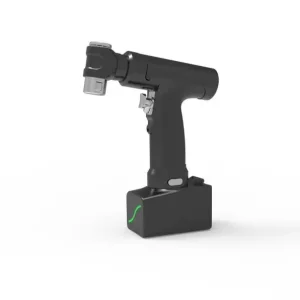




A comprehensive examination of how the transition toward 24V architecture has redefined bone-resection ergonomics, mechanical efficiency, and surgical safety margins.
The orthopedic reciprocating saw market has historically faced thermal throttling and rotational droop under heavy cortical bone resistance. Legacy 9.6V and 14.4V systems required higher amperage to sustain resection torque, resulting in fast battery degradation and localized handpiece heating.
By leveraging an advanced 24V power platform, modern surgical systems reduce current draw by up to 40% for the same watt-load output. This dramatic drop in current mitigates resistive heat dissipation inside the sterile envelope, keeping thermal signatures under 41°C per ASTM F2180 specifications.
Traditional carbon brushes introduce particulate shedding risks, friction losses, and rapid mechanical degradation over aggressive sterilization protocols. The brushless architecture employed in Flex 24V reciprocating systems uses hall-sensor-less magnetic commutation, achieving high efficiency.
Thermal osteonecrosis occurs when local bone temperatures exceed 47°C for more than one minute, compromising implant osseointegration and postoperative stability. Our reciprocating drive profiles feature sinusoidal motion damping and harmonic balancing.
Optimized stroke mechanics clear bone debris along the cutting path, minimizing friction and mechanical shear. The result is rapid, atraumatic osteotomies with stable margins for joint reconstruction and trauma fixation.
Institutional buying committees, medical OEMs, and regional distributors evaluate surgical power systems across four fundamental metrics.
Global tenders now enforce CE-MDR (EU) 2017/745 Class IIa/IIb classifications and ISO 13485:2016 quality systems. Handpieces must maintain verifiable EUDAMED identifiers and complete clinical safety files.
Operating suites favor unified power hubs that interchange between reciprocating, oscillating, sternum, and cannulated drill adapters without requiring redundant drive assemblies.
Instruments must withstand steam autoclave cycles (134°C at 2.2 bar) and ethylene oxide (EO) without drive degradation or seal failure across high operating frequencies.
Hospitals balance initial procurement costs with maintenance expenses. Brushless motors avoid ongoing brush replacement schedules, significantly reducing operational downtime.
Tailored mechanical implementations supporting precise bone resection across complex trauma, joint revision, and spine procedures.
During revision total hip arthroplasty (THA) or complex fracture reductions, removing stubborn cement mantles and preparing stable bone beds requires fine reciprocating action. Our high-rate reciprocating drive enables rapid longitudinal cuts with minimal collateral soft-tissue disturbance.
Cardiothoracic procedures rely on high-speed reciprocating saws to perform rapid median sternotomies without snagging underlying pleura. Dedicated adapters provide integrated blade guards and steady stroke delivery under heavy clinical pressure.
For medical brand owners seeking white-label or turnkey surgical power lines, we provide full platform customization. Tailor torque curves, handpiece weights, branding, collet geometry, and packaging formats in our DIN 13972 testing facility.
Ensuring frictionless border clearance, tender compliance, and localized post-market surveillance across 80+ partner territories.
Our manufacturing sites operate under ISO 13485:2016 and MDSAP oversight. Handpieces comply with CE-MDR (EU) 2017/745, alongside Free Sale Certificates filed across 21 countries, streamlining regulatory approvals for local importers.
To reduce hospital downtime, strategic inventory hubs maintain standard components ready for rapid fulfillment. We deliver under 48-hour response windows across Europe and under 24 hours within the Asia-Pacific territory.
Every handpiece bears laser-etched UDI numbers traceable to factory production lots. Distributors receive full technical dossiers, sterilization validation reports, and localized multilingual IFUs.
Strategic directions guiding the future generations of surgical reciprocating instruments and power systems.
Our upcoming platform integrates active tracking arrays directly into reciprocating handpieces, linking with computer-assisted surgery (CAS) and optical navigation suites to safeguard surgical boundaries in real time.
Next-phase control loops monitor back-EMF variations at 1 kHz to differentiate between cortical margins and cancellous bone, automatically dialing back stroke velocity upon boundary breakthrough.
Moving toward solid-state and lithium titanate battery chemistries will increase capacity density while withstanding direct high-temperature autoclave cycles without battery removal.
Complete surgical tool configurations, neuro adapters, and high-frequency saws designed for clinical workflows.





Key information regarding battery configurations, sterilization stability, motor choices, and OEM/ODM engagement models.
The 24V architecture provides higher torque reserve while lowering the electrical current demand during continuous cutting. This keeps operating temperatures below tissue necrosis levels (41°C) while preventing motor stalls in dense cortical bone.
Brushless motors use electronic commutation without friction contacts, generating less internal heat, eliminating carbon particle shedding, and enduring repeated steam autoclave cycles without the brush wear common in standard motors.
Our equipment is produced in ISO 13485:2016 and MDSAP certified cleanrooms, carrying full CE-MDR (EU) 2017/745 certificates across Class I, IIa, and IIb devices, complete with EUDAMED listings and Free Sale Certificates for 21 countries.
Handpieces and blade drive assemblies are validated for steam autoclave (134°C, 2.2 bar) and ethylene oxide (EO) reprocessing, maintaining transmission clearances below 0.03 mm after 200 consecutive high-pressure cycles.
Standard OEM modifications covering private labeling, casing colorways, and stroke speeds run on an agile 3-week timeline, supported by automated manufacturing lines and our in-house DIN 13972 testing lab.
Emergency replacement surgical kits dispatch within 24 hours. Regional hub warehouses maintain 200+ backup systems, providing response windows under 48 hours in Europe and under 24 hours across Asia-Pacific.
