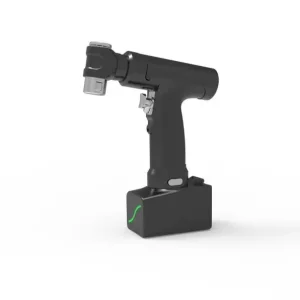
Direct from our Shanghai manufacturing facility: precision brushless drives, specialized surgical adapters, and cannulated cutting instruments built to DIN 13972 accuracy benchmarks.








Understanding the biomechanical challenges of cannulation, bone chip evacuation flutes, and heat management in modern trauma and reconstruction orthopedics.
Hollow core drill bits (cannulated drill bits) allow surgeon-directed guidance over pre-placed Kirschner wires (K-wires) ranging from 1.0 mm to 3.2 mm outer diameter. Maintaining lumen concentricity during high-speed rotation is paramount.
Bone necrosis occurs when cortical bone temperature exceeds 47°C for more than one minute during reaming. SNK cannulated tooling is engineered specifically to suppress thermal build-up under high procedural load.
Surgical hollow drill bits must endure extreme torsional shear forces while surviving hundreds of harsh autoclaving and ethylene oxide (EO) reprocessing cycles without structural degradation or micro-pitting.
How medical device OEMs, tier-1 hospital procurement groups, and distribution conglomerates evaluate hollow core drill bit suppliers in 2026.
With MDD certifications fully expiring, global distributors cannot accept legacy documentation. European buyers require EUDAMED-registered Class IIa/IIb technical dossiers with post-market clinical follow-up (PMCF) data.
Hollow core drill bits require variable drive dynamics. Low-speed reaming requires high torque (up to 20 N·m at 300 RPM) without stalling, whereas pilot drilling demands 1,600 RPM high-speed stability.
Tender boards in the Middle East, Latin America, and Southeast Asia are moving away from single-use disposable models toward high-durability reusable bits backed by verified sterilizability cycles.
Orthopedic implant manufacturers seek turnkey instrument kits matching their proprietary screw pitches. Factory-direct flexibility enables custom shank geometries, laser markings, and customized caddies.
Inside SNK's Baoshan, Shanghai smart production plant: automated 5-axis machining centers, ISO 14644-1 cleanrooms, and intelligent quality control matrices.
Manufacturing hollow core drill bits requires deep-hole gun-drilling followed by synchronous multi-axis milling to preserve wall concentricity along lengths exceeding 300 mm.
Every batch undergoes destructive and non-destructive quality screening. Our internal metrology laboratory ensures zero tolerance escapes before sterile or bulk packaging.
Modern surgical suppliers cannot afford downtime. SNK maintains 200+ ready-to-dispatch core orthopedic power tools and over 50,000 cannulated drill bit blanks in standing buffer stock.
Engineered for procedural precision across diverse surgical disciplines, from high-energy trauma centers to minimally invasive spine operating suites.
Used in conjunction with our high-torque cannulated drills (SNK 20 N·m / 300 RPM systems) for guided distal locking screws in femoral and tibial intramedullary nails. The hollow lumen slides smoothly over 1.5–2.0 mm guide wires without cortical skiving.
Clinical Benefit: Reduces radiation exposure by accelerating cross-screw trajectory location under fluoroscopy.Spinal pedicle screw preparation requires tight tolerances to prevent medial or lateral pedicle wall breaching. SNK hollow core drill bits feature calibrated depth markings and self-centering cutting tips specifically engineered for narrow tubular retractor corridors.
Clinical Benefit: Delivers high cutting tactile feedback while holding temperatures below neuro-damaging thresholds.Compatible with Hudson and modified Trinkle couplings, our large-diameter hollow reamers and core drills prepare the proximal femur and acetabular bed with uniform spherical geometries without tearing soft cancellous bone stock.
Clinical Benefit: ASTM F2180 verified thermal limitation ensures superior cementless osseointegration.| Specification Parameter | SNK Medical Premium Series | Standard Market Benchmark | Clinical / Operational Benefit |
|---|---|---|---|
| Lumen Concentricity Runout | ≤ 0.02 mm | ≤ 0.06 - 0.08 mm | Prevents K-wire jamming and cortical wall skiving |
| Core Raw Material | Custom 455 / 465 Medical Stainless | Standard 304 / 420 Stainless | High yield strength; virtually immune to torsional fatigue |
| Thermal Rise at 1,200 RPM | < 2.0 °C Rise (ASTM F2180) | 4.5 °C - 7.0 °C Rise | Eliminates danger of bone osteocyte thermal death |
| Autoclave Durability | 200+ Validated Cycles (134°C) | 50 - 100 Cycles | Reduces hospital instrument replacement costs by >50% |
| Defect Rate & Traceability | < 0.03 PPM / Laser UDI Marking | Industry Avg ~2.5 PPM | Complete MDR audit security and surgeon confidence |
Critical answers for hospital biomedical directors, procurement committees, and orthopedic distributor product managers.
Hollow core drill bits (also known as cannulated drill bits) possess a precision-machined continuous central lumen designed to track over a guide wire (typically 1.0 mm to 3.2 mm K-wire). This allows surgeons to place implants, lag screws, or intramedullary nails with sub-millimeter accuracy along a verified fluoroscopic trajectory. The central channel also enables saline flushing to clear cortical bone swarf, significantly lowering surgical cutting friction and thermal build-up.
Torsional fracture in cannulated instruments occurs when the wall thickness is uneven due to gun-drilling runout or when metallurgy lacks toughness. SNK uses vacuum-melted Custom 455 and 465 medical martensitic stainless steel aged under inert atmosphere to achieve an optimal balance of hardness (50–54 HRC) and fracture toughness. Our Swiss longitudinal lathes ensure lumen concentricity within ≤0.02 mm, preventing localized stress concentrations under aggressive reaming loads up to 20 N·m.
Yes. SNK designs its quick-coupling connections to international ISO and DIN standards. We offer interchangeable shanks compatible with AO (Synthes-style) quick coupling, Hudson, Modified Trinkle, Zimmer, and Jacobs chuck systems. Our drill attachments also seamlessly interface with SNK brushless power systems, ensuring complete versatility for global distributor catalogs.
Every OEM/ODM order is accompanied by a comprehensive technical documentation dossier. This includes CE-MDR Declaration of Conformity under Regulation (EU) 2017/745, ISO 13485:2016 factory audit certificates, raw material mill test certificates (MTR) verifying biocompatibility under ISO 10993, cleaning and sterilization validation protocols (steam autoclave and EO), and DIN 13972 accuracy verification reports.
Thanks to our flexible intelligent manufacturing setup in Shanghai, prototype evaluation is typically delivered within 7 to 10 working days. Full-scale production lots with custom laser markings, depth gradations, and custom sterilization trays are manufactured and dispatched within 3 weeks, compared to the conventional European and North American lead time of 8 to 12 weeks.
Explore our low-speed reamers, lightweight carbon handpieces, oscillating bone saws, and specialized surgical attachments engineered for rigorous daily clinical usage.