Configured for demanding surgical bone cutting, joint arthroplasty, and precision trauma interventions. Explore our high-speed, sterilizable power drive attachments and adapters.








How advanced robotic assembly, complete supply chain localization, and medical-grade precision CNC machining create unbeatable quality-to-cost economics for international OEM partners.
Unlike regional assemblers reliant on multi-tiered international logistics, our Shanghai industrial manufacturing campus operates with 100% domestic supply integration. From rare-earth neodymium brushless magnet processing to Swiss-type longitudinal turning for micro-gears, raw materials enter our foundry and emerge as packaged Class II surgical saw sets. This end-to-end integration eradicates shipping bottlenecks and reduces procurement lead times to an agile 3-week window.
Our workshop houses high-precision DMG MORI 5-axis simultaneous machining centers and Sodick wire-cutting EDM equipment operating inside temperature-stabilized Class 7 cleanrooms. Reciprocating mechanical linkages require tight geometric tolerance (±0.003 mm) to eliminate non-axial radial runout. This rigorous mechanical accuracy minimizes mechanical backlash, prevents chatter at 12,500 SPM, and delivers exceptionally clean osteotomies without bone debris splintering.
Navigating global medical barriers requires audited proof, not assumptions. Our facility operates strictly under ISO 13485:2016 and MDSAP across five major regional health authorities. Our complete reciprocating and oscillating saw families are fully registered under EU CE-MDR 2017/745 (covering Class I, IIa, and IIb devices). Every unit leaves with authenticated EUDAMED traceability records, bio-compatibility certifications, and comprehensive Free Sale certificates for 21 countries.
Industrial-grade reciprocating saws must achieve a precarious equilibrium: delivering immense cutting torque to slice through dense cortical bone while strictly limiting thermal osteonecrosis.
During orthopedic procedures (such as total knee arthroplasty, femoral neck osteotomies, or median sternotomies), bone temperature exceeding 47°C for longer than one minute leads to irreversible thermal necrosis, impaired cellular regeneration, and subsequent implant loosening. Standard industrial saws lack thermal regulation algorithms; SNK industrial reciprocating saws integrate a high-frequency brushless drive featuring dynamic load-sensing torque adjustment.
By coupling continuous micro-oscillation frequencies (up to 12,500 SPM) with precision rake-angle saw blades, the tool maximizes chip evacuation per stroke. According to standardized ASTM F2180 testing, our handpiece sustains an interface temperature strictly below 41°C, even through dense cortical femur resections without supplemental fluid irrigation.
Medical and cleanroom environments enforce severe reprocessing protocols: saturated steam sterilization at 134°C under 2.2 bar pressure. Traditional carbon motors degrade due to moisture penetration, bearing oxidation, and carbon brush disintegration. SNK’s brushless reciprocating handpieces incorporate dual-barrier fluoroelastomer O-rings, vacuum-potted magnetic stators, and aerospace-grade ceramic hybrid bearings.
Transmission deviation tests verify that after 200 high-temperature, high-pressure autoclave cycles, axial stroke runout remains below 0.03 mm, guaranteeing repeatable surgical performance over a multi-year service lifecycle.
Comparative validation testing under ISO 6475 and DIN 13972 clinical bone cutting conditions demonstrates the mechanical superiority of our industrial reciprocating saw line:
| Kinematic Parameter | SNK Industrial Grade | Industry Benchmark |
|---|---|---|
| Stroke Frequency (SPM) | 0 – 12,500 Adjustable | 8,000 – 10,000 Static |
| Stroke Amplitude | 3.2 mm Optimized | 2.5 mm – 4.5 mm Runout |
| Interface Heat Rise | <2.1 °C Elevation | >5.8 °C Elevation |
| Operating Noise Level | ≤ 62 dBA Whisper Mode | 78 – 85 dBA Harsh |
| Torque Deviation | ±1.5% Constant Flow | ±4.8% Variable Load |
| Reprocessing Lifespan | 200 Autoclave Cycles | 80 – 100 Cycles Limit |
*Data validated in SNK's DIN 13972 accuracy testing lab using artificial cortical bone substrate blocks (40 PCF polyurethane).
From trauma operating theaters to precision biomedical prototyping, our reciprocating platform provides custom motor curves, specialized chuck adapters, and ergonomic handpieces.
In acute trauma cases (e.g., compound fractures, pelvic reconstruction, non-union bone decortication), surgeons require swift resection without soft-tissue snagging. Our quick-coupling reciprocating saw attachments enable instant rotational angle adjustments (360° blade indexing in 45° increments). This enables orthopedic surgeons to navigate deep surgical corridors, such as acetabular exposures, without obstructing direct visual lines of sight or stressing surrounding neurovascular bundles.
For urgent open-heart procedures, emergency access speed must coincide with absolute sternal depth control to avoid pericardial laceration. The S2150 system integrates a dedicated sternum guard footpiece attached directly to the reciprocating assembly. Operating at high stroke rates, it delivers uniform longitudinal bisection of the sternum in under 12 seconds, reducing cardiac entry trauma and promoting post-operative sternal bone union stability.
Veterinary orthopedic surgeons performing Tibial Plateau Leveling Osteotomy (TPLO) on companion animals encounter uniquely dense canine cortical structures. Standard consumer saws cause microfractures and thermal necrosis. Our dedicated TPLO reciprocating and radial adapters provide constant low-speed, high-torque output, sustaining clean radial crescentic cuts that speed recovery in canine patients.
Beyond standalone handpieces, SNK solves operational fragmentation for healthcare authorities. Hospital procurement directors frequently struggle with incompatible batteries, differing sterilization trays, and proprietary blade lockouts from disparate vendors. SNK offers a Universal Power Chassis: one single brushless motor module powers reciprocating saws, sagittal oscillating saws, high-speed cannulated drills, cranial mills, and acetabular reamers. This consolidated ecosystem cuts hospital capital expenditure by 40%, lowers sterile processing technician overhead, and slashes stock-keeping unit (SKU) complexity across operating theaters.
Navigating overseas supplier qualification demands comprehensive verification across engineering capability, material traceability, and regulatory readiness.
Tender boards across the European Union now reject legacy MDD certificates. Corporate purchasers verify complete Technical Documentation dossiers meeting (EU) 2017/745 Annex II & III. Every SNK reciprocating handpiece carries a laser-etched UDI-DI (Unique Device Identifier) mapped to EUDAMED databases, providing distributor legal protection and frictionless customs clearance through Rotterdam, Hamburg, and beyond.
Biomedical saw blades and drive shafts undergo severe cyclic fatigue. Industrial purchasers require raw material test certificates (MTR) verifying medical-grade 17-4PH or 316L stainless steel per ASTM F899 standards. Our factory retains spectrometer melt-lot records for every production batch, ensuring drive components will not experience brittle catastrophic shear under maximum bone resection resistance.
Supply continuity defines distributor profitability. With regional distribution centers maintaining >200 pre-calibrated standby sets, European orders dispatch in ≤48 hours, while Asia-Pacific hub orders fulfill within ≤24 hours. For customized OEM lines, production turnaround averages 21 calendar days—less than half the conventional European manufacturing lead time.
The intersection of smart mechatronics, high-density power cells, and surgical robotics is transforming traditional reciprocating instruments into connected medical devices.
As robotic-assisted orthopedic surgery (RAOS) systems gain global market share, hand-held saws are adopting digital interfaces. SNK’s latest research models incorporate low-latency CAN-bus and optical tracking geometry directly into the handpiece casing. This allows surgical robots to dynamically regulate reciprocating stroke speeds and enforce haptic "virtual safety boundaries", preventing inadvertent cuts into posterior cruciate ligaments or popliteal arteries.
Traditional lithium battery packs cannot endure steam autoclave cycles and require complex non-sterile transfer funnel protocols. The sector is moving rapidly toward solid-state and high-temperature lithium-iron-phosphate chemistries sealed within polyether ether ketone (PEEK) enclosures. SNK is actively validating entire battery-in-handpiece assemblies that withstand autoclaving alongside titanium saw blades, eliminating non-sterile OR transfer workflows.
Modern hospital biomedical engineering departments face unexpected surgical downtime when handpieces fail during active procedures. Our forthcoming generation features integrated BLE (Bluetooth Low Energy) microchips that track cumulative cycle counts, motor thermal histories, and gear vibration signatures. Handpieces automatically transmit maintenance alerts to biomedical teams when internal seals approach their 200-cycle threshold, preventing intraoperative failures.
Detailed answers addressing engineering parameters, regulatory documentation, private labeling, and global logistics.
Broaden your distribution portfolio with our high-power reciprocating saws, oscillating bone cutters, and rapid-connect modular surgical adapters.




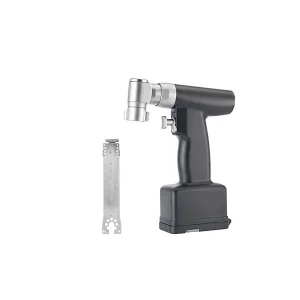
Schedule an engineering review, request 3D CAD step files, or receive complete CE-MDR conformity documentation and evaluation samples for hospital tender qualification.
