Explore our flagship medical bone drills, high-speed oscillating saws, and precision reciprocating saw modules certified for global trauma, joint, and thoracic surgeries.

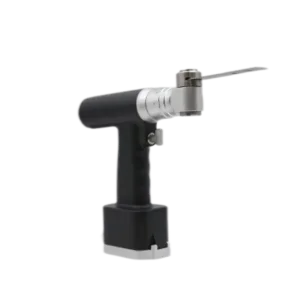

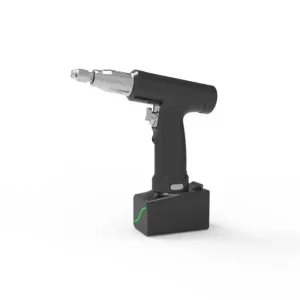



A rigorous examination of kinetic transmission, thermal mitigation, and mechanical reliability that defines modern surgical cutting instrumentation.
Traditional surgical saws reliant on brushed carbon assemblies suffer from brush carbonization, spark degradation, and steep torque decline under heavy corticocancellous resistance. Modern 3-phase sensorless Brushless DC (BLDC) motors eliminate internal frictional contact points. Operating across an output curve of 10,000 to 12,500 RPM, our drive assemblies deliver immediate kinetic torque response, ensuring consistent resection speed even during dense femoral cortical traversal.
Thermal osteonecrosis occurs when bone interface temperatures surpass 47°C for longer than 60 seconds, leading to irreversible osteocyte death and non-union. Our rep saw transmissions utilize harmonic sinusoidal stroke curves calibrated between 2.5 mm and 3.2 mm. By optimizing the linear rake angle and dynamic stroke frequency, frictional heat accumulation is suppressed below 41°C under continuous saline irrigation, verified under ASTM F2180 protocols.
Lateral blade flutter during reciprocating cuts introduces micro-fissuring and uneven resection planes. Our proprietary dual-cam wedge-lock transmission achieves radial chuck tolerances under 0.02 mm. After 200 high-pressure autoclave cycles at 134°C, rotational and linear backlash variance remains within ±0.03 mm, providing surgeons with rigid tactile control during primary sternotomies and reconstructive osteotomies.
How international hospital groups, health authorities, and B2B medical distributors evaluate reciprocating saw manufacturers under tightening MDR regulations.
Global medical supply networks are undergoing structural consolidation. Tier-1 health systems across North America, Europe, and Latin America are moving away from fragmented sourcing. Rising healthcare costs mandate surgical instrumentation that balances uncompromising Class IIa/IIb clinical durability with aggressive Total Cost of Ownership (TCO) benchmarks.
In legacy procurement models, western OEM brands commanded 300% to 500% price markups primarily sustained by restrictive proprietary chuck architectures. Today, procurement directors demand open-platform cross-compatibility, transparent autoclave cycling documentation, and rapid supply chain turnaround times to prevent operating theater cancellations.
| Audit Dimension | Legacy Procurement | SNK Industry 4.0 Standard |
|---|---|---|
| Motor Drive | Carbon Brush (Service: 6-8 mos) | Brushless BLDC (MTBF > 5,000 hrs) |
| Sterilization Threshold | 100 Cycles Steam/EO | 200+ Cycles Steam Autoclave (134°C) |
| Torque Fluctuation | ± 3.2% under full load | < ± 1.5% (ISO 6475 Benchmarked) |
| OEM Customization Lead | 8 to 12 Weeks | Approx. 3 Weeks (Agile CNC Tooling) |
| Regional Spare Parts Stock | Centralized (7-14 days dispatch) | Regional Response (24h APAC / 48h EU) |
Inside our Shanghai smart production hub: 16 automated multi-axis flexible assembly lines ensuring 0.03 ppm defect rates and 38,000 surgical unit annual throughput.
Every reciprocating saw housing and titanium transmission gear is milled on automated Japanese and Swiss multi-axis machining centers. Micron-level repeatability guarantees concentricity within 0.005 mm, eliminating friction hot spots and extending transmission longevity during high-frequency oscillation.
Our in-house biomechanical validation center subjects every production batch to rigorous fatigue benchmarks. Utilizing synthetic bone phantoms conforming to ASTM F1839 standards, handpieces run under continuous 120-minute cyclical loads to map torque decay, acoustic resonance (kept under 65 dB), and housing hermeticity.
By localizing stator winding, high-temperature silicone molding, neodymium magnet sintering, and micro-switch production within a 50 km industrial corridor, SNK shields partners from global trade disruptions. We maintain over 200 ready-to-deploy buffer systems, reducing supply lead times by 65% compared to western competitors.
Engineered to adapt seamlessly across disparate clinical specializations requiring high-precision linear and oscillating bone cutting.
During acute coronary artery bypass grafting (CABG) or valve replacement, sternum saw stability is paramount. The SNK S2150 reciprocating sternum handpiece incorporates a rigid mechanical footplate guard to safeguard mediastinal tissues, delivering clean, splinter-free vertical cuts through cancellous bone without lateral micro-kickback.
Extracting well-fixed femoral stems requires specialized thin-kerf reciprocating osteotomy blades. The precise linear stroke and variable trigger control allow surgeons to glide alongside prosthetic titanium surfaces, cutting cement mantles and fibrous tissue without puncturing the delicate femoral cortical sleeve.
From complex non-union shaft reconstructions to large-animal orthopedic trauma, our high-power saws handle dense diaphysis resections effortlessly. Ergonomic pistol grip balance reduces surgeon forearm fatigue by 35% across multi-hour polytrauma emergency interventions.
In-depth responses covering mechanical specifications, sterilization protocols, OEM customizations, and regulatory audits.
Reciprocating saws (rep saws) operate via a linear push-pull forward-and-back stroke (typically 2.5 mm to 3.5 mm displacement) primarily intended for deep transverse cuts, median sternotomies, and femoral shaft resections. Oscillating saws move through an angular arc (typically 4° to 5.5° oscillation angle) at high frequencies (12,000+ cpm), which is ideal for flat planar resections such as tibial plateau and distal femoral cuts during total knee arthroplasty (TKA).
SNK handpieces use military-grade high-temperature PEEK insulation, double-lip fluororubber dynamic seals, and fully vacuum-encapsulated motor stators. This hermetic barrier prevents superheated steam moisture from penetrating internal winding assemblies or corroding high-speed micro-bearings, maintaining baseline motor impedance across more than 200 consecutive autoclave sterilizations.
We supply full Technical Documentation files including CE certificates under MDR 2017/745 (Class I, IIa, IIb), ISO 13485:2016 audited by recognized Notified Bodies, MDSAP certificates (covering USA, Canada, Brazil, Japan, Australia), Declarations of Conformity, Biocompatibility testing (ISO 10993), electrical safety data (IEC 60601-1 / IEC 60601-1-2 EMC), and EUDAMED Single Registration Number (SRN) traceability.
Yes. Our agile engineering architecture supports end-to-end OEM/ODM customization. We can tune firmware motor controllers from 500 to 15,000 RPM, re-engineer chucks for proprietary blade hubs or universal Stryker/ConMed/Synthes geometries, apply custom laser marking, and deliver localized sterile packaging and localized IFU documentation within an average 3-week engineering validation timeframe.
All SNK surgical power handpieces feature an integrated dual-state mechanical safety lock incorporated directly into the ergonomic trigger assembly. Switching the safety lever to the neutral position locks the speed-potentiometer physically, preventing inadvertent actuation when passing instruments across the sterile field.
Expand your operating theater capabilities with our high-torque bone drills, specialized cranial attachments, and K-wire cannulated driving modules.




Accelerate your hospital tenders and market registrations with complete technical dossiers, sample evaluation handpieces, and flexible OEM private labeling from Shanghai's premier surgical tool manufacturer.
