
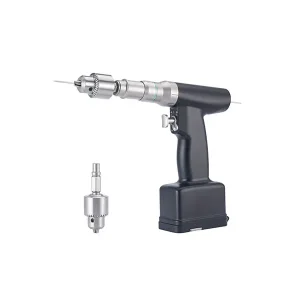
Direct manufacturer supply of precision cannulated drills, micro saws, and cranial-thoracic modular handpieces manufactured under Class 7 cleanroom protocols.







Median sternotomy remains the gold-standard access pathway for coronary artery bypass grafting (CABG), aortic root reconstruction, and complex valve interventions. However, clinical studies associate power-saw induced thermal necrosis and structural raggedness with Deep Sternal Wound Infections (DSWI) and sternal dehiscence.
Traditional pneumatic sternal saws operating without calibrated torque often exhibit micro-stalls, generating frictional heat well above the 47°C threshold where osteoblast cellular apoptosis begins. SNK’s brushless sternum saw features closed-loop current feedback that guarantees continuous cutting speed up to 15,000 cpm under heavy cortical loads, keeping local bone margin temperatures under 41°C.
Inadvertent laceration of the right ventricle, innominate vein, or internal mammary graft during sternal transection represents a catastrophic surgical emergency. Our sternum handpiece integrates an anatomical curved guard shoe (pericardial protector footpiece) that gently lifts the sternal body away from underlying mediastinal structures before blade engagement.
Excessive blade vibration shatters cancellous sternal bone and disrupts the periosteal microvascular network, which severely impedes primary bone union during cerclage wiring or sternal rigid plate fixation. SNK’s balanced concentric drive reduces transmission backlash to under 0.03 mm, leaving a clean, straight 0.8 mm kerf for post-op sternal stability.
| Performance Parameter | Legacy Pneumatic / Commutated Saws | SNK Next-Gen Brushless Sternal Saw System | Clinical Advantage |
|---|---|---|---|
| Motor Technology | Pneumatic turbine or carbon brush motor | Hermetically sealed brushless DC (BLDC) | Zero carbon particulate shed; zero intra-operative sparking risk in high-O₂ OR |
| Cutting Stroke Rate | 8,000 – 11,000 cpm (unregulated) | Up to 15,000 cpm (dynamically regulated) | Fast transection (6–9 seconds) with zero mechanical binding in calcified sternums |
| Thermal Rise at Cut Edge | +8°C to +14°C above baseline | < +2.5°C above baseline (ASTM F2180) | Prevents osteoblast death; reduces sternal nonunion and post-op dehiscence |
| Transmission Backlash | > 0.12 mm after 50 cycles | < 0.03 mm after 200 autoclave cycles | Strict linear blade trajectory; eliminates wandering off the sternal midline |
| Sterilization Reprocessing | Limited to 80–100 steam cycles; moisture ingress prone | 200+ steam cycles at 134°C / EO / Plasma validated | Drastically lowers hospital replacement and lifecycle costs |
The cardiothoracic power tools ecosystem is undergoing rapid transformation driven by hospital tender cost pressures, MDR compliance deadlines, and the decentralization of precision medical device manufacturing.
For decades, Western hospital procurement departments remained captive to legacy Western conglomerates that sold proprietary power consoles with exorbitant maintenance contracts and closed-system handpieces costing upwards of $20,000 each. As healthcare budgets tighten globally, hospital CFOs and surgical distributors are seeking high-precision Tier-1 direct OEM/ODM manufacturers capable of delivering equivalent or superior metallurgical durability at a 40% to 55% reduction in acquisition and lifecycle expenses.
SNK (Snaikang Technology Development Co., Ltd.) has positioned itself as an agile powerhouse in Shanghai, operating 16 automated production lines and delivering an annual capacity of 38,000 power tool units. With over 800 highly trained employees and 194 patents, SNK bridges European precision standards with advanced Asian scale economics.
The enforcement of the European Medical Device Regulation CE-MDR (EU) 2017/745 has caused widespread disruption across the medical equipment sector. Many legacy suppliers have abandoned product lines or failed notified body clinical audits due to inadequate Post-Market Clinical Follow-up (PMCF) and insufficient bio-compatibility files under ISO 10993.
SNK maintains certified conformity under CE-MDR covering Class I, IIa, and IIb surgical power systems, alongside full ISO 13485:2016 and Medical Device Single Audit Program (MDSAP) credentials. Every single handpiece and sterile adapter is permanently tracked via the European Databank on Medical Devices (EUDAMED), ensuring frictionless distributor tender participation across 27 EU member states and 21 recognized free-sale jurisdictions.
Inside our specialized Shanghai facility, medical instrument manufacturing combines aerospace-grade 5-axis CNC Swiss machining, automated winding, and ISO Class 7 cleanroom packaging.
Every batch of reciprocating and oscillating sternal saw blades is subjected to laser interferometry and optical surface profilometry in our in-house DIN 13972 testing laboratory. We verify concentricity, tooth pitch profile, and harmonic resonance frequencies to prevent high-speed metallurgical fatigue during prolonged thoracic operations.
With 16 fully automated production cells and automated robotic inspection stations, our recorded field failure rate across 420+ global clinical installations remains below 0.03 parts-per-million (PPM). Our hermetic motor enclosures prevent sterile fluid intrusion during repeated pre-vacuum steam cycles at 134°C.
Surgical delays cost lives. SNK maintains a continuous warehouse inventory of 200+ ready-to-ship standby orthopedic and cardiothoracic power systems. For emergency surgical requirements or rapid hospital replenishment, kits are dispatched within 24 hours, ensuring sub-48-hour response across European hubs and sub-24 hours across APAC.
Engineered to adapt to distinct cardiothoracic challenges—from emergency primary access to treacherous repeat sternotomies.
In standard CABG or aortic valve replacement procedures, rapid linear transection from jugular notch to xiphoid process is critical. The SNK reciprocating sternum saw delivers instantaneous cutting speed through dense manubrium bone with zero torque stall, reducing total opening time to under 8 seconds while maintaining pristine margins for post-op cerclage wiring.
Patients undergoing re-operative cardiac surgery (e.g., valve re-replacement, aortic graft repair) possess severe retrosternal adhesions where the right ventricle or aorta adheres directly to the posterior sternum. Our oscillating sternal saw system cuts outward from posterior-to-anterior or utilizes micro-oscillating blades to prevent tearing vascular adhesions.
Neonatal and pediatric sternums are fragile, largely cartilaginous, and possess extremely narrow mediastinal margins. SNK manufactures dedicated micro-sternotomy saw attachments with ultrathin 0.5 mm blade kerf and short protective shoes, preventing deep chest wall injury and preserving delicate cartilaginous growth plates.
Used widely for J-hemisternotomy or upper parasternal access in isolated aortic valve surgeries, this approach demands compact handpiece ergonomics. SNK’s lightweight carbon and brushless micro-saws allow surgeons clear microscopic line-of-sight into deep surgical tunnels without obstructing illumination or suction instruments.
Supplying cardiothoracic power systems worldwide requires comprehensive legal documentation, region-specific technical dossiers, and localized field engineering support.
Full CE-MDR (EU) 2017/745 Class IIb technical files, Declaration of Conformity (DoC), Authorized Representative (EC REP) support, and localized Instructions for Use (IFU) translated across major EU official languages. Central European warehouse stocking ensures 48-hour delivery times for warranty replacements and urgent accessories.
Apostilled Free Sale Certificates (FSC) filed and validated for 21 countries. Complete technical dossier packages formatted for expedited Ministry of Health (MoH) tenders, SFDA (Saudi Arabia) clearance, and UAE MoHaP submissions. Robust motor sealing prevents dust and environmental degradation in challenging operational conditions.
MDSAP audited quality management systems satisfying Canadian (Health Canada), Australian (TGA), and Latin American (ANVISA, COFEPRIS) medical device frameworks. OEM/ODM brand custom speed and torque parameterization executed within 3 weeks to support localized distributor brand strategies.
The convergence of sensorized surgical power instruments, smart telemetry, and novel battery chemistries is reshaping cardiothoracic theater safety.
SNK’s R&D laboratory is currently validating intelligent closed-loop algorithms that measure microscopic torque fluctuations and acoustic backscatter at 1,000 Hz. The instant the saw blade passes the posterior cortical wall and encounters non-osseous mediastinal fat, the motor executes sub-5-millisecond braking, virtually eliminating human-error laceration injuries.
Present battery systems require sterile transfer funnels or aseptic battery shrouds because standard lithium-ion cells cannot withstand 134°C steam pressure. SNK is engineering solid-state autoclavable battery enclosures capable of undergoing simultaneous autoclave cycles directly alongside the handpiece, radically streamlining CSSD workflow.
Next-gen SNK handpieces integrate heat-shielded RFID memory chips that automatically count every sterilization cycle, cumulative operational run hours, and internal bearing friction indexes. When uploaded to hospital Central Sterile Processing Department (SPD) networks, preventative maintenance is flagged before bearing degradation occurs in surgery.
Engineered for seamless cross-specialty interchangeability across high-torque cannulated reaming, spinal resection, and sternotomy procedures.






Expert answers addressing mechanical tolerances, sterilization validation, pediatric adaptations, and tender qualification standards.
Reciprocating sternal saws move the blade in a high-speed linear in-and-out motion along a protective sternal footpiece, which is the primary technique used for rapid adult primary median sternotomy. Oscillating sternal saws feature a sagittal arc swing and are specifically preferred for re-do sternotomies where dense retrosternal fibrosis anchors the right ventricle or previous saphenous vein grafts directly to the posterior sternum. SNK manufactures both interchangeable drive heads onto a single brushless handpiece base.
Thermal necrosis occurs when cutting friction elevates bone tissue temperature above 47°C for longer than 60 seconds, which frequently occurs with underpowered motors that experience RPM drop under load. SNK brushless motors incorporate closed-loop Hall sensor electronic feedback that instantly modulates current to maintain a consistent 12,500 to 15,000 cpm cutting stroke regardless of cortical bone density. Independent testing according to ASTM F2180 confirms temperature rise remains below 2.5°C when accompanied by standard saline wash.
Yes. Every SNK handpiece is engineered with medical-grade fluoropolymer seals and hermetically enclosed stator windings. Our tools are thoroughly validated for over 200 consecutive cycles of pre-vacuum steam autoclaving at 134°C (273°F) at 2.2 bar pressure, as well as Ethylene Oxide (EO) and hydrogen peroxide low-temperature gas plasma cycles. Transmission concentricity deviation remains under 0.03 mm following 200 high-temperature cycles.
We supply a complete regulatory dossier including European CE-MDR (EU) 2017/745 certification, ISO 13485:2016 Medical Device Quality Management System certificates, MDSAP audit certificates, and Apostilled Free Sale Certificates (FSC) filed for 21 countries. All individual products feature Unique Device Identification (UDI) laser-etched onto the titanium handpiece housing and registered within EUDAMED.
Standard OEM customizations—including proprietary chuck mechanisms, customized speed/torque programming (500 to 15,000 RPM/CPM), branded laser etching, and tailored sterilization container layouts—are completed in approximately 3 weeks. Volume inventory orders are fulfilled directly from our Shanghai logistics hub within 24 to 48 hours for standard catalog configurations.
Partner directly with Snaikang Technology Development Co., Ltd. for factory-direct distributor pricing, comprehensive CE-MDR registration files, CAD attachment files, and custom OEM/ODM surgical power development.