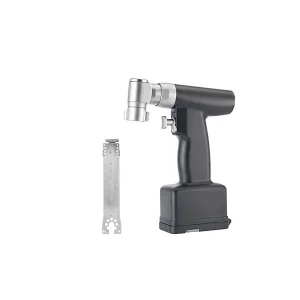
Direct from our ISO 13485:2016 automated surgical power device facility. Fully compatible with mainstream orthopedic surgical platforms, high-frequency trauma saws, and heavy reaming drills.
How third-party high-precision engineering is solving supply chain bottlenecks, mitigating premature hospital cell decay, and driving down total cost of ownership (TCO).
Hospitals and surgical outpatient centers (ASCs) globally face soaring OEM replenishment costs. Proprietary OEM replacement battery packs for Stryker System 6, System 7, and System 8 platforms represent recurring high-margin line items that strain orthopedic theater budgets.
Surgical power batteries operate in harsh environments. Aseptic transfer systems require meticulous OR nurse handling, whereas autoclavable battery systems undergo brutal 134°C (273°F) saturated steam cycles under 2.1 bar pressure that degrade standard lithium cells.
Modern specialized medical battery factories utilize military-grade automated cell matching, thermal runaway containment barriers, and custom smart BMS architecture that faithfully clone and optimize handpiece handshake communication.
Surgical power demands fluctuate from sustained low-RPM, high-torque bone reaming to instantaneous 15,000 RPM oscillating resection. Our Stryker-compatible power modules deliver uninterrupted, linear current.
Acetabular reaming and femoral canal preparation demand massive torque under dense trabecular and cortical bone resistance. Voltage sag results in motor stalls that disrupt surgical rhythm.
Long emergency trauma procedures require swift oscillating resection and high-speed bicortical screw hole drilling without battery pack swap disruptions mid-reduction.
Micro-burring, laminectomies, and transforaminal decompressions necessitate ultralow handpiece vibration and ultra-steady motor voltage to protect adjacent neural structures.
Emergency sternum opening during bypass surgery cannot tolerate sudden thermal shut-off or terminal corrosion caused by repeated disinfectant chemical washing.
Comprehensive metallurgical, chemical, and electrical performance breakdown across Stryker System compatible power architectures.
| Performance Parameter | OEM Standard Battery | SNK Smart High-Capacity Line | Autoclavable Heavy-Duty Line | Clinical Advantage |
|---|---|---|---|---|
| Nominal Voltage & Chemistry | 9.6V / 13.2V NiMH or Li-ion | 14.8V High-Rate NMC | 13.2V High-Temp LiFePO4 | Consistent torque output, zero plateau drop |
| Rated Pack Capacity | 1,800 – 2,100 mAh | 2,800 – 3,200 mAh | 2,200 – 2,400 mAh | +35% to +50% runtime in double knee revisions |
| Sterilization Capability | Aseptic Transfer Shield | Aseptic Transfer Housing | Direct Steam Autoclave (134°C) | Flexible OR workflow matching CSSD protocols |
| Sterilization Cycle Life | ~100 Cycles before 20% loss | >250 Chemical/UV Disinfections | >200 Autoclave Sterilizations | Reduces annual hospital battery turnover cost |
| BMS Protection Modules | Basic Thermal Fuse | Active Multi-Cell Balancer + NTC | Hermetic High-Temp Hybrid BMS | Eliminates risk of intraoperative thermal runaway |
| Connector Pin Metallurgy | Flash Gold Plated Brass | 30μ" Hard Gold Beryllium Copper | Laser-Welded Platinum-Gold Alloy | Eliminates oxidation and erratic contact drops |
| Housing Material | Standard Polycarbonate | Medical-Grade PEEK / PPSU | Ultrasonically Sealed Radel PPSU | Resists aggressive alkaline enzymatic detergents |
| Regulatory Traceability | Standard OEM Mark | CE-MDR, UN 38.3, ISO 13485 | CE-MDR, IEC 62133, UL 2054 | Full EUDAMED Trace |
Combining world-leading lithium manufacturing ecosystems with cleanroom medical device quality controls under ISO 13485:2016.
Every single lithium cylindrical cell is subjected to a 72-hour aging vault, measuring 0.1mV voltage deviations and micro-ohm AC impedance matching before pack assembly.
To resist autoclave steam penetration, our automated multi-axis ultrasonic welding machines fuse the Radel PPSU enclosures with molecular level hermetic seals verified by helium mass spectrometry.
Unlike Western OEMs that mandate 6 to 9-month development backlogs, our end-to-end tooling, PCB fabrication, and cell procurement clusters in the Yangtze River Delta deliver finished batches in 21 days.
Previewing upcoming breakthroughs in solid-state medical cells, inductive sterilizable charging, and IoT theater fleet telemetry.
Replacing liquid electrolyte with inorganic solid ceramic separators. Eliminates ignition risks, allows internal temperature tolerances up to 160°C, and completely removes the need for bulky thermal insulating shields.
Eliminating physical exterior pins entirely through magnetic resonance wireless power transfer. Hermetically encapsulated packs recharge directly within sterile storage trays without breaking CSSD barriers.
Built-in NFC and Bluetooth Low Energy (BLE) microchips track real-time sterilization cycle counts, state of health (SoH), peak discharge events, and predictive maintenance schedules for biomedical engineering teams.
Medical power packs require rigorous international filings. We maintain ready-to-audit technical dossiers for seamless institutional qualification.
Full compliance covering active surgical instruments and associated power accessories under strict Notified Body surveillance, complete with Post-Market Clinical Follow-up (PMCF) registries.
Certified air, ocean, and express logistics clearance. Every battery model passes altitude simulation, thermal tests, vibration, impact, external short-circuit, and forced discharge verification.
Certified against IEC 62133-2 (secondary lithium cells for portable use) and UL 2054 (commercial batteries) ensuring seamless approval during hospital biomedical acceptance audits.
Expert answers addressing handpiece compatibility, sterilization life cycles, custom branding, and clinical procurement standards.
Yes. Our engineering division conducts reverse-microprofiling of all mechanical docking grooves, terminal spring tension coefficients, and proprietary communication data protocols. Our battery packs seat smoothly with zero play into Stryker System 6, 7, and 8 rotary handpieces, sagittal saws, and reciprocating tools. Furthermore, they are fully recognized by both original OEM universal multi-bay charging stations and our own high-speed automated charging racks without triggering charging fault error codes.
Aseptic transfer battery packs are non-sterilizable power units placed inside a sterilized battery housing shield via sterile OR nurse transfer techniques. This keeps procurement costs low and preserves lithium cell chemistry for over 500+ procedures. Direct Autoclavable batteries, conversely, are hermetically welded inside heat-resistant Radel PPSU shells utilizing specialized high-temperature LiFePO4 or solid-state cells engineered to survive 134°C saturated steam autoclaving. Our factory supplies both formats depending on your facility's CSSD infrastructure.
Every battery module incorporates a proprietary hardware Smart BMS with four layers of fail-safe protection: overcharge, over-discharge, short-circuit, and dual-zone thermal monitoring (NTC thermistors). If excessive surgical load causes continuous reaming spikes, our intelligent algorithmic control buffers peak current for 4.5 seconds before safely regulating discharge, avoiding instantaneous motor stoppage during critical osteotomies.
Every shipment is accompanied by an extensive quality assurance package, including ISO 13485:2016 factory audit copies, CE-MDR declarations of conformity, IEC 62133-2 electrical safety test reports, UN 38.3 test summaries for flight clearance, MSDS sheets, and batch-specific autoclave validation certificates. We also furnish complete technical IFU booklets in multiple languages for distributor bidding requirements.
Absolutely. We support comprehensive OEM/ODM customization. This includes custom laser-etched distributor branding, serial number barcoding integrated with your ERP, customized housing coloring, and tailor-made packaging sets. For large volume tenders, our R&D center can fine-tune voltage curves and burst discharge ceilings within 21 business days.
Cut surgical power tool life-cycle costs by up to 55% while maintaining surgical precision, CE-MDR compliance, and rock-solid supply chain delivery.
Engineered for high torque transmission, rapid locking mechanisms, and continuous autoclave durability across orthopedic departments.