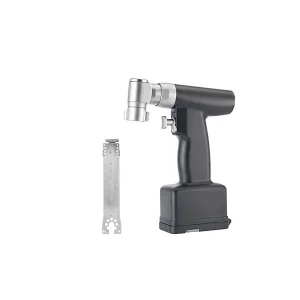
Explore high-torque cannulated drills, micro-oscillating saws, cranial milling adapters, and multi-size Kirschner wire clamping modules built to withstand repetitive autoclave cycles.








In contemporary orthopedics, traumatology, spine arthroplasty, and reconstruction surgery, the clinical usage of orthopedic drill machines has evolved far beyond rudimentary mechanical osteotomy. Modern surgical workflows demand powered handpiece systems capable of delivering high-torque penetration through sclerotic cortical bone while preventing thermal osteonecrosis, ensuring sub-millimeter axial run-out, and maintaining absolute hermetic sealing under severe 134°C high-pressure steam sterilization regimes.
As hospitals, private ambulatory surgery centers (ASCs), and specialized orthopedic hospitals worldwide transition from pneumatic drive lines to high-efficiency Brushless Direct Current (BLDC) battery platforms, the manufacturing standards expected of an ODM (Original Design Manufacturer) have dramatically elevated. Precision drive train fabrication now requires closed-loop real-time feedback loops, sensorless vector commutation algorithms, and dynamic balancing down to microgram-millimeter thresholds. Understanding the intricate biomechanics of orthopedic drill machine use is fundamental to qualifying global manufacturing partners capable of meeting stringent regulatory demands under EU CE-MDR and US FDA guidelines.
Thermal threshold exceedance (>47°C for longer than 60 seconds) irreversibly denatures alkaline phosphatase and induces osteocyte death. Our ODM handpiece architecture integrates micro-fluidic chip heat dissipation, optimized fluting dynamics, and stable low-speed/high-torque settings (300 RPM @ 20 N·m) to maintain bone viability per ASTM F2180 standards.
Cannulated drills require a continuous hollow core through the rotor shaft to accommodate guide wires (0.8 mm to 4.2 mm). Industrial run-out tolerances must stay under 0.02 mm to prevent K-wire galling, structural deflection, and intraoperative tissue trauma during intramedullary nailing and closed reduction fixation.
Autoclave longevity remains the primary differentiator in orthopedic power tool procurement. Utilizing medical-grade fluorosilicone double-lip seals, aerospace-grade PEEK isolators, and proprietary hydrophobic nano-coatings, our surgical handpieces maintain IPX8 liquid ingress protection across more than 200 consecutive vacuum-steam cycles.
Strategic analysis of global tender trends reveals a bifurcated market demand requiring flexible ODM solutions tailored for diverse institutional environments.
The global orthopedic power tools market, valued at upwards of USD 2.1 billion, is experiencing massive structural transformations driven by three macro-economic forces: the post-pandemic clearing of elective joint replacement backlogs, the accelerated growth of outpatient Ambulatory Surgical Centers (ASCs), and stringent cost-containment initiatives enforced by national healthcare systems such as the NHS in the UK, DRG frameworks across the European Union, and CMS reimbursement restructuring in North America.
Historically, Tier-1 teaching institutions were monopolized by capital-intensive Western multinational corporations. However, supply chain bottlenecks, exorbitant replacement attachment fees, and slow repair turnaround cycles have catalyzed medical device distributors and hospital groups to seek robust Tier-1 qualified ODM manufacturing partners. The market has divided into a high-utility dual-track procurement structure:
Engineered for high-throughput orthopedic theaters performing multi-case total hip arthroplasty (THA), total knee arthroplasty (TKA), and spinal fusion. Employs brushless commutation, instant tool-less quick-coupling, universal smart lithium battery management, and ultra-quiet planetary gearboxes (<65 dB(A)).
Designed for public hospital tenders, field hospitals, trauma centers in emerging markets, and veterinary surgical clinics. These handpieces prioritize high torque reliability, mechanical simplicity, immediate on-site modular brush serviceable maintenance, and exceptionally low capital acquisition thresholds.
To reduce hospital capital expenditure, modern ODM contracts mandate cross-platform modularity. A single primary motor handpiece can instantly latch onto Jacobs chucks, AO quick-couplers, sagittal saw heads, cranial burr drill units, and high-frequency sternum saw attachments without auxiliary tooling.
How advanced manufacturing infrastructure in Shanghai delivers unparalleled speed-to-market and regulatory compliance for international private labels.
The manufacturing of surgical power instruments operates at the highest echelon of precision engineering. A minor mechanical vibration or electromagnetic interference (EMI) can impair surgical precision or compromise intraoperative navigation systems. At our ISO 13485:2016 and MDSAP certified facility in Baoshan, Shanghai, our production paradigm embodies the pinnacle of China Industry 4.0 principles, blending vertical supply chain integration with automated quality control.
Where traditional Western manufacturing cycles require 8 to 14 weeks for standard OEM tooling modifications, our automated flexible manufacturing systems compress end-to-end ODM cycle times to approximately 3 weeks. This includes customized rotor shaft machining, firmware tuning for specific orthopedic surgical procedures, laser etching, ergonomic housing modifications, and bespoke aluminum containment cases.
| Performance / Manufacturing Metric | Legacy Industry Standard | SNK ODM Smart Factory Standard | Clinical / Procurement Impact |
|---|---|---|---|
| Torque Deviation Tolerance (ISO 6475) | ± 3.2% - ± 5.0% | ≤ ± 1.5% | Prevents sudden drill plunge during cortical breakthrough |
| Cleanroom Environmental Standard | ISO Class 8 (100,000 ppm) | ISO 14644-1 Class 7 (10,000 ppm) | Eliminates sub-micron particulate contamination in motor bearings |
| Autoclave Steam Durability Verification | 100 Cycles @ 134°C | 200+ Validated Cycles | Extends mean time between failures (MTBF) and handpiece lifespan |
| OEM / ODM Customization Lead Time | 8 - 12 Weeks | Approx. 3 Weeks | Rapid market entry for international distributor private brands |
| Spinal Saw Temperature Rise (ASTM F2180) | > 5.5°C Rise | < 2.0°C Total Rise | Mitigates thermal degradation during delicate spine & neuro osteotomies |
| Emergency Surgical Kit Dispatch Logistics | 48 - 72 Hours | Within 24 Hours | Ensures surgical operational continuity across 80+ partner markets |
Every handpiece housing and cannulated shaft is milled from solid billets of aviation-grade magnesium-aluminum alloy or 316L medical stainless steel on multi-axis turning-milling centers, guaranteeing wall-thickness uniformity down to 5 microns.
Our Shanghai facility houses an accredited bone drill performance laboratory. Handpieces undergo continuous dynamic torque profiling, cyclic stall testing, acoustic level monitoring, and thermal camera mapping against artificial bone substrates.
With CE-MDR (EU) 2017/745 certificates spanning Class I, IIa, and IIb devices and Free Sale Certificates (FSC) filed for 21 nations, our international partners access immediate regulatory acceptance without bureaucratic tender delays.
Detailed performance parameters for specific anatomical theaters, operating room environments, and surgical techniques.
Used extensively for cannulated bicortical drilling, locked intramedullary nail placement, and lag screw fixation in femoral, tibial, and humeral shafts. Features stepless throttle speed regulation (0-1,200 RPM) and instant forward/reverse toggle for controlled tapping without bone micro-cracking.
In total knee arthroplasty (TKA), our oscillating saw adapters provide high-frequency resection (up to 12,500 oscillations/min) with tight sagittal blade dampening to produce flat, smooth planar cuts essential for prosthetic implant alignment, while low-speed cannulated drills ream the acetabulum at high torque without thermal burn.
Minimally invasive transforaminal lumbar interbody fusion requires narrow visual corridors. Our specialized 7 mm ultra-thin oscillating saws and micro-bone drills ensure bone decompression and facetectomy without dural sheath contact or excessive nerve root heat transfer (holding temperature rise below 2°C).
Coupled with our dedicated high-speed cranial mill and perforator adapters, the brushless drive automatically engages micro-burrs for precise craniotomy flaps. Featuring auto-stop clutch mechanisms that immediately disengage the drive upon penetrating the inner cranial table, safeguarding brain parenchyma.
Our heavy-duty sternum saw modules offer rapid, atraumatic median sternotomy access in open-heart surgery. Incorporating an integrated anatomical footplate guide that shields cardiac soft structures, combined with an enclosed brushless chassis that limits aerosolized surgical fluid ingress.
Demanding veterinary clinical settings benefit from our durable carbon-motor cannulated line. Accommodating varied bone densities across canine TPLO (Tibial Plateau Leveling Osteotomy) and equine arthrodesis, balancing maximum economic value with high torsional strength.
In-depth responses to critical engineering, sterilization durability, and ODM contractual qualification inquiries.
Complete surgical room sets featuring oscillating bone resection saws, heavy-duty Kirschner wire fixtures, and specialized low-speed high-torque cannulated drivers.