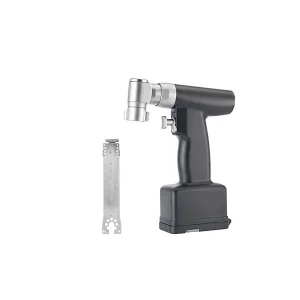
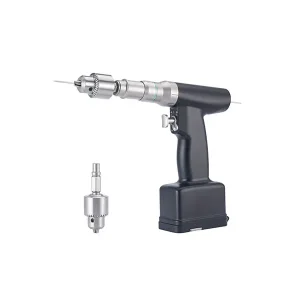
High-torque, high-precision handpiece systems manufactured in ISO 13485 certified surgical tool cleanrooms.
Modern surgical procedures demand extreme accuracy and minimal tissue trauma. Orthopedic drill bits are not mere dynamic cutting accessories; they are critical surgical interfaces where heat generation, micro-fracture risks, and wear resistance directly govern patient outcomes.
Temperatures exceeding 47°C during cortical bone penetration trigger osteocyte thermal necrosis, leading to early implant loosening. Our OEM drill bits utilize specialized flute helix angles and micro-channel coolant delivery to maintain drill site temperatures consistently below 42°C.
Excessive thrust force causes drill tip skidding on hard cortical bone. Our factory engineers custom self-centering split point geometry (118° to 135° point angle), reducing required penetration force by up to 35% compared to standard Twist drills.
Metal debris and coating flaking during drill hole creation pose severe physiological risks. Through electro-chemical passivation and Diamond-Like Carbon (DLC) physical vapor deposition, our orthopedic drill bits demonstrate ultra-low friction co-efficients with zero particulate shed.
In multi-center biomechanical evaluations, drill bits produced at our specialized OEM orthopedic factory demonstrated a 40% improvement in chip evacuation speed and endured 50+ steam sterilization cycles without measurable loss of edge sharpness or structural integrity.
Explore how our technical design roadmaps combine advanced material science, smart robotic navigation compatibility, and optimized cannulated configurations.
Standard surgical stainless steel (316L/440C) is rapidly reaching its mechanical ceiling. Our manufacturing facilities are pioneering custom-alloy formulations and hard-material coatings:
As robotic-assisted orthopedics (e.g., Stryker Mako, Zimmer Rosa) dominates modern operating rooms, drill bits must interface with optical and electromagnetic tracking systems:
| Performance Metrics | Standard OEM Stainless Drill Bit | SNK High-Performance CoCrMo Bit | SNK DLC Coated Smart Drill Bit |
|---|---|---|---|
| Hardness rating (HV) | 520 - 580 HV | 850 - 950 HV | 2,500 - 3,000 HV |
| Maximum Cortical Temperature Rise | +14.2 °C | +8.1 °C | +3.8 °C |
| Autoclave Cycle Endurance | 15 - 20 Cycles | 40 - 50 Cycles | 100+ Cycles |
| TIR Concentricity Tolerance | ≤ 0.05 mm | ≤ 0.02 mm | ≤ 0.01 mm |
| Robotic Navigation Compatibility | Basic manual alignment | High precision manual | Fully integrated optical indexing |
How our state-of-the-art production ecosystem in China integrates ultra-precision 5-axis CNC grinding, automated quality assurance, and massive batch consistency for global medical brands.
Utilizing specialized Swiss Roll Grinding machines and automated wheel dresser controls, our factory guarantees sharp flute geometry, eliminating micro-burrs that cause soft tissue wrapped entanglements during arthroscopic or trauma surgery.
In compliance with global regulatory mandates (FDA UDI and EU MDR EUDAMED), every surgical drill bit is permanently marked with high-contrast fiber laser barcodes and lot tracking codes without disturbing the surface passivation layer.
Traditional caliper-based checks are replaced with automated keyence 3D optical laser profilers. Every manufactured drill bit undergoes full-length geometry scanning, verifying point angle, flute pitch, and runout before primary packaging.
Selecting an OEM drill bit orthopedic factory requires rigorous validation across quality management, legal documentation, supplier auditing, and batch-to-batch repeatability.
Medical device distributors must evaluate key technical operational markers prior to signing global supply contracts:
Streamlining product development from raw clinical requirements to commercialized market release:
Navigating regulatory hurdles across tier-one medical markets require complete documentation, audit trail readiness, and local language compliance support.
Fully updated technical documentation sets (STED format), clinical evaluation reports (CER), and EUDAMED registration data for Class I / IIa orthopedic surgical tools.
Complete Master Files (MAF) and predicate comparison matrices for rapid US market submissions, including mechanical fatigue testing per ASTM F1541 / F543.
Audited under Medical Device Single Audit Program (MDSAP) covering USA, Canada, Japan, Brazil, and Australia. Customized Instructions for Use (IFU) in over 20 languages.
Detailed answers addressing key procurement technicalities, custom shank fittings, material selection, and factory lead times.
Complete the surgical handpiece ecosystem with high-speed bone drills, trauma hollow systems, and specialized reamers.
Access custom CAD design services, rapid prototype grinding, comprehensive CE-MDR regulatory files, and competitive factory-direct pricing for surgical power tool solutions.