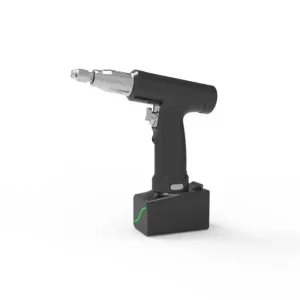
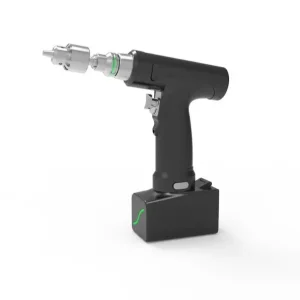
Explore precision-engineered surgical handpieces and interchangeable modules tailored for arthroplasty, osteotomy, and emergency traumatology.
In high-load orthopedic procedures, instrument vibration, thermal necrosis, and sudden torque stalling remain critical challenges. Our OEM GMC reciprocating saw engineering addresses clinical biomechanics at the root.
Cutting cortical bone produces localized friction temperatures often exceeding 47°C, initiating osteocyte apoptosis. Our proprietary variable-frequency micro-stroke algorithms and specialized blade fluting reduce cut-zone friction by up to 38%, preserving structural bone viability during extensive osteotomies.
Traditional surgical motors suffer substantial speed drops upon engaging dense cancellous-cortical junctions. Integrated sensorless field-oriented control (FOC) recalculates mechanical load at 20,000 cycles per second, adjusting output within microseconds to ensure instantaneous cut initiation without kickback.
Operating rooms demand uncompromised sterility. Handpieces feature multi-barrier fluororubber seals and hermetically welded stators, resisting more than 200 harsh autoclave cycles (134°C, 2.2 bar) and vaporized hydrogen peroxide (VHP) cycles without mechanical degradation or insulation decay.
The global demand for orthopedic and trauma power systems is rapidly accelerating, driven by aging populations, active lifestyles, and increasing joint replacement volume across emerging markets.
While multinational tier-1 brands maintain commanding market visibility, hospital purchasing authorities face severe budget compression, elongated lead times, and prohibitive post-warranty maintenance costs. Our OEM GMC reciprocating saw manufacturing platform solves this economic bottleneck by offering direct-to-manufacturer supply relationships, reducing total cost of ownership by up to 45% while strictly meeting ISO 13485:2016 and MDR compliance mandates.
By shifting from fragmented component sourcing to closed-loop CNC machining, surface treatment, winding, cleanroom assembly, and validation testing, we empower distributors to launch customized, high-reliability private label systems in record timelines.
Entering international healthcare markets demands robust documentation and localized readiness. We safeguard your import pipelines with full regulatory dossier integrity.
Every reciprocating saw and drill system conforms to EU Medical Device Regulation (EU) 2017/745 (Class IIa/IIb). We supply comprehensive Technical Documentation Files (TDF), biocompatibility dossiers (ISO 10993), electrical safety data (IEC 60601-1 / IEC 60601-1-2), and unified EUDAMED traceability codes.
We solve service turnaround latency through localized logistics support. Rapid emergency stock modules ship within 24 to 48 hours across Europe, North America, and Asia-Pacific, preventing operating theater downtime and ensuring uninterrupted clinical workflows for hospital clients.
Our agile contract engineering program customizes industrial ergonomics, brushless motor velocity presets (up to 15,000 rpm), trigger actuation curve profiles, laser etching, sterile packaging formats, and multi-lingual Instructions for Use (IFU) tailored to country-specific regulatory bodies.
Engineered to deliver high precision, minimal chatter, and predictable linear stroke control across diverse surgical specialties.
From femoral shaft segmental resections to distal tibial reconstructive osteotomies, our reciprocating saws maintain ultra-stable strokes. High-torque output ensures steady cutting through dense cortical walls without binding, even when subjected to off-axis manual pressure by the surgical team.
Navigating around prosthetic stems during hip and knee revision surgeries demands tight clearances and clean planar margins. The GMC platform accommodates varied blade geometries with secure quick-lock chucking systems, preventing blade migration during impaction-interface access.
Coupled with our specialized sternum adapter and blade guard shields, our high-frequency motor platforms perform median sternotomies with smooth, vibration-free travel, providing rapid chest opening while shielding mediastinal structures from mechanical damage.
The convergence of surgical robotics, sensor miniaturization, and intelligent motor controllers defines the next frontier of surgical bone resection.
Integration of real-time tissue electrical impedance sensors into reciprocating chuck assemblies to automatically halt blade reciprocation the microsecond cortical bone penetration is completed, safeguarding adjacent soft tissues and neurovascular bundles.
Developing low-latency wireless communication modules interfacing with optical navigation and orthopedic robotic arms, offering active speed adaptation based on digital 3D spatial boundaries (virtual fixtures).
Transitioning to ultra-high-density solid-state battery systems capable of undergoing direct autoclave sterilization while maintaining a lighter handpiece weight, doubling operating run-times, and eliminating hazardous aseptic battery-transfer protocols.
Implementing embedded cycle-count, thermal-history, and vibration micro-logging to notify hospital biomedical engineering teams of preventive service intervals prior to any mechanical seal or motor bearing compromise.
Full suite of multi-functional attachments, high-precision chucks, and ergonomic power handpieces for orthopedic sub-disciplines.
Essential technical, regulatory, and manufacturing answers for brand owners, hospital tender contractors, and medical distributors.
Medical-grade reciprocating saws are engineered from the ground up for strict aseptic performance, biosafety, and high-temperature durability. Unlike retrofitted industrial motors, our handpieces employ surgical-grade medical stainless steels (17-4PH, 316L) and medical PEEK, high-temperature NdFeB rare-earth magnets, dynamic balancing below 0.05 g·mm, and medical EMC filtering conforming to IEC 60601-1-2 standards to eliminate interference with sensitive operating theater monitors.
Our validation protocol follows ISO 17665 guidelines. Handpieces are submitted to rigorous cyclic accelerated life testing exceeding 200 cycles of saturated steam exposure at 134°C for 18 minutes under 2.2 bar pressure. Post-sterilization quality inspection benchmarks include stator insulation impedance measurements (>100 MΩ at 500V DC), motor bearing dynamic noise monitoring (<65 dBA), and blade chuck mechanical runout checks ensuring tolerances remain strictly below 0.03 mm.
With comprehensive in-house CNC wire cutting, 5-axis machining centers, motor winding, and CMM inspection labs, initial CAD design and rapid prototyping are typically completed within 7 to 10 working days. Pre-clinical verification prototypes are ready within 3 weeks, while comprehensive technical documentation packages for national regulatory filings are usually delivered within 6 to 8 weeks.
Yes. We engineer customized universal quick-coupling quick-release chuck mechanisms compatible with major international reciprocating blade designs, or proprietary keyed quick-lock interfaces depending on your branding strategy and proprietary recurring consumable revenue objectives.