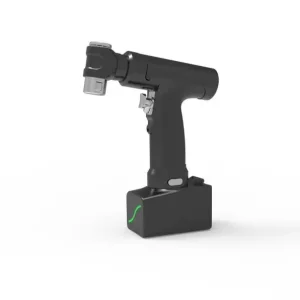
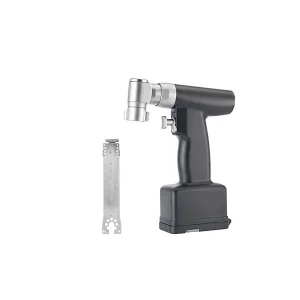
Engineered for trauma fixation, osteotomy, joint reconstruction, and micro-cannulated surgical procedures.
A cannulated electric drill must balance micro-fluidics, thermal thresholds, and axial rigidity during intramedullary fixation and pin placement.
Cortical bone necrosis occurs when local temperatures surpass 47°C for longer than one minute. SNK cannulated drill platforms incorporate optimized concentric channel geometries that facilitate low thermal accumulation and clear saline micro-irrigation paths over Kirschner wires (K-wires).
Deviations in the hollow passage cause oscillating vibrations that can misalign trauma fixation rods or deflect intramedullary guide pins. Our CNC deep-hole gun-drilling tolerance holds an internal concentricity of ≤0.02 mm over standard shaft lengths.
Repeated exposure to high-pressure saturated steam cycles degrades conventional motor seals. Our multi-stage fluoropolymer and fluoroelastomer sealing architecture guarantees full barrier containment against moisture infiltration during 134°C sterilization.
How the medical electric hollow drill meets localized anatomical workflows and structural operational demands across specialized surgical theaters.
Demands swift high-torque drilling across dense cortical bone followed by rapid low-speed intramedullary reaming. Variable triggers allow surgeons in acute trauma centers to switch speeds without handpiece substitution, cutting procedural setup times significantly.
Demands micro-guidance along navigated K-wires without binding or pin stripping. The balanced pistol grip centers the mass directly over the surgeon's palm, reducing peripheral muscle fatigue during prolonged pelvic and lumbar reconstruction operations.
High RPM precision for delicate ligamentous fixation, cruciate reconstructive anchors, and periarticular tension wiring. The hollow drill’s fine-tuned torque cutoff prevents stripped anchor channels in osteoporotic or soft cancellous tissue.
Combining complete domestic industrial chains with strict ISO medical compliance to reduce production cycles and buffer global logistics volatilities.
Located in the heart of China’s high-precision medical corridor, SNK maintains upstream control spanning raw medical stainless steels (316L, 17-4PH), high-torque brushless windings, through to five-axis Swiss CNC profiling, cutting component bottlenecks completely.
While traditional medical manufacturers average 8 to 12 weeks for configuration cycles, SNK's flexible lean assembly infrastructure delivers tailored OEM/ODM modifications (speed calibrations, housing designs, torque thresholds) in approximately 3 weeks.
We preserve over 200 ready-to-ship standby orthopedic power units in sterile-ready condition alongside strategic spare components. Emergency instrument configurations ship within 24 hours to support our overseas tier-one distributors and hospital tenders.
Seamless pathway across worldwide regulatory landscapes with forward-looking support for digital surgical systems.
Full transition to the European Medical Device Regulation (EU) 2017/745. SNK provides complete Technical Documentation Files (TDF), clinical evaluation reports (CER), risk analysis (ISO 14971), and EUDAMED serialization to simplify partner registrations.
Tomorrow’s orthopedics requires communication between powered handpieces and surgical navigation systems. Our next-gen hollow core drivers integrate optical tracking arrays, dynamic position encoders, and remote CAN-bus control for robotic arm attachment.
Transitioning toward high-density lithium-iron polymer and solid-state cell integration with real-time temperature telemetry. Handpieces stream thermal, load, and battery health telemetry directly to OR monitors during critical resections.
Explore additional high-performance attachments, reamers, cranial systems, and micro-saws for specialized procedures.
Essential guidance for hospital biomedical departments, OEM brand managers, and regulatory compliance teams.
Our standard production lines deliver hollow cannulations of 4.0 mm, 4.2 mm, and 4.5 mm, engineered to support universal K-wires, intramedullary reamer shafts, and standard guidance pins. Custom internal bore diameters can be precision-machined via our Swiss gun-drilling tooling to suit proprietary implants upon request.
SNK implements an advanced hermetic dual-lip seal design constructed from surgical-grade perfluoroelastomers. The sealing interfaces undergo accelerated wear testing verifying fluid barrier integrity against 134°C steam and 0.22 MPa pressure for over 200 cycles without elastomeric hardening or bearing contamination.
Every OEM contract is accompanied by our comprehensive technical registration dossier. This includes CE-MDR Declaration of Conformity, ISO 13485:2016 audit reports, biocompatibility test results according to ISO 10993, electrical safety (IEC 60601-1) records, and Free Sale Certificates (FSC) filed across 21 partner nations.
Thanks to our flexible robotic manufacturing lines and standardized core chassis, initial prototype runs and aesthetic custom adaptations (custom anodized colorations, laser engraving, tailored packaging, speed preset calibrations) are completed within approximately 3 weeks from approved technical drawings.