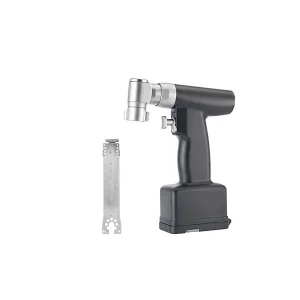
Factory-direct modular surgical cutting and drilling solutions engineered for low acoustic resonance, minimal thermal rise, and extended autoclave longevity.
The convergence of brushless electronic commutation, dual-eccentric mass balancing, and metallurgical thermal regulation in high-load osteotomy cutting.
Traditional pneumatic and brushed reciprocating bone saws frequently generate sound pressure levels exceeding 85 to 92 dB(A) in operating theatres. In enclosed surgical suites with laminar airflow, these acoustic spikes induce cognitive fatigue, impair inter-professional auditory communication between surgical leads and scrub nurses, and exacerbate micro-vibration tremors in delicate arthroplasty procedures.
Next-generation OEM quiet reciprocating saw manufacturing centers around three acoustic decoupling pillars: brushless direct-current (BLDC) motor commutation with sinusoidal field-oriented control (FOC), dynamic dual-eccentric counterweight balancing, and acoustic chamber dampening using medical-grade PEEK (Polyetheretherketone) isolation sleeves. By dampening the primary harmonic frequency of high-speed reciprocal oscillation (up to 12,500 to 15,000 cpm), sound output is constrained below 58 dB(A), preserving surgeon ergonomics and theatre tranquility.
Acoustic Dampening Matrix: Combining balanced drive pins with high-viscosity PFPE medical greases limits frictional heat propagation and mechanical gear chatter during heavy femoral resection.
Kinematic engineering transforms mechanical oscillation into predictable, smooth cutting strokes without transferring resonant recoil into the surgeon's wrist:
How international hospital consortia, private surgical chains, and medical device distributors qualify power tool manufacturers beyond initial unit price.
Global distributors demand complete regulatory transparency under the European Medical Device Regulation (EU MDR 2017/745). Suppliers must deliver comprehensive technical documentation dossiers, including ISO 10993 biocompatibility test records, risk management files according to ISO 14971, and verified EUDAMED registration data for all Class IIa and Class IIb orthopedic handpieces.
Hospital Group Purchasing Organizations (GPOs) audit life-cycle maintenance costs rather than capital expenditure alone. A quiet reciprocating saw system must survive upwards of 200 high-temperature (134°C) vacuum autoclave sterilizations without transmission seal failure, motor torque degradation, or degradation of the proprietary quick-coupling blade locking chuck.
Procurement teams require laser-etched DataMatrix serialization down to individual drive pins and bevel gears. Compliance with ANSI/AAMI ST79 for steam sterilization, along with validation files for STERRAD® hydrogen peroxide gas plasma sterilization, ensures immediate integration into hospital central sterile services departments (CSSD).
Inside an ISO 13485:2016-certified manufacturing center in Shanghai: Delivering high-precision surgical instruments at unprecedented scale and agility.
Our intelligent smart manufacturing floor incorporates 5-axis Swiss-type CNC automatic lathes (Citizen and DMG Mori) operating with positioning tolerances down to ±0.002 mm (2 microns). By vertically integrating gear hobbing, micro-motor magnetic circuit assembly, PEEK injection molding, and vacuum titanium nitriding (TiN) blade surface coatings under a single roof, external lead times are compressed by 65% compared to multi-tier subcontracting chains.
Traditional European and North American orthopedic device OEMs often impose 8 to 14 weeks for functional prototype sampling and require massive minimum order quantities (MOQs). SNK's digital factory model connects Computer-Aided Design (CAD) finite element acoustic models directly to automated CNC cell controllers.
Custom OEM engineering projects—such as altering stroke length (from 2.5 mm to 4.2 mm), integrating wireless RFID surgical navigation tracking pins, or calibrating specific motor torque profiles from 500 to 15,000 cpm—can achieve complete rapid physical validation, assembly, and sterilization trials within 21 business days.
Logistical Redundancy: Maintaining over 200 standby complete surgical sets in bonded warehouses guarantees standard order dispatches within 24 hours across APAC and 48 hours to major European transit hubs.
| Manufacturing Dimension | SNK Smart Factory 4.0 Benchmark | Legacy Industry Standard | Strategic Advantage for Global OEM Brands |
|---|---|---|---|
| CNC Machining Tolerance | ±0.002 mm (2 μm) Dual-Spindle Turning | ±0.015 mm (15 μm) | Eliminates harmonic blade wobble, minimizing intra-operative kerf loss. |
| Acoustic Testing Methodology | 100% Anechoic Chamber FFT Spectral Analysis | Batch Random Auditory Check | Guarantees every handpiece is clinically certified sub-58 dB(A). |
| Reprocessing Durability Cycle | 200 Autoclave Cycles (134°C / 0.22 MPa) | 100 Cycles Average | Doubles hospital operational life span; halves warranty service liabilities. |
| Torque Dynamic Consistency | ±1.5% Output Variance under Heavy Cortical Load | ±3.5% to ±5.0% Output Variance | Prevents blade stalling during deep femoral revision and periacetabular cuts. |
| OEM Customization Lead Time | Approx. 3 Weeks (Concept to Working Tooling) | 10 to 14 Weeks Standard | Accelerates time-to-market for private-label orthopedic market entry. |
Analyzing market adoption vectors across North America, the European Union, the Middle East, and the Asia-Pacific region.
The aggressive shift of total knee arthroplasty (TKA) and total hip arthroplasty (THA) into Ambulatory Surgery Centers (ASCs) has created massive demand for lightweight, low-decibel, modular handpiece platforms that eliminate the cumbersome pneumatic hoses of yesteryear.
With legacy MDD certificates expiring, EU distributors face acute supply shortages. SNK's proactive CE-MDR 2017/745 certification across Class I, IIa, and IIb handpieces offers European partners an audit-proof pathway for multi-year public hospital tenders.
Fueled by rapid tier-1 hospital infrastructure investments and an aging demographic requiring reconstructive joint procedures, APAC clinics demand high-reliability brushless handpieces backed by immediate 24-hour regional logistics and repair turnaround.
Emerging markets require hybrid portfolios balancing premium brushless surgical systems with rugged, easily maintainable carbon-brush units to accommodate municipal public health tender limits without sacrificing cutting safety.
Engineered specifically for extreme precision osteotomy cutting where tissue necrosis must be strictly prevented.
During hip revision surgery, navigating dense osseointegrated bone cement or extracting stubborn femoral stems requires controlled linear reciprocating power. The SNK reciprocating saw delivers precise longitudinal cutting strokes without erratic lateral deviations, protecting delicate cortical bone walls from catastrophic fracture.
In bypass graft procedures and emergency thoracic re-entry, our reciprocating sternum saw adapters with integrated retractable protective footplates facilitate rapid midline splitting of the sternum in under 12 seconds, preventing sub-sternal pericardial soft-tissue lacerations while maintaining total acoustic composure.
Canine cruciate ligament reconstructive surgeries, including Tibial Plateau Leveling Osteotomy (TPLO) and corrective limb deformities, demand whisper-quiet handpieces. Reduced acoustic hum and minimal motor vibration prevent panic in anesthetized critical animal patients and protect fine micro-structures during radial blade cuts.
Technical, regulatory, and commercial clarifications direct from our chief biomedical engineering and export compliance team.
Explore our full line of surgical motors, carbon-brush drills, and multi-functional attachment heads engineered to identical cleanroom standards.