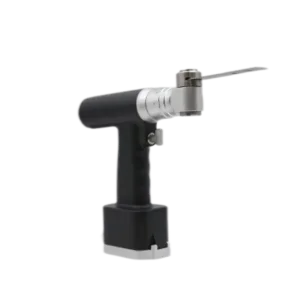
Engineered for high-torque osteotomy, neurosurgical trepanation, and orthopedic trauma stabilization under stringent hospital sterilization protocols.







A rigorous examination of kinetic transmission, thermal necrosis prevention, and motor dynamics across modern trauma and reconstructive surgeries.
Traditional bone hacksaws relied on direct mechanical cam linkage, generating substantial micro-vibration, axial blade deflection, and erratic linear strokes. Modern surgical reciprocating hacksaws utilize compact brushless DC (BLDC) motors coupled with harmonic micro-gearheads, maintaining stable 12,500 to 15,000 RPM reciprocating frequencies under heavy cortical bone resistance.
Zero-Backlash MechanicsOsteocyte survival deteriorates exponentially when bone tissue temperatures surpass the critical threshold of 47°C during resection. Through micro-milled specialized tooth geometry, progressive kerf clearance, and high-frequency stroke optimization (<2°C elevation verified via ASTM F2180), our precision hacksaw attachments significantly accelerate post-operative vascularization.
ASTM F2180 CompliantOperating theater power systems face aggressive thermal shock and moist heat exposure during routine 134°C vacuum autoclave reprocessing. Our reciprocating hacksaw housings feature medical-grade hermetic Viton and fluoropolymer sealing with PEEK transmission components, ensuring zero mechanical binding and transmission deviations below 0.03 mm after 200 cycles.
Class B Sterilization ReadyB2B hospital tenders in Europe, the Americas, and APAC are shifting away from closed vendor-lock models toward high-compatibility, modular OEM surgical power tool systems.
Under EU Medical Device Regulation (EU) 2017/745, distributors cannot import unverified instruments. Complete technical documentation, Clinical Evaluation Reports (CER), and Unique Device Identification (UDI) trackable via EUDAMED are non-negotiable prerequisites for hospital qualification.
Private hospital networks and military defense medical centers calculate cost-per-procedure. Carbon-brush systems deliver economical entry points for low-frequency wards, whereas brushless reciprocating setups maximize multi-year throughput across intensive trauma theaters.
Hospitals avoid managing multiple battery ecosystems. A single modular handpiece platform that accepts reciprocating hacksaw modules, oscillating sagittal saws, cannulated drills, and cranial milling attachments reduces sterile storage footprint by over 45%.
Proprietary blade locks strangle distributor cash flows. Global buyers mandate open blade coupling profiles (e.g., universal quick-release collets) and guaranteed 48-hour localized safety warehouse reserves to prevent surgery cancellation incidents.
| Performance Parameter | Legacy Mechanical Hacksaw | Standard Commercial Reciprocating | SNK Medical OEM Brushless Hacksaw |
|---|---|---|---|
| Kinetic Drive Architecture | Manual / Rotary Brushed DC | Industrial AC / Brushed DC | High-Flux Sensorless Brushless (BLDC) |
| Oscillation / Stroke Rate | 2,000 – 4,000 SPM (Variable) | 0 – 8,000 SPM (Unregulated) | 0 – 15,000 SPM Closed-Loop Governed |
| Thermal Rise at Cut Edge | > 54°C (Significant Necrosis Risk) | > 65°C (Uncontrolled Friction) | < 39.5°C (Active Micro-Clearance) |
| Sterilization Reprocessing | Surface Wipe / Formalin Only | Non-Submersible / Non-Sterile | 134°C Steam Autoclave / EtO / H2O2 Plasma |
| Torque Stability under Load | ± 15.0% Fluctuation | ± 12.0% Fluctuation | < ± 1.5% Dynamic Deviation (ISO 6475) |
| Regulatory Traceability | Legacy Class I Manual | Industrial CE / Non-Medical | CE-MDR 2017/745, ISO 13485:2016, EUDAMED |
Inside our Shanghai manufacturing hub: automated 5-axis DMG MORI CNC milling, ISO Class 7 cleanrooms, and digitized traceability ensuring unmatched medical instrument yields.
Every reciprocating hacksaw chuck, eccentric shaft, and titanium motor core is machined under continuous climate control utilizing 5-axis Swiss-type multi-axis CNC centers. Dimensional tolerances are held rigorously to ±2 microns (0.002 mm), eliminating micro-play that triggers blade chatter and premature wear in clinical theaters.
DIN 13972 CalibrationBased in the high-tech Yangtze River Delta medical hardware cluster, our manufacturing base integrates medical-grade austenitic stainless steel forging, custom winding of high-frequency brushless stators, laser hermetic welding, and biocompatible passivation within a 50-kilometer supply radius, compressing production cycles to 3 weeks.
Resilient Sourcing Loop16 automated assembly cells implement optical computer-vision monitoring for gear meshing alignment, dynamic balancing lasers to measure rotor eccentricity, and 100% full-duty load cycle burn-in testing under simulated bone cutting conditions. Defect rates are controlled strictly below 0.03 PPM across mass production runs.
Zero-Defect ProtocolWhether you require specialized stroke amplitude adjustments (from 2.5 mm to 4.5 mm), customized cannulation diameters for guiding K-wires, proprietary battery interface encapsulation, or personalized laser brand marking, our R&D engineering team delivers custom prototypes within 21 working days.
Evaluating clinical biomechanical performance and localized operating room demands across four key surgical specializations.
During median sternotomy, rapid bone splitting is crucial while avoiding posterior periosteal tear or cardiac laceration. The S2150 sternum saw adapter provides a robust pectus protector guard and rapid reciprocating stroke, allowing surgeons to traverse dense sternum cortex cleanly in under 12 seconds.
Total Hip Arthroplasty (THA) revisions frequently require windowing the femoral shaft or cutting cemented femoral stems out of sclerotic cortical bone. Precision reciprocating hacksaws offer the narrow aspect ratio and extended reach required to dissect deep medullary canals without damaging cortical bridges.
Orthognathic osteotomies and craniosynostosis corrections demand sub-millimeter cut margins. Miniature reciprocating hacksaw attachments driven by high-resolution micro-brushless motors enable intricate sagittal split cuts without soft tissue entanglement or microvascular laceration.
Veterinary referral hospitals treating large canine cruciate tears (TPLO/TTA) and equine fracture osteotomies require robust, multi-sterilizable, high-torque hacksaws capable of handling dense cortical thicknesses while remaining cost-effective across high operational turnover.
Essential insights for medical device distributors, tender committees, and hospital biomechanical engineers evaluating SNK power tools.
An oscillating saw oscillates angularly in an arc pattern (commonly 4° to 5°), making it ideal for perpendicular bone resections such as tibial plateaus in total knee arthroplasty (TKA). A surgical reciprocating hacksaw moves linearly in-and-out along a straight horizontal axis with a stroke length between 2.5 mm and 4 mm. This linear reciprocating kinematics allows surgeons to perform deep-seated canal resections, sternotomies, and narrow osteotomy access holes where an oscillating blade would bind or fail to reach.
Unlike suppliers still attempting to sell under expiring MDD certificates, our entire surgical power tool line is formally audited and certified under EU CE-MDR 2017/745 covering Class I, IIa, and IIb instruments. We provide complete technical documentation dossiers, biological safety test reports (ISO 10993), electromagnetic compatibility certifications (IEC 60601-1-2), and full UDI registration for seamless verification inside the European Databank on Medical Devices (EUDAMED).
Carbon-brush motors generate internal physical carbon dust particles as the brushes wear, which presents contamination hazards and increases thermal buildup inside handpiece enclosures. Brushless motors use electronic commutation with Hall sensors or sensorless field-oriented control (FOC). They operate up to 60% cooler, produce zero carbon particulate friction, provide higher continuous torque, and tolerate more than 200 high-pressure steam autoclave cycles without performance loss.
Yes. All SNK orthopedic handpieces, adapters, and blade shafts are engineered from medical-grade 316L stainless steel and biocompatible PEEK alloys. They are validated under ISO 17665 standards for 134°C pre-vacuum steam sterilization (autoclave), Ethylene Oxide (EtO) gas sterilization, and low-temperature hydrogen peroxide gas plasma sterilization, maintaining transmission runout under 0.03 mm after hundreds of cycles.
Our OEM program provides comprehensive end-to-end customization: handpiece shell industrial design, motor torque tuning (500 to 15,000 RPM), ergonomic weight rebalancing, customized chuck adapters for specific surgical blades, private label laser engraving, medical-grade silicone cable colors, custom aluminum transport cases, and localized multi-lingual Instruction for Use (IFU) booklets. Most OEM custom programs can be validated in 3 weeks.
SNK maintains an active global inventory of over 200 complete standby orthopedic power systems and thousands of replacement adapters at our Shanghai logistics terminal. For emergency surgical replacements and tender sampling, dispatch can be initiated within 24 hours. Transit to major logistics hubs across Europe takes under 48 hours, and under 24 hours across the Asia-Pacific territory.
Explore our core portfolio of reciprocating bone saws, high-speed oscillating tools, acetabular reamers, and multifunctional surgical drill systems.