Engineered for seamless integration with 240V high-density fast-charging docks and continuous-duty autoclave sterilization cycles.








Strategic alignment with 220V–240V 50Hz/60Hz electrical standards dominating the European Union, United Kingdom, Australia, and key Asian-Pacific healthcare systems.
Over 75% of global healthcare and specialized industrial sectors outside North America rely strictly on 220V–240V power grids. In sterile operating theaters and industrial cleanrooms, 240V power modules drive rapid-recharge battery docking bays and corded constant-torque systems without transformers.
Under the EU CE-MDR 2017/745 directive, surgical bone cutting systems and motorized power handpieces face rigorous notified body audits. 240V medical-grade adapters and handpieces require validated electrical isolation (IEC 60601-1) and full EUDAMED traceability across the supply chain.
Reciprocating saws handle dense cortical bone resection in arthroplasty, trauma osteotomy, and emergency sternotomy. Handpiece drives must maintain stable reciprocating strokes (up to 12,500 rpm or 15,000 cpm) under load without thermal bone injury (osteonecrosis threshold: 47°C).
Combining vertically integrated component fabrication, high-precision 5-axis CNC machining centers, and closed-loop ISO Class 7 cleanroom assembly lines.
Chinese OEM facilities utilize high-speed Swiss DMG MORI and Mazak multi-axis turning centers to produce titanium and surgical stainless steel (420J2, 17-4PH) drive components. Eccentric connecting shafts maintain runout tolerances under ±0.005 mm.
Handpieces feature military-grade fluoroelastomer dynamic seals and laser-welded titanium casings engineered to withstand over 200 consecutive autoclave cycles (134°C at 2.2 bar) without moisture ingress, vacuum breakdown, or bearing degradation.
Factory-direct quality validation incorporates in-house DIN 13972 bone cutting and torque deviation laboratories. Surgical bone drill and saw systems guarantee torque variance below ±1.5% under variable dynamic friction loads.
From complex joint arthroplasty to emergency trauma and hazardous-environment industrial cutting, precision reciprocating systems deliver controlled kinetic output.
Femoral neck resection and deep pelvic osteotomies demand narrow-kerf reciprocating blades. Tight oscillatory arcs and balance dampening prevent acetabular socket micro-fractures during revision surgery.
Diaphyseal resections require high-torque linear strokes to penetrate thick cortical shafts cleanly. Brushless motor governors dynamically ramp current when bone density transitions from cancellous to cortical.
Equipped with specialized sternum guards, reciprocating saw systems cut along the mid-sternal line with precision, protecting underlying pericardial tissue through mechanical depth-stop adapters.
Beyond human surgery, veterinary orthopedic centers and sterile aerospace component fabricators deploy 240V-recharged medical-grade saws for low-vibration, burr-free polymer and composite slicing.
The transformation from pneumatic and legacy carbon-brushed motors to sensor-monitored, digitally commutated surgical power tools.
Modern surgical power systems eliminate wear-prone mechanical carbon brushes. Sensorless electronic commutation reduces internal motor friction, suppresses spark generation, minimizes operating heat rise to < 2°C, and expands service life fivefold.
Microcontroller-managed 240V docking stations incorporate individual cell voltage telemetry, pulse-width charging algorithms, and thermal cutoffs. Surgical battery modules reach 90% state-of-charge (SoC) within 35 minutes while preserving 800+ discharge cycles.
Contemporary orthopedic suites require tool handpieces to interface directly with robotic surgical arms and optical tracking systems. Standardized quick-release collars and open-protocol spatial trackers ensure blade tip tracking accuracy within 0.2 mm.
Comprehensive evaluation metrics for international procurement teams, hospital consortiums, and medical device brand owners.
| Technical Dimension | Standard Industrial Grade | SNK Medical-Grade OEM Tier | Clinical & Operational Impact |
|---|---|---|---|
| Motor Architecture | Carbon Brushed (DC) | High-Torque Brushless (BLDC) | Zero particulate carbon dust; 400% extended operational lifecycle. |
| 240V Dock Input Isolation | Basic Industrial (Class I) | Reinforced Medical (IEC 60601-1 2x MOPP) | Complete surge protection and clinical patient/operator safety compliance. |
| Oscillating/Cutting Frequency | 8,000 – 10,000 cpm | Up to 12,500 – 15,000 cpm Adjustable | Clean cortical bone shear; cuts surgical resection time by up to 35%. |
| Autoclave Cycle Endurance | 50 – 80 Cycles | > 200 Cycles (134°C High Pressure) | Drastically lowers the total cost of ownership (TCO) for hospitals. |
| Certification Baseline | CE Self-Declaration (Legacy) | CE-MDR (EU) 2017/745 + ISO 13485:2016 | Immediate qualification for public hospital tenders and health authority dossiers. |
| OEM Customization Lead Time | 8 – 12 Weeks | Approx. 3 Weeks (Flexible Lines) | Accelerated time-to-market for private label distributor launches. |
Essential answers regarding voltage adaptation, motor topology, sterilization protocols, and OEM contract manufacturing.
Complete surgical tool configurations manufactured to DIN 13972 accuracy standards for trauma, thoracic, and joint reconstruction.
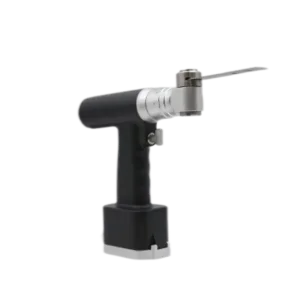






A proven roadmap turning distributor concept requirements into compliant, hospital-ready medical device solutions.
Collaborative engineering defining stroke amplitude (2.5 mm – 4.2 mm), oscillation speeds, ergonomic grip balances, custom quick-connect blade chucks, and localized aesthetic housing anodization.
Physical functional prototypes produced within 15–20 days using precision CNC milling. Design for Manufacturability (DFM) audits optimize production yields and verify motor commutation stability under load.
Direct supply of full Design History Files (DHF), biocompatibility test results (ISO 10993), electrical safety certifications (IEC 60601), and sterilization validation protocols to streamline local MoH filings.
