Verified surgical bone cutting platforms engineered for low vibrational distortion, dynamic thermal dissipation, and extended multi-sterilization duty cycles.
Analyzing operating theatre workflows, micro-vibrational bone resection dynamics, and kinematic load transfer in heavy osteotomy procedures.
Thermal bone necrosis occurs when operative cut-zones exceed 47 °C for more than one minute. SNK reciprocating and oscillating systems integrate an advanced brushless rotor and low-friction eccentric linkage that stabilize stroke velocity at high load, keeping osteotomy surface temps strictly beneath 41 °C under ASTM F2180 conditions.
Reciprocating saws often induce surgeon fatigue due to secondary harmonic resonance. Our OEM transmission systems utilize dual-opposed counterweights and hardened aerospace-grade bevel gears. This reduces axial handpiece chatter, keeping blade deflection within ±0.02 mm for razor-sharp sternum and femoral cut planes.
Traditional surgical power tools suffer moisture ingress and magnetic degradation during high-temperature steam sterilization. By enclosing our stator windings in precision-potted medical silicone and sealing moving shafts with Viton fluoropolymer dual O-rings, SNK ensures uninterrupted function beyond 200 autoclave cycles at 134 °C.
Addressing market demands, tender pricing structures, and Tier-1 hospital standardization pressures across Europe, the Americas, and emerging Asia-Pacific markets.
Tier-1 academic healthcare centers are rapidly phasing out carbon-brush motor saws due to carbon particle discharge risks and torque loss over time. The SNK brushless drivetrain platform delivers instantaneous peak torque, lower running noise (< 65 dB), and a 300% lifespan increase compared to traditional brush assemblies.
Healthcare providers often face a choice between overpriced domestic brands and unreliable budget imports. SNK bridges this gap by offering high-end brushless tools for main surgical blocks, along with cost-efficient, carbon-motor variations engineered specifically for regional tenders, ambulatory surgical centers (ASCs), and veterinary hospitals.
Global supply chain volatility has made lead times a critical metric. SNK maintains over 200 ready-to-ship standby units, stocks extensive core sub-assemblies, and operates 16 automated precision CNC production lines. This allows us to finalize custom OEM/ODM configurations in 3 weeks, rather than the 8-12 week industry standard.
Comprehensive qualification packages designed to streamline your local market registration dossiers and meet international hospital audit requirements.
Unlike suppliers operating on expired or conditional MDD documentation, SNK products maintain full Class I, IIa, and IIb coverage under the new EU Medical Device Regulation (MDR). Every unit includes verifiable EUDAMED UDI data, accelerating regulatory reviews across European procurement networks.
Our quality management system is audited under the Medical Device Single Audit Program (MDSAP). This provides multi-jurisdiction compliance across the United States (FDA), Canada (Health Canada), Japan (PMDA), Brazil (ANVISA), and Australia (TGA), reducing local regulatory hurdles for regional distributors.
Entering public hospital tenders requires more than basic certificates. We supply localized technical files, testing certifications (DIN 13972, ISO 6475, ASTM F2503), toxicological and biocompatibility data, and official Certificates of Free Sale (CFS) for 21 countries worldwide.
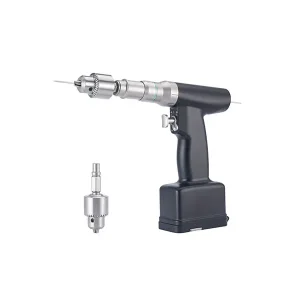
Precision-engineered reciprocating, oscillating, and cannulated drive adapters configured for specialized surgical interventions.
In high-energy fractures and corrective osteotomies of the femur and tibia, SNK's variable-speed reciprocating saws maintain continuous power through dense cortical bone, reducing operative times and minimizing collateral periosteal tearing.
The S2150 sternum saw system uses a high-frequency, short-throw cutting motion combined with a dedicated blade guard footplate. This configuration protects the underlying pericardium and mediastinum during urgent cardiothoracic entries.
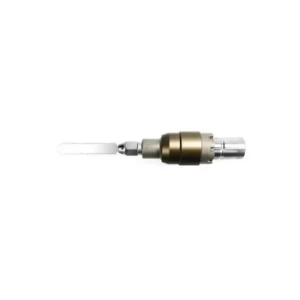
Navigating tight revision sites requires fine-tuned instrument control. Our reciprocating saw adapter provides 360-degree blade indexing, allowing surgeons to precisely dissect cement mantles and reshape bone graft struts at odd angles.
When adapted with low-profile thin-kerf blades, our brushless micro-drive maintains low vibrational transfer. This allows surgeons to perform delicate laminotomies, facet resections, and foot-and-ankle osteotomies close to critical neural anatomy.
Leading the next frontier in surgical power instruments: Digital telemetry, robotic integration, and ultra-high-efficiency coreless motor designs.
Modern operating rooms are moving toward robotic arm integration. SNK is actively developing mechanical interfaces compatible with optical and electromagnetic tracking arrays, matching registration inputs across 12 open surgical navigation protocols.
Future tool lines will feature on-chip thermal telemetry embedded within the reciprocating drive head. Real-time temperature readouts communicate wirelessly with display modules, notifying the surgical team if interface temps approach critical margins.
To reduce overall handpiece weight while extending continuous run-time, we are moving from traditional Li-ion cells to solid-state battery technology. This shift will cut battery pack volume by 25% while maintaining uncompromised high-torque output throughout complex, multi-level procedures.
Engineering-level insights to support procurement audits, clinical trials, and distributor registration pipelines.
Brushless motors use electronic commutation rather than mechanical carbon brushes. This eliminates brush wear and particulate shed, reduces internal thermal buildup, cuts operating acoustic noise below 65 dB, and maintains steady torque across varying bone densities.
We seal sensitive electronic commutators and drive gears using medical-grade fluoropolymer seals, hydrophobic conformal potting, and corrosion-resistant surgical stainless steel (316L). This architecture ensures transmission accuracy remains below 0.03 mm after 200 autoclave runs at 134 °C.
Our unified platform architecture allows us to configure motor speed ranges (500 to 15,000 RPM), custom torque stops, tailored housing finishes, and private labeling with test validation in roughly 3 weeks—significantly faster than standard development cycles.
We supply complete compliance binders for regional submissions, including CE-MDR certificates, ISO 13485:2016 factory documentation, MDSAP summaries, full biocompatibility reports (ISO 10993), electrical safety data (IEC 60601-1), and Certificates of Free Sale.
Modular attachments, cannulated systems, and trauma handpieces designed to expand your surgical instrumentation platform.