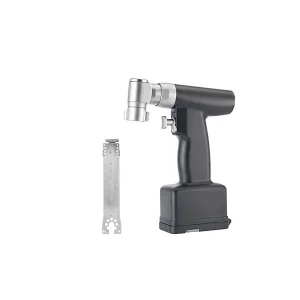
Pre-qualified surgical handpieces, high-frequency reciprocating saws, and quick-dock reaming adapters configured for global institutional supply and private label tender bids.
A multi-dimensional appraisal of surgical cut precision, blade-hub coupling dynamics, thermal bone necrosis prevention, and total life-cycle ownership in operating theaters.
The core clinical value of a reciprocating surgical saw rests in the mechanical interface connecting the motor shaft to the cutting blade. Wright-compatible and universal cross-pin drive mechanisms must eliminate microscopic axial play during 12,500 to 15,000 CPM oscillation cycles.
Global procurement teams evaluate "value" far beyond initial capital expenditure. Legacy OEM tier-1 systems often trap healthcare networks into hyper-expensive single-use blade contracts and multi-thousand dollar factory battery refurbishments.
Cortical bone necrosis occurs when tissue temperatures exceed 47 °C during surgical cutting. SNK's brushless engineering profile optimizes cutting stroke amplitude (standard 3.2 mm) to eject bone chips rapidly, limiting local friction heat elevation.
How closed-loop supply chains, five-axis CNC machining centers, and automated Cleanroom assembly deliver institutional medical device consistency at scalable volume.
Unlike repackaging trading operations, our Baoshan, Shanghai facility operates proprietary Brother & DMG MORI multi-axis machining cells. Gear trains, drive eccentrics, rotor shafts, and titanium handpiece shells are milled in-house under micron tolerances.
Every motor canister and reciprocating linkage is assembled in an ISO 14644-1 Class 7 cleanroom environment. Dynamic fluoropolymer hermetic seals protect sensitive brushless stators and neodymium rotor magnets from moisture ingress during steam autoclave cycles.
With localized tier-1 metal processing, polymer molding, and battery pack encapsulation partners within a 50-kilometer radius, SNK reduces typical OEM/ODM product turnaround cycles from standard 8-week timelines down to 21 working days.
Ensuring frictionless market access across European MDR 2017/745, North American 510(k) programs, MDSAP frameworks, and national ministry of health tenders.
While many legacy suppliers face obsolescence due to the sunset of the MDD directive, SNK maintains active Class I, Class IIa, and Class IIb CE-MDR conformity assessment certifications backed by comprehensive clinical evaluation reports (CER).
Audited under the Medical Device Single Audit Program (MDSAP), our factory satisfies joint regulatory criteria for Health Canada, US FDA, TGA Australia, and ANVISA Brazil in a single harmonized quality management system.
Institutional hospital chains demand uptime guarantees. SNK backs every international distribution tier with regional backup inventory, rapid spare replacement, and localized technician training.
From revision hip arthroplasty to emergency thoracic access, discover how optimized reciprocating kinematics outperform standard sagittal saws in deep, narrow surgical corridors.
Femoral stem extraction and cement mantle removal require slender, deep-cutting blades operating along an axial path. The reciprocating saw navigates the femoral canal without compromising the cortical wall.
Rigid bone resection in complex fractures requires accurate transversal or oblique bone squaring. High linear cutting strokes prevent blade deflection in dense cortical diaphyses.
Equipped with a specialized sternum blade guard, SNK reciprocating systems provide rapid midline sternal opening while protecting pericardial and vascular structures underneath.
In narrow endoscopic or tubular retractor portals, reciprocating action eliminates lateral sweeping clearance requirements, allowing targeted bone decompression adjacent to nerve roots.
How digital connectivity, motor miniaturization, robotic end-effector coupling, and intelligent autoclaving lifecycle chips are reshaping device procurement.
Traditional mechanical brush commutators generate conductive carbon dust and thermal sparks. Field-Oriented Control (FOC) vector-driven brushless motors dynamically monitor rotor position via Hall sensors, delivering seamless low-speed high torque for reaming alongside ultra-stable high-frequency reciprocating rates up to 15,000 CPM.
SNK handpieces support standardized optical tracking frame mounts and CAN-bus telemetry communication. Handpieces dynamically regulate reciprocating speeds based on spatial boundaries dictated by robotic stereotactic boundary envelopes, preventing accidental dural punctures.
Hospital Central Sterile Supply Departments (CSSD) increasingly mandate cycle tracking. Embedded high-temperature RFID chips record every 134 °C autoclave thermal exposure cycle, notifying biomedical engineering teams automatically when seal maintenance is clinically due.
| Evaluation Parameter | SNK Brushless Reciprocating System | Legacy Tier-1 Brand (Wright/Stryker Type) | Standard Market Generic Exporter |
|---|---|---|---|
| Motor Technology | Brushless Electronic Commutation (FOC) | Proprietary Brushless (Closed System) | Standard Carbon Brush (Wear Prone) |
| Oscillation / Stroke Rate | 0 – 15,000 CPM (Stepless Trigger) | 0 – 14,500 CPM | Fixed / Low Dynamism (0–11,000 CPM) |
| Sterilization Durability | ≥200 Steam Autoclave Cycles (<0.03mm run-out) | 150–200 Autoclave Cycles | 50–80 Cycles Before Seal Breakdown |
| Regulatory Approval Matrix | CE-MDR 2017/745, ISO 13485:2016, MDSAP | FDA 510(k), CE-MDR, PMDA | MDD Directive / Non-compliant for EU 2024+ |
| OEM Tooling & Adaptation Lead Time | ~21 Working Days (Full Customization) | Closed Architecture / No OEM | 12–16 Weeks with High Minimum Orders |
| Blade Locking System | Universal Cross-Pin & Quick-Dock Collet | Proprietary Hub (Restricted Sourcing) | Manual Screw / High Deflection |
In-depth responses curated from hospital biomedical departments, global tender committees, and private label distributors.
Complete your surgical suite with high-frequency bone cutters, micro-collet attachments, torque limiting adapters, and lightweight trauma drilling solutions.