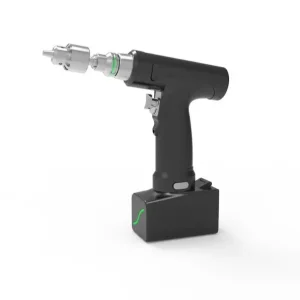
Essential precision surgical handpieces engineered for rapid bone fixation, emergency blast trauma debridement, and high-frequency orthopedic interventions.




The healthcare and medical devices sector in Iraq represents one of the most resilient, rapid-growth arenas across the Middle East. With decades of post-conflict reconstruction now transitioning into structured institutional modernization, the demand for precision orthopedic surgical instruments has outpaced traditional localized supply networks. The State Company for Marketing Drugs and Medical Appliances (Kimadia), operating under the Ministry of Health (MOH) of Iraq, is executing high-priority national procurement frameworks aimed at re-equipping tertiary surgical hubs across Baghdad, Mosul, Basra, Najaf, and Erbil.
Simultaneously, the private healthcare tier in autonomous areas like the Kurdistan Region of Iraq (KRI) and burgeoning private hospital complexes in Baghdad has catalyzed an immediate requirement for Tier-1 equivalent surgical power tools. Iraqi orthopedic surgeons are confronting severe ballistic traumas, complex multi-fragmentary fractures from high-speed roadway transit accidents on Federal Highway 1, and an aging demographic presenting degenerative musculoskeletal disorders. In this demanding clinical environment, power tools must balance unyielding mechanical endurance against complex procurement budgets.
Public sector medical procurement in Iraq demands comprehensive compliance dossiers: CE-MDR (EU) 2017/745 certification, ISO 13485:2016 verification, full biocompatibility declarations, and authenticated Certificates of Free Sale (CFS). Direct manufacturer engagement streamlines tender pre-qualification.
Surgical suites in Baghdad Medical City and Erbil Surgical Hospital process high concentrations of complex long-bone comminutions. Handpieces require high-torque cannulated channels (over 16 N·m for femoral nailing) that do not stall under sudden cortical bone density transitions.
Regional variations in power grid consistency across central and southern Iraq necessitate autonomous surgical equipment. Our brushless units incorporate dual-bay intelligent quick-charge lithium-ion systems delivering 70+ minutes of continuous heavy osteotomy on a single charge.
Analyzing global supply chain evolution, mechanical design convergence, and how next-generation motor control architectures elevate surgical precision.
The global powered surgical instruments market—projected to surpass USD 3.2 billion by 2030—is witnessing a structural paradigm shift from legacy pneumatic systems and brushed motors to fully hermetic, brushless DC (BLDC) architectures. While legacy carbon-brush systems remain viable for cost-restricted community clinics, high-throughput teaching hospitals globally are phasing them out due to mechanical brush wear, internal particulate generation, and heightened thermal conduction to surgical hands during protracted procedures.
Our research and engineering centers have established four core technical vectors driving modern orthopedic manufacturing:
In conventional motors, mechanical friction between carbon brushes and copper commutators creates uncontrolled heat and mechanical torque drop-off under load. Our BLDC motors integrate Hall-effect sensors and algorithmic FOC micro-controllers. As the drill bit or sagittal saw encounters denser cortical bone, the system dynamically boosts magnetic stator flux within 12 milliseconds, maintaining steady RPM, minimizing thermal osteonecrosis (maintaining contact temperatures strictly below 41°C per ASTM F2180), and eliminating rotational chatter that impedes clean bone margin cuts.
Reprocessing environments in desert climates and high-load hospital facilities present unique degradation challenges. Repeated exposure to pressurized steam at 134°C (273°F) breaks down standard elastomeric gaskets, allowing moisture into internal micro-bearings and stator windings. By utilizing aerospace-grade fluororubber seals, laser-welded surgical stainless-steel casings (AISI 316L), and potted electronic circuit assemblies, our handpieces withstand more than 200 consecutive autoclave cycles without loss of insulation resistance or increase in transmission eccentricity (bearing run-out held within <0.03 mm).
| System Attribute | Brushless Flagship Platform (SNK S-Series) | Standard Carbon-Brush Series (ND-Series) | Market Conventional Benchmark |
|---|---|---|---|
| Motor Technology | Sensorless / Hall BLDC with Electronic Commutation | Heavy-Duty Replaceable Carbon Brush Rotor | Standard Carbon Brushed DC Core |
| Dynamic Torque Range | Up to 20 N·m (Stable torque across variable loads) | Up to 14 N·m (Standard operating output) | 8 - 11 N·m (Susceptible to stalling under heavy load) |
| Autoclave Longevity | 200+ Cycles (134°C @ 2.2 bar steam sterilization) | 80 - 100 Cycles (Periodic carbon inspection needed) | 50 - 60 Cycles before seal deterioration |
| Heat Management | < 2.0°C handpiece thermal rise (ASTM F2180) | < 5.5°C handpiece thermal rise | 7.0°C - 10.0°C handpiece thermal rise |
| Clinical Applicability | Total Hip/Knee Arthroplasty, Complex Trauma, Neuro | General Trauma, Small Bone, Extremities, Tenders | Basic Trauma, Ambulatory Clinics |
| Regulatory Compliance | CE-MDR 2017/745 / ISO 13485 | CE-MDR 2017/745 / ISO 13485 | Legacy CE-MDD / ISO 9001 only |
Specific hardware modifications developed to withstand extreme ambient temperatures, airborne dust, and fluctuating electrical supplies.
Summer operating temperatures in non-centralized clinics across Southern Iraq (Basra, Nasiriyah) place immense stress on power tool electronics. Integrated aluminum alloy internal heat sinks and micro-cooling vents prevent thermal battery shutdowns during multi-hour revision arthroplasties.
Seasonal dust storms (Shamal winds) in central Mesopotamia generate ultra-fine airborne silica that penetrates conventional tool chucks and triggers mechanical locking. Our chuck assemblies utilize patented labyrinth seals, safeguarding internal gears against environmental contamination.
Hospital power generators frequently produce unstable voltages ranging between 170V and 260V. Our intelligent sterilization-safe battery chargers feature integrated surge-suppression and wide-band transformer units to ensure uniform battery cell charging without fire hazard.
Procuring surgical power systems for Iraqi clinical institutions requires far more than box shipping. As an established direct manufacturing partner, we provide complete lifecycle empowerment programs tailored for regional distributors in Iraq:
Detailed technical, regulatory, and logistics answers compiled for healthcare procurement directors, hospital bio-engineers, and authorized Iraqi distributors.
Comprehensive powered surgical systems designed for joint arthroplasty, micro-neuro, thoracic reconstruction, and high-precision bone resection in Iraqi medical institutions.