Direct factory configurations manufactured for high-frequency osteotomy, cannulated trauma stabilization, and neurosurgical cranial procedures with high autoclave resistance.






An authoritative technical analysis of mechanical stroke tolerances, harmonic dampening, and high-temperature autoclave longevity for B2B buyers and surgical device distributors.
In modern surgical theaters and heavy-duty orthopedic intervention, the terminology surrounding "Mastercraft Reciprocating Saw" reflects the pinnacle of manufacturing excellence—tools built not merely for bulk resection, but for micro-meter geometric accuracy, complete thermal mitigation, and rigorous biological safety. Where standard commercial reciprocating tools focus primarily on motor wattage and cutting speed, medical-grade and master-crafted reciprocating saws are engineered around bone preservation mechanics, zero axial flutter, and frictionless ergonomic energy transfer.
A surgical reciprocating saw functions under demanding operational envelopes. The blade must translate rotary motion from a brushless DC (BLDC) motor into strict linear reciprocating travel via eccentric wobbler drives or counterbalanced dual-cam gearboxes. Any microscopic slack in the drive carriage manifests as destructive lateral chatter, elevating osteocyte necrosis risks through localized frictional heating beyond the critical threshold of 47°C. As qualified manufacturers and suppliers, China's modern engineering hubs deploy five-axis CNC machining centers (such as DMG Mori and Mazak platforms) capable of producing hardened transmission cams with surface roughness values down to Ra 0.2 μm, guaranteeing that mechanical runout remains consistently under 0.03 mm throughout hundreds of surgical sterilization intervals.
Internal counter-opposed oscillating flyweights neutralize the recoil force vector inherent in reciprocating cutting strokes, directly alleviating surgeon fatigue during multi-hour complex total joint revisions.
Integrated heat sinks milled from aircraft-grade aluminum alloy 7075-T6 interface directly with sealed motor cavities, shunting thermal load away from delicate soft tissue and nerve structures.
Proprietary dynamic fluorosilicone O-rings and laser-welded stainless sleeves preserve motor core vacuum integrity against repeated saturated 134°C steam and vacuum pressure cycles.
How Shanghai and the Yangtze River Delta medical device corridor consolidate raw metallurgy, precision CNC milling, brushless stator winding, and cleanroom assembly.
The manufacturing dominance of Chinese medical power tool suppliers stems from deep vertical integration. Rather than sourcing motor windings, gear reducers, injection-molded carbon-fiber shells, and micro-controller circuit boards from fragmented international vendors, certified manufacturers like Snaikang Technology Development Co., Ltd. leverage an end-to-end industrial ecosystem in Shanghai. This structural clustering slashes development cycles from conventional 18-month lead times down to under 12 weeks for bespoke ODM reciprocating saw handpieces.
Within clean workshops operating strictly under ISO 14644-1 Class 7 environmental controls, high-speed automated winding lines construct brushless stators using Japanese ultra-pure copper magnet wire and high-temperature neodymium (NdFeB) grade N52H magnets. The resulting power density yields up to 35% higher continuous stall torque without an increase in handpiece outer diameter, giving orthopedists unprecedented control during dense cortical bone osteotomies.
High-precision German and Japanese milling centers ensure concentricity down to ±3 microns across transmission pinions and push-rod guides.
With 16 automated production lines and 800+ trained personnel, annual output surpasses 38,000 surgical power sets with sub-0.03 ppm defect rates.
Independent intellectual property safeguards OEM distributors from Western IP conflicts, covering modular quick-release chucks and BLDC controllers.
From CAD modeling and rapid stereolithography prototyping to physical sterilization pilot runs, our engineering turns OEM revisions around in 21 days.
Eliminating tender bottlenecks with audited Technical Documentation Dossiers, EUDAMED registration, MDSAP auditing, and multi-country Free Sale Certificates.
| Regulatory Body / Standard | Compliance Status | Audit Mechanism & Traceability | Tender Applicability |
|---|---|---|---|
| EU CE-MDR 2017/745 | Class IIa / IIb Certified | Notified Body Technical Dossier Review; EUDAMED UDI Integration | Mandatory for all 27 EU member state public & private hospital tenders |
| ISO 13485:2016 | Accredited QMS | Annual On-site Cleanroom, Traceability, & Risk Process Surveillance | Baseline global benchmark for medical device distributor contracts |
| MDSAP (5 Jurisdictions) | Fully Audited | Unified single-audit program covering USA, Canada, Japan, Brazil, Australia | Accelerates regional drug/device registration in major G20 healthcare systems |
| DIN 13972 & ISO 6475 | Laboratory Validated | Calibrated dyno-torque and blade deflection under cyclic torsional resistance | Guarantees cutting edge concentricity during deep trauma intervention |
| ASTM F2503 & F2180 | Thermally Validated | Infrared thermographic continuous logging under simulated cortical load | Pre-requisite for hospital bio-safety committee technical approvals |
A frequent challenge faced by medical instrument importers is regulatory friction post-procurement. SNK solves this by establishing dedicated regulatory liaison desks in European and North American time zones. All technical dossiers, declarations of conformity (DoC), biocompatibility test protocols (ISO 10993), and Instructions for Use (IFU) are supplied localized in English, German, French, Spanish, Portuguese, and Arabic.
Additionally, our global buffer inventory strategy protects hospital partners against supply disruptions. With regional dispatch hubs operating in Europe (response window ≤48 hours) and the Asia-Pacific basin (response window ≤24 hours), distributors maintain rapid access to emergency backup toolkits, sterile handpiece shells, and specialized blade adapters without tying up working capital.
A granular look at lifecycle economics, component standardization, warranty coverage, and high-margin private label customization for procurement executives.
A single SNK brushless power handpiece accommodates oscillating, reciprocating, sternum, and cannulated drilling attachments. This drastically reduces the capital investment required for hospital instrument sterilization trays.
We provide complete industrial branding solutions—including fiber laser chassis engraving, bespoke anodized color variations for surgical specialty coding, custom CNC-milled transport cases, and private-label packaging.
Every reciprocating unit is backed by an unconditional 12-to-24 month warranty on the internal BLDC rotor assembly, supported by 200+ readily available standby instruments in Shanghai and European depots.
The evolution of surgical saws from legacy pneumatic cords to sensorless BLDC motor intelligence and robotic arm end-effector connectivity.
The global orthopedic power tool arena is undergoing unprecedented disruption driven by three core technologies: advanced electrical commutation, intelligent lithium power management, and computer-assisted surgical navigation integration. The era of carbon-brush surgical handpieces is fading in tier-one medical facilities due to thermal brush sparking, brush dust particulate discharge, and mechanical wear under repeated thermal cycling.
Modern SNK reciprocating systems integrate microprocessor-controlled sensorless brushless motors. These motors constantly monitor back-electromotive force (Back-EMF), dynamically modulating pulse-width modulation (PWM) power delivery within milliseconds. When the reciprocating saw blade encounters ultra-dense cortical bone in a femoral shaft, the control system instantly injects torque compensation to prevent stalling—maintaining a steady cutting stroke frequency without surgeon over-pressure.
High-drain lithium iron phosphate (LiFePO4) battery packs equipped with digital fuel-gauge microcontrollers track battery degradation and thermal health during autoclave runs.
Handpieces incorporate geometric optical tracking array fixtures compatible with major navigation systems (Brainlab, Stryker, Medtronic protocols).
Precision non-venting chassis designs isolate cooling airflow from surgical fields, ensuring laminar air integrity remains completely undisturbed.
Quick-mounting precision coupling flanges allow SNK reciprocating modules to be securely locked into haptic robotic arms for autonomous knee and hip bone resection.
Examining how reciprocating cutting geometry performs across disparate procedural realities and specialized surgical disciplines.
During challenging total hip arthroplasty (THA) revisions, the reciprocating saw's slim axial blade profile slips safely into the femoral intramedullary canal to disrupt bone-cement interfaces without cracking surrounding cortical envelopes.
With a dedicated sternum guard attachment, SNK reciprocating units act as high-velocity sternum saws. The reciprocating guard smoothly shields pericardial tissue and retrosternal vessels while cleanly dividing bone in under 15 seconds.
From open pelvic fracture debridement to metatarsal corrective osteotomies, the combination of variable trigger sensitivity (0–12,500 SPM) and low overall mass allows delicate handheld manipulation in restricted trauma windows.
In-depth answers addressing sterilization durability, international warranty protocols, MDR conformity, and bespoke OEM manufacturing lead times.
High-speed trauma cutters, hollow-core cannulated reamers, and neurosurgical systems engineered to ISO 13485 standards for worldwide clinical deployment.





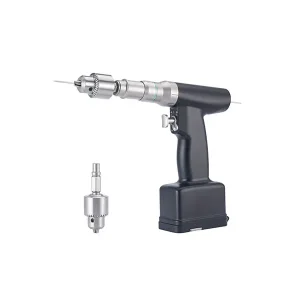
Audit questions and manufacturing benchmarks every biomedical procurement team must verify prior to signing bilateral supply chain agreements.
Demand third-party particle count audits verifying that handpiece closure occurs within certified ISO 14644-1 Class 7 cleanrooms to ensure sterile packaging does not harbor pyrogenic particulates.
Verify dynamometer reports confirming that the reciprocating drive motor suffers under 2% magnetic flux degradation following 100 consecutive autoclave steam cycles at 134°C.
Confirm that the supplier holds active EUDAMED registration codes, ISO 10993 cytotoxicity certifications, and ASTM F2180 temperature profiles immediately ready for submission to local health ministries.
