Explore our industrial-grade, CE-compliant surgical drill assemblies and high-precision motor adapters engineered for arthroplasty, trauma fixation, and veterinary reconstruction.

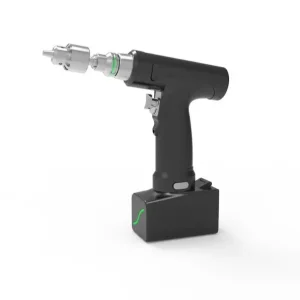





A comprehensive examination of how battery-operated cordless power tools are superseding pneumatic systems across trauma suites, military field hospitals, and private surgical centers.
For decades, orthopedic surgical theaters were dominated by pneumatic power tools driven by compressed air or nitrogen hoses. However, modern surgical standards prioritize ergonomic maneuverability, sterile field integrity, and floor-level hazard elimination. Hoses not only represent an entanglement risk for surgical personnel but also introduce potential vectors for laminar airflow disruption and cross-contamination.
The contemporary transition toward high-voltage, balanced lithium battery-operated drill systems allows total intraoperative autonomy. Surgical teams benefit from unrestricted 360-degree articulation around the patient, critical during complex multi-fragment pelvic reconstructions and bilateral total knee arthroplasties.
Global regulatory frameworks have evolved past the legacy Medical Device Directive (MDD). Today, manufacturers exporting to the European Union must demonstrate uncompromised compliance with CE-MDR (EU) 2017/745 for Class IIa and Class IIb electromechanical devices. Rigorous clinical evaluation reports (CER), biological compatibility testing (ISO 10993), electrical safety validation (IEC 60601-1), and EUDAMED serialization traceability are obligatory.
OEM brand custodians can no longer rely on unverified supply chains. Partnering with certified facilities operating certified ISO 13485:2016 and MDSAP manufacturing protocols is an essential risk mitigation strategy against catastrophic market access revocations.
Across North America and Western Europe, joint reconstructions and minor trauma procedures are increasingly transitioning from tertiary academic hospitals to standalone Ambulatory Surgical Centers (ASCs). ASC facilities operate under bundled-payment reimbursement schemes requiring rigorous Total Cost of Ownership (TCO) assessments.
Surgical power systems must achieve sustained sterilization durability—withstanding over 200 high-temperature steam autoclave cycles without seal degradation—while maintaining component modularity. Modular drill platforms featuring hot-swappable reaming, sawing, and K-wire driving adapters drastically decrease initial capital outlay and annual per-procedure instrument sterilization costs.
A technical analysis of motor commutation, thermal mitigation, hermetic sealing, and lithium battery chemistry within demanding intraoperative environments.
Traditional surgical drills utilized carbon brushes to mechanically commutate current into the rotating armature. In an orthopedic theater, this presents two severe points of failure: friction-induced thermal buildup and internal particulate contamination from carbon degradation. Carbon residue not only compromises internal bearings but also poses risks during repeated autoclave thermal cycling.
Modern SNK high-power drills integrate Brushless DC (BLDC) motors driven by digital Hall-effect sensing or sensorless Field-Oriented Control (FOC). Electronic commutation eliminates frictional friction, reducing handpiece operating temperature by up to 35% and extending operational life past 5,000 surgical hours. The resulting motor response yields an immediate torque ramp-up, delivering sustained torque from 0.5 N·m to 20 N·m without bogging down during dense cortical bone drilling.
Osteocyte thermal necrosis occurs when living bone tissue is exposed to temperatures exceeding 47°C for longer than one minute, resulting in permanent micro-structural vascular collapse, impaired osseointegration of prosthetic stems, and elevated risk of postoperative implant loosening. Our engineering focuses heavily on kinematic thermal suppression, strictly complying with ASTM F2180.
By pairing precision helical gearboxes machined from hardened 17-4PH medical stainless steel with synthetic PFPE medical lubricants, transmission heat is confined. Handpiece casing temperature rise is systematically restricted to less than 2.0°C during sustained heavy-load reaming cycles. Concurrently, operational acoustic emissions are capped below 65 dB(A), reducing cognitive fatigue for the surgical team during lengthy spinal or joint reconstructive surgeries.
The harshest environment for an orthopedic handpiece is not the human body, but the central sterile services department (CSSD). Sterilization routines subject tools to pressurized saturated steam at 134°C under 2.2 bar pressure (ISO 17665-1 validation). Steam penetrating motor windings, planetary gear trains, or sensor PCBs causes rapid short-circuits and catastrophic corrosion.
SNK implements a triple-barrier encapsulation system utilizing medical-grade fluorosilicone O-rings, dynamic magnetic liquid seals, and conformal parylene PCB coatings. This architecture preserves an IPX8 immersion and high-pressure hermetic barrier, allowing tools to endure over 200 complete high-temperature steam autoclave and ethylene oxide (EO) sterilization cycles with total transmission integrity.
Battery architecture represents one of the most critical logistical decisions in orthopedic device design. The industry balances two distinct paradigms: Aseptic Battery Transfer Systems and Hermetically Sealed Autoclavable Battery Packs.
Aseptic transfer workflows utilize non-sterilized, high-capacity Lithium-ion (NMC) cells positioned into the handpiece handle via a specialized sterile funnel handled by circulating nurses. This keeps the battery cells away from extreme 134°C heat cycles, preserving long-term cycle life (500+ charges) and maximizing energy density. Conversely, autoclavable battery packs utilize specialized Lithium Iron Phosphate (LiFePO4) or high-temperature cell chemistries housed in welded PEEK/titanium enclosures. While requiring heavier casing materials, they allow simplified one-piece sterile processing in emergency triage and military field hospitals.
| Kinematic Parameter | SNK Brushless OEM Series | Standard Market Brushless | Legacy Carbon Motor Systems |
|---|---|---|---|
| Motor Technology | Digitally Commutated BLDC (FOC) | Analog Brushless DC | Brushed DC Carbon Commutator |
| Cannulated Drill Torque | Up to 20 N·m (Stable Low-Speed) | 12 - 14 N·m | 6 - 9 N·m (High Speed Drop-off) |
| Cannulated Lumen Diameter | Ø 4.5 mm (Passes K-Wires/Pins) | Ø 4.0 mm - 4.2 mm | Ø 3.2 mm - 3.8 mm |
| Autoclave Cycle Tolerance | > 200 Cycles (134°C Steam) | 80 - 100 Cycles | 30 - 50 Cycles (Seal Deterioration) |
| Handpiece Temp Rise | < 2.0 °C (ASTM F2180 Compliant) | 4.5 °C - 6.0 °C | 8.0 °C - 12.0 °C (Necrosis Risk) |
| Noise Emission @ 15,000 RPM | ≤ 62 dB(A) | 70 - 75 dB(A) | > 78 dB(A) |
From high-volume joint replacement suites to austere combat medical environments, our orthopedic power platforms are calibrated to distinct procedural requirements.
Trauma theaters require extreme reliability, wide torque ranges, and hollow-core cannulation. During femur or tibia intramedullary (IM) nail insertions, the cannulated drill must advance guide wires (K-wires) up to 4.0 mm smoothly without binding or wobbling.
SNK cannulated drills feature precision concentric chuck alignment with run-out tolerances below 0.02 mm, preventing micro-bending of Kirschner pins. The handpieces offer bi-directional forward and reverse switches allowing single-handed transitions during screw threading and depth gauge validation.
Total Hip and Knee Arthroplasty (THA/TKA) present high mechanical resistance during bone shaping. Preparing the acetabular cup demands low rotational speed (250–350 RPM) paired with massive, uninterrupted low-end torque (exceeding 16–20 N·m) to carve sclerotic subchondral bone without stalling.
Our acetabular reaming adapters incorporate multi-stage planetary reduction gearing that multiplies torque while maintaining smooth, non-oscillating motion, guaranteeing pristine hemispherical reaming geometries that promote implant press-fit stability.
Spinal decompressions, laminectomies, and transforaminal lumbar interbody fusions (MIS-TLIF) require slender handpieces with absolute rotational balance. Uncontrolled vibration within the spinal canal risks dural tears or nerve root trauma.
SNK thin-profile oscillating and reciprocating saws feature micro-balanced drive assemblies that minimize handpiece tremor to near-zero levels. Ultra-thin 0.6 mm saw blades preserve critical bone stock, while integrated irrigation nozzle adapters flush debris and prevent localized heat spikes near sensitive neural structures.
Veterinary orthopedic surgery has advanced rapidly, particularly regarding Tibial Plateau Leveling Osteotomy (TPLO) for canine cranial cruciate ligament disease. Veterinary clinics require compact, highly versatile instruments capable of driving radial semi-lunar saw blades with extreme torsional rigidity.
SNK veterinary-calibrated adapters seamlessly dock onto our standard surgical brushless handpiece bodies. This delivers commercial-grade human surgical power, thermal safety, and full steam autoclave compliance at a price point appropriate for private veterinary referral practices.
The surgical power tool is transforming from a purely mechanical resection device into a sensor-enabled, digitally integrated surgical instrument.
Computer-assisted orthopedic surgery (CAS) and robotic arm assistants (such as Mako, ROSA, and VELYS) are fundamentally shifting surgical accuracy standards. Future surgical drill platforms must seamlessly integrate with navigation systems.
SNK's technology roadmap includes open-protocol tracking arrays and low-latency digital communication buses embedded directly into the handpiece casing. This allows robotic workstations to read real-time rotational speed, drill bit penetration depth, and applied torque, dynamically throttling tool power when approaching soft-tissue boundaries.
Accidental plunge through the far cortex of a bone during bicortical drilling risks severe vascular and neurological injury. Our advanced R&D initiatives focus on real-time acoustic and current-load impedance feedback.
By sampling motor winding back-EMF at 10 kHz, our proprietary algorithm detects the instant a drill bit crosses from dense cortical bone into cancellous bone or pierces the far periosteum. The electronic controller initiates autonomous regenerative dynamic braking, arresting drill bit rotation in under 8 milliseconds to prevent soft tissue entanglement.
As global environmental healthcare directives intensify (including European Green Deal mandates for hospital procurement), medical power systems must eliminate single-use components and reduce e-waste.
SNK is advancing modular battery architectures that feature recyclable lithium chemistries, field-replaceable cell blocks, and contactless magnetic induction recharging. Future systems will charge handpieces continuously inside sterile docking stations during intraoperative staging, eliminating external battery transfers entirely.
Accelerating time-to-market for medical device brands through specialized design, automated production, and turnkey regulatory documentation.
While traditional medical instrument manufacturers require 6 to 12 months to customize drill kinematics and casing aesthetics, SNK operates 16 fully automated precision machining lines and modular tooling stations. We prototype, validate, and execute private-label production in as little as 3 weeks.
The greatest barrier for medical brand growth is navigating international regulatory certification. SNK provides international distribution partners with comprehensive regulatory technical files.
Supply chain disruptions in hospital operating theaters directly impact patient safety. SNK maintains an uncompromised global inventory strategy with over 200 ready-to-dispatch standby toolsets held in automated warehousing.
Review our advanced medical drill series certified for neurosurgery, traumatology, and multi-specialty hospital supply chains.




In-depth responses covering regulatory compliance, reprocessing validations, duty cycle ratings, and contract manufacturing options.
SNK medical power systems are engineered under a comprehensive Quality Management System (QMS) certified to ISO 13485:2016 and the Medical Device Single Audit Program (MDSAP). Our active portfolio is certified under the EU Medical Device Regulation (EU) 2017/745 (CE-MDR) for Class I, IIa, and IIb devices. We maintain full Technical Documentation according to Annex II and III of the MDR, with full Device Master Records (DMR) and unique UDI serialization registered directly into EUDAMED for uninterrupted European market traceability.
Brushless motors use electronic micro-inverters rather than mechanical carbon brushes to commutate power into the rotor. This eliminates friction and mechanical wear, preventing internal graphite contamination and reducing handpiece heating. Brushless systems deliver consistent torque curves across their full RPM range, reduce acoustic noise below 62 dB(A), and comfortably survive over 200 pressurized autoclave cycles. Carbon-motor handpieces offer a lower initial procurement price point, serving as practical choices for cost-sensitive regional tenders, primary care clinics, or veterinary practices.
All SNK premium handpieces, saw adapters, and blade couplings undergo validation per ISO 17665-1 for moist heat steam sterilization (pre-vacuum autoclave at 134°C, 2.2 bar pressure for 18 minutes). High-grade fluorosilicone seals, specialized magnetic liquid barriers, and Parylene-C conformal PCB encasings prevent steam entry into the motor assembly. Laboratory testing verifies that after 200 high-temperature, high-pressure autoclave cycles, radial transmission run-out error remains strictly below 0.03 mm, with zero breakdown of dielectric electrical insulation.
SNK supports custom OEM and ODM development programs. Standard OEM customizations—including handpiece housing color anodization, laser-engraved brand logos, bespoke coupling interfaces (e.g., AO Large, Jacobs, Hudson, or Synthes type), and custom IFU packaging—are completed within 3 weeks. Full ODM contracts requiring ground-up biomechanical kinematics, custom torque-speed profiles (500 to 15,000 RPM), or specialized surgical robot mounting brackets are managed by our in-house engineering team with functional prototypes delivered within 45 business days.
We operate 16 automated production lines yielding an annual capacity of 38,000 orthopedic power tool sets. To eliminate theatre downtime, SNK maintains over 200 fully assembled, standby orthopedic power tool kits in continuous inventory. For established distribution partners in Europe, regional logistics hubs fulfill emergency orders in under 48 hours; Asia-Pacific shipments dispatch within 24 hours.
